US Space Force accelerates Andromeda programme as Russia enters geosynchronous surveillance race
With Moscow deploying suspected reconnaissance assets in geosynchronous orbit, American commanders cite fuel limitations on current GSSAP satellites and fast-track a cheaper, refuelable replacement architecture.
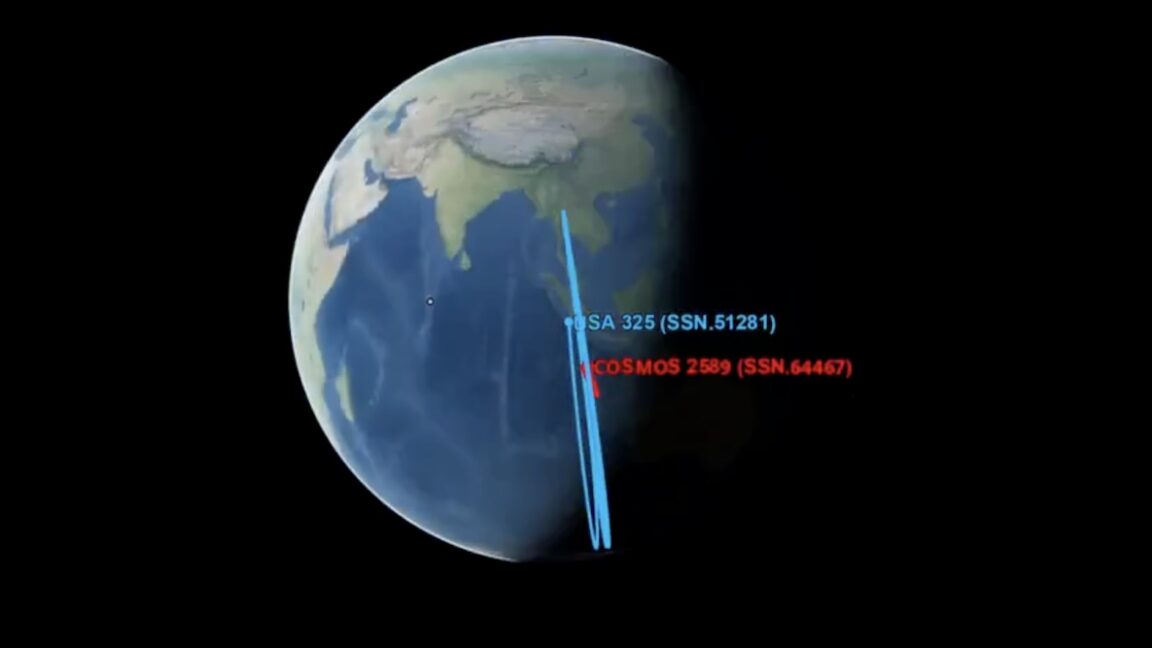
The United States, China, and Russia are now actively engaged in a high-stakes surveillance contest within geosynchronous orbit (GEO), a critical orbital belt approximately 36,000 kilometres above the equator where commercial and military satellites remain stationary relative to the Earth. The dynamic has intensified following the arrival of Russia’s suspected inspector satellite, Kosmos 2589, which entered the orbit in April 2026, prompting the US Space Force to accelerate plans for a proliferated fleet of new reconnaissance assets.
Kosmos 2589 was launched in June 2025 into a highly elliptical orbit alongside a smaller spacecraft, Kosmos 2590. After conducting high-altitude rendezvous operations, the Russian satellite transitioned to a circular geosynchronous orbit, arriving at its operational slot in April. US Space Force GSSAP satellites, specifically USA-325, have been monitoring the asset’s approach, executing close-proximity manoeuvres that brought the American inspector spacecraft within 8 miles (13 kilometres) of its Russian counterpart on 1 May 2026.
This cat-and-mouse activity mirrors Cold War submarine tactics, though the reflective nature of satellites makes stealth difficult. Retired Lt Gen John Shaw, former deputy commander of US Space Command, noted that adversaries often attempt to observe new arrivals during their initial orbital checkout period. However, he warned that rivals are evolving to minimise this vulnerability, necessitating a shift in US operational doctrine to allow for immediate and aggressive manoeuvring.
Fuel constraints on the current GSSAP fleet, manufactured by Northrop Grumman, are limiting the Space Force’s ability to respond rapidly to new threats. Gen Stephen Whiting, commander of US Space Command, emphasised the need for satellites that can be flown with greater tactical freedom. He highlighted the requirement for technologies that enable rapid, disruptive acts to maintain space superiority, moving away from the conservative operational profiles imposed by limited propellant reserves.
In response, the Space Force is prioritising the RG-XX programme, also known as Andromeda, which aims to deploy a proliferated architecture of cheaper, refuelable satellites. The programme seeks to replace or augment the existing GSSAP assets, which number fewer than eight, with a larger fleet capable of providing predictive battlespace awareness. Space Systems Command stated the new assets will support both offensive and defensive space operations while securing superiority through 2030 and beyond.
A wide range of defence contractors has been selected as potential suppliers for the Andromeda programme, including Anduril Industries, Lockheed Martin, and Northrop Grumman, alongside firms such as BAE Systems, General Atomics, and Intuitive Machines. The US military’s current focus on optical reconnaissance in GEO follows a decade of similar activities by US and Chinese forces, with China having launched comparable inspector satellites since 2018.
