US-China Summit Concludes With Modest Trade Truce Extension Amidst Deep Structural Barriers
Washington and Beijing are expected to extend a one-year pause on tariff escalation, but experts warn that deep-seated rivalry and China’s push for technological self-sufficiency constrain meaningful concessions.
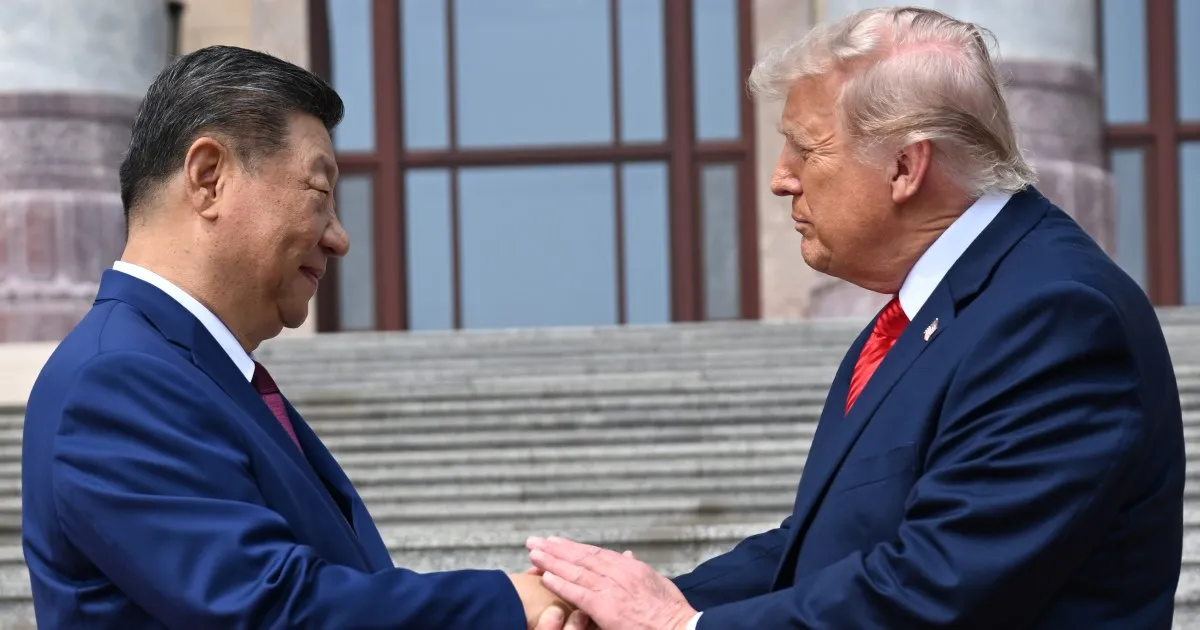
US President Donald Trump and Chinese President Xi Jinping are concluding a two-day summit in Washington with expectations limited to stabilisation rather than revitalisation of bilateral ties. Despite Trump’s pre-summit pledge to urge Beijing to “open up” its economy, observers anticipate only a modest extension of the one-year trade war truce originally agreed upon in South Korea in October. The outcome is viewed as a pause in escalation rather than a significant thaw in relations between the world’s two largest economies.
The US delegation, which included high-profile business leaders such as Elon Musk of Tesla, Tim Cook of Apple, and Jensen Huang of Nvidia, sought to secure increased Chinese investment and market access. In an interview with Fox News, Trump stated that China would invest “hundreds of billions of dollars” in companies led by these executives, though specific details were not provided. The US side has also flagged the establishment of a “Board of Investment” to manage bilateral investments and expects increased Chinese purchases of US agricultural goods, energy, and Boeing aircraft.
However, the economic landscape remains heavily constrained by high existing tariffs. According to the Peterson Institute for International Economics, the average US tariff on Chinese goods stands at 47.5 per cent, up from 3.1 per cent before Trump’s first term, while Chinese tariffs on US goods are at 31.9 per cent, compared to 8.4 per cent in 2018. Consequently, two-way goods trade has declined to approximately $415bn in 2025, down sharply from a peak of $690bn in 2022.
Experts suggest that China is unlikely to make substantial structural changes due to its strategic goal of eliminating dependence on US technology. Claire E. Reade, a senior counsel at Arnold & Porter and former official at the Office of the United States Trade Representative, noted that Beijing does not trust the US and views the relationship through the lens of long-term global competition. Reade indicated that China may offer symbolic gestures, such as temporary removal of trade barriers on beef or short-term purchases of US tech products, without compromising its long-term industrial policies.
Taiyi Sun, an associate professor at Christopher Newport University, noted that a realistic opening would likely focus on sectors with obvious economic complementarity, such as agricultural goods and high-value manufacturing. Meanwhile, Gabriel Wildau of Teneo highlighted that the US may offer tariff relief in exchange for Beijing’s commitment to keep rare earth exports flowing, citing increased US vulnerability to export controls following the Iran war.
Carsten Holz of the Hong Kong University of Science and Technology argued that China has less incentive to make concessions due to the rise of its domestic industries, which now hold leading positions in many sectors. Deborah Elms of the Hinrich Foundation added that US leverage is limited, as Trump’s approach assumes bilateral fairness that Beijing does not acknowledge.
Amidst the diplomatic efforts, US Trade Representative Jamieson Greer indicated that Beijing wants to see the Strait of Hormuz reopen without restrictions or tolls. Allies of Trump are placing hopes on Xi to help defuse the escalating crisis, as an oil supply shock has triggered a worsening energy crisis that analysts suggest could threaten the Republican Party’s prospects in upcoming midterm elections.