Telescopes Reveal Energy Loss in Nearby Star-Forming Nebula
New research led by The Ohio State University suggests gas leakage, mixing, and conduction account for less X-ray-emitting gas than previously expected.
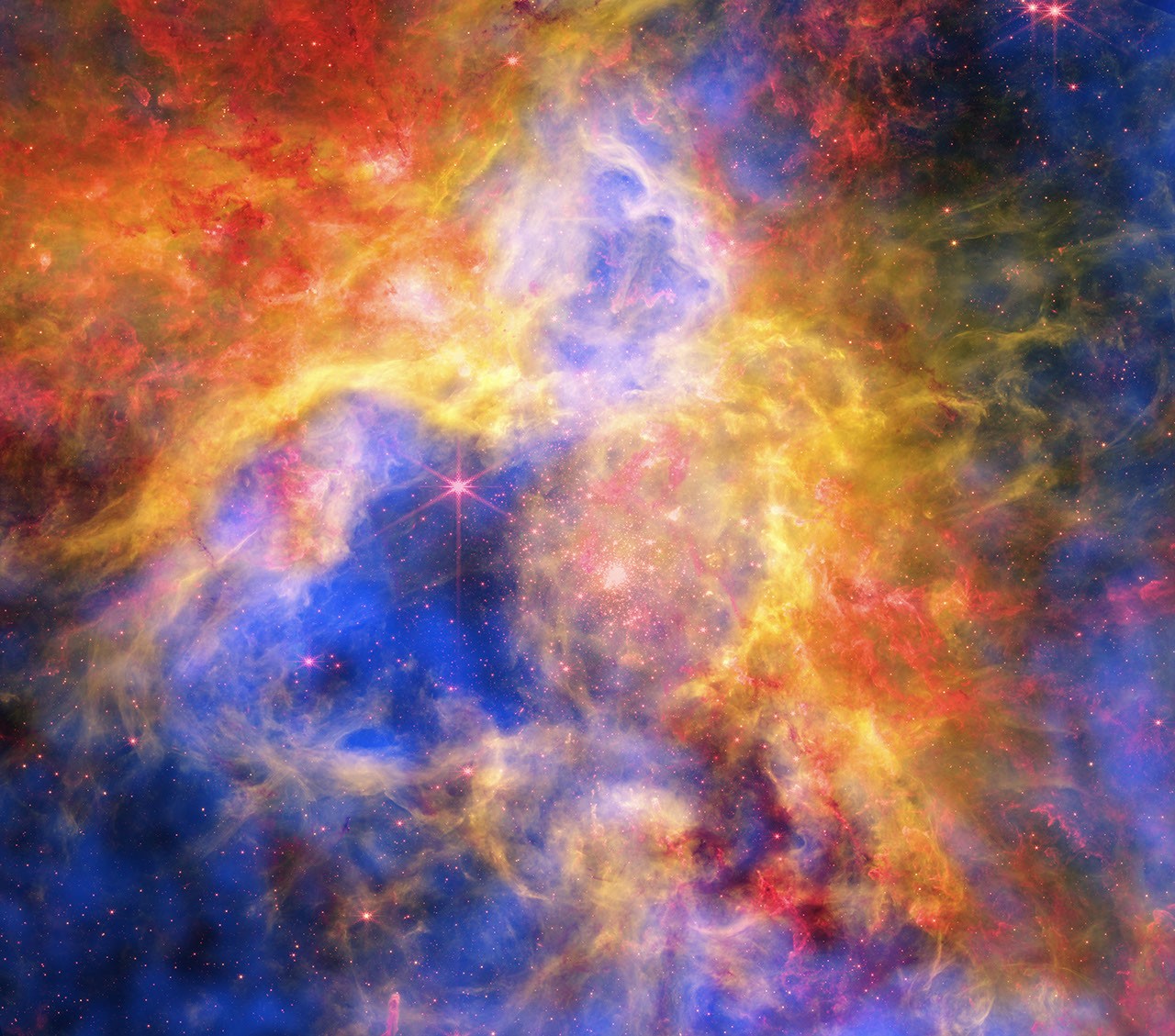
NASA has released a vibrant composite image of the Tarantula Nebula, also known as 30 Doradus, combining observations from the Chandra, Hubble, and James Webb Space Telescopes. The study, published in the Astrophysical Journal and led by Jennifer Rodriguez of The Ohio State University, utilises the multi-wavelength data to investigate why the nearby star-forming region contains less X-ray-emitting gas than models predicted.
Located in the Large Magellanic Cloud, a satellite galaxy approximately 160,000 light-years from Earth, the Tarantula Nebula is a dense region containing thousands of young stars embedded in a honeycomb-like structure of gas and dust. The new image layers X-ray data from Chandra, which appears in blue, infrared data from James Webb in red, and optical data from Hubble in green. This combination provides a holistic view of the nebula’s complex structure, highlighting gas heated to millions of degrees by shock waves from massive stars.
Previous astronomical studies focused heavily on the energy produced by winds from these young, massive stars. Scientists generally expected this energy to heat the surrounding gas sufficiently to produce significant X-ray emissions. However, the analysis of data from Chandra, Hubble, Webb, and the retired Spitzer Space Telescope revealed a discrepancy: there is significantly less X-ray-emitting gas than anticipated.
To explain this deficit, the research team identified three potential channels through which the nebula loses energy. The first involves gas leakage, where up to half of the hot gas escapes through the walls of the gas and dust shells. The second channel is the stirring and mixing of cold gas near the shell walls with hotter gas, which lowers the overall temperature of the mixture.
The third mechanism, suggested by comparisons with computer simulations, is conduction. This process occurs when hot gas is in direct physical contact with cooler material, such as the dense gas in the nebula’s shells, allowing heat to transfer and temperatures to equalise without necessarily mixing the gases. While the exact proportion of energy lost through each channel remains to be definitively quantified, the combination of these factors offers a plausible explanation for the observed energy distribution.
The paper describing these findings was led by Rodriguez, with contributions from researchers at Columbia University, San Diego State University, the Space Telescope Science Institute, and NASA’s Goddard Space Flight Center. The study underscores the value of coordinated observations across NASA’s premier observatories in refining our understanding of star formation and energy dynamics in the cosmos.