Syria opens trial of Assad cousin Atef Najib; former regime judge presides
Judge Fakhr al-Din al-Aryan presides over the opening of the trial of Atef Najib, a cousin of former President Bashar al-Assad and a former head of political security in Deraa.
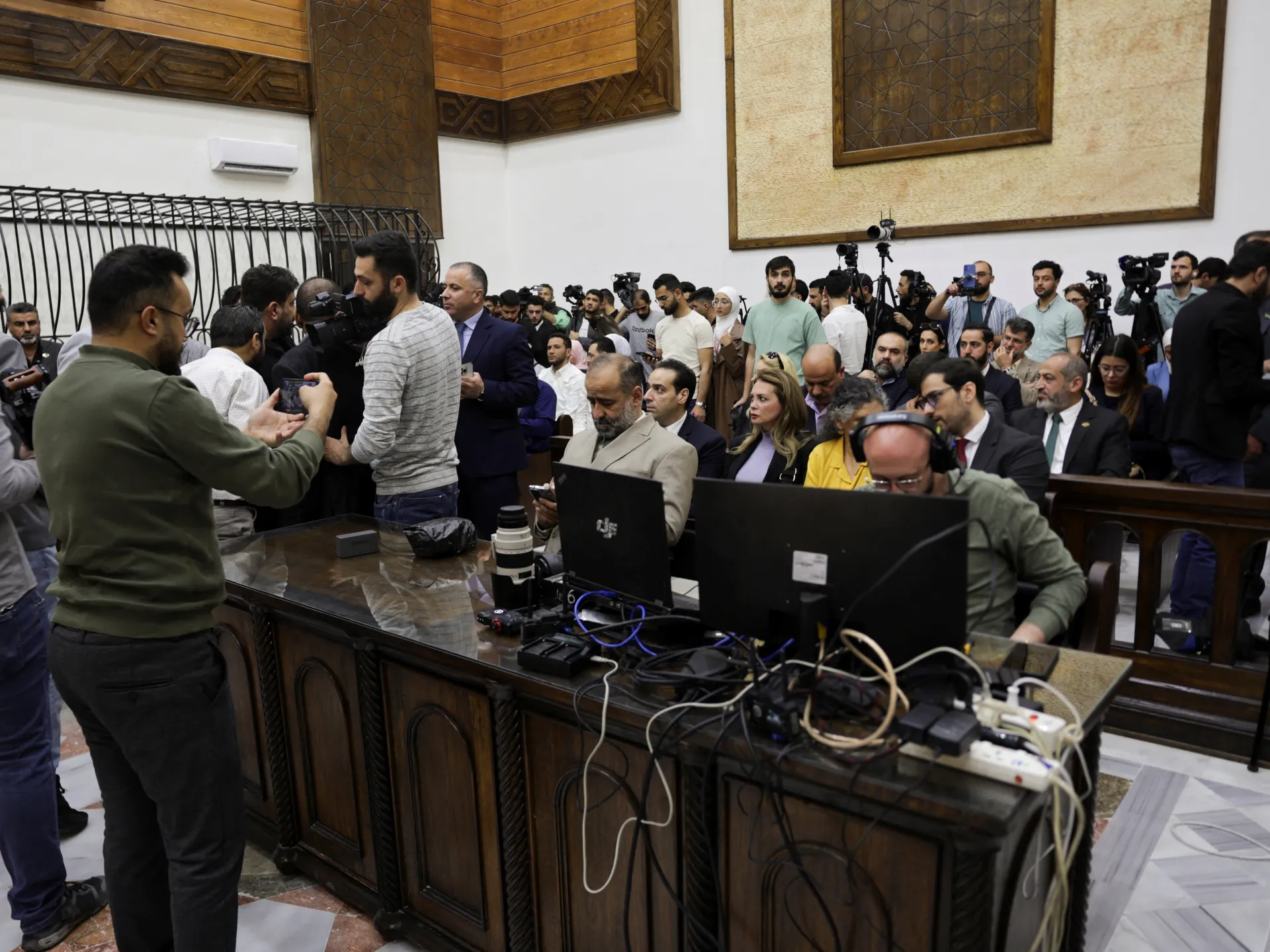
On Sunday, Judge Fakhr al-Din al-Aryan presided over the opening of the trial of Atef Najib, a cousin of former President Bashar al-Assad and the former head of political security in Deraa. Najib faces charges of premeditated murder, torture leading to death, and crimes against humanity. Al-Aryan, who was sentenced to death in absentia by the Assad regime after defecting in 2013, now oversees the proceedings. Former President Bashar al-Assad and his brother Maher al-Assad are also being tried in absentia after fleeing to Russia.
The trial marks the first major step in Syria's transitional judicial proceedings, with a former regime judge applying the law to top perpetrators of the previous regime. Al-Aryan publicly defected from the Syrian regime in March 2013, leading to his death sentence in absentia. He subsequently joined the judicial bodies of the Syrian Interim Government and helped establish parallel courts in opposition-held areas. Following the overthrow of the Assad regime in December 2024, al-Aryan was reinstated via presidential decree and appointed head of the Fourth Criminal Court in Damascus.
Najib was arrested in January 2025 in the Latakia region, where former regime loyalists had taken refuge. Deraa is known as the "cradle of the revolution" following the 2011 arrest and torture of schoolchildren, including the killing of 13-year-old Hamza al-Khateeb, which sparked the uprising. Najib's connection to that incident and the death of Hamza is one of the reasons why his trial is so significant in Syria.
The Syrian Network for Human Rights (SNHR) emphasises that the trial has moved through formal legal stages, including arrest, investigation, prosecution, and referral to a criminal court in Damascus, rather than being a "victors' court". Fadel Abdulghany, the founder of the SNHR, told Al Jazeera that the moment carries deep symbolic weight. "A judge once sentenced to death by the Assad regime for defending the rule of law has returned to the bench to apply that same law to one of the regime's most extensively documented perpetrators of violations," Abdulghany explained.
Experts note that while the trial carries deep symbolic weight regarding the rule of law, the broader transitional justice process remains incomplete, with hundreds of thousands of cases of enforced disappearance still unresolved. The SNHR has documented at least 177,000 cases of enforced disappearances since 2011, attributed to the former government. Abdulghany argues that transitional justice requires four interconnected pillars: criminal accountability, truth-seeking, reparations, and institutional reform.
Despite the inclusion of the former president and his brother as defendants despite their absence from the proceedings and from Syria, Abdulghany stressed that the trial was not the end of the transitional justice process in a country where hundreds of thousands of people died and disappeared during the war and the five-decade rule of al-Assad and his father, Hafez.