Space sector updates: Rocket Lab expands flexibility, Blue Origin details New Glenn failure
Industry players navigate mixed results with Firefly ramping production, China suffering a launch failure, and Rocketdyne returning as a standalone entity.
Rocket Lab has unveiled its GHOST (Global Hypersonic & Orbital Spaceport Technology) portable spaceport system, a move designed to increase the launch flexibility of its Electron vehicle. The company also confirmed plans to begin operations from Alaska’s Pacific Spaceport Complex, expanding its footprint beyond its existing sites in New Zealand and Virginia. Chief executive Peter Beck stated the initiative was driven by customer demand for greater mobility, particularly for HASTE suborbital hypersonic test bed missions.
Despite these operational expansions, Rocket Lab indicated that its medium-lift Neutron rocket will likely not launch in 2026. Beck noted that while hardware delivery to the launch pad is targeted for the fourth quarter, final integration and testing phases often reveal unforeseen issues. Consequently, the company described the chances of a debut launch before the year’s end as narrowing, with 2027 remaining the plausible window for its first flight.
Blue Origin provided its first substantive update on the catastrophic loss of the New Glenn rocket in May, confirming that a valve issue on the main oxygen line of one of its seven BE-4 engines initiated the anomaly. Chief executive Dave Limp stated that while the root cause has not yet been fully identified, hardware recovery and inspections have clarified the origin of the failure. The company remains on track to return New Glenn to flight before the end of the year.
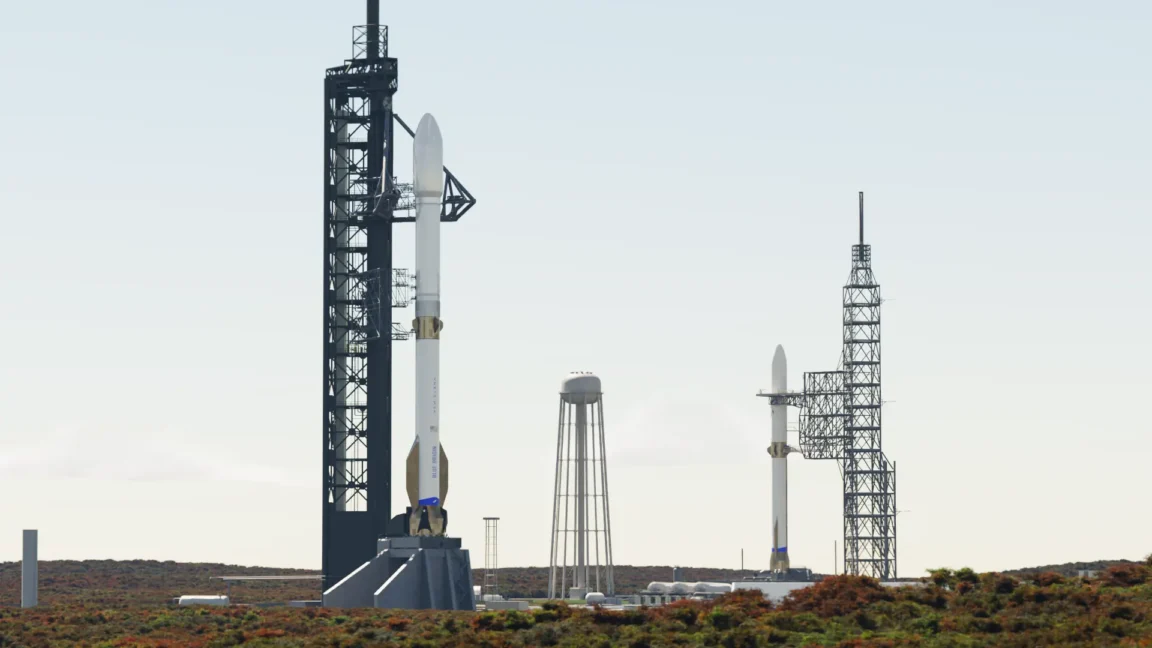
In parallel infrastructure developments, Blue Origin outlined a two-pad strategy at Cape Canaveral. Following the destruction of Launch Complex 36A, the company will restore the site for its smaller New Glenn 7x2 vehicle. Simultaneously, it will develop a larger pad at Launch Complex 36B to serve as the operational home for the nine-engine New Glenn 9x4 variant, including new vertical integration and payload processing facilities built in partnership with the US government.
Firefly Aerospace reported strong market interest in its launch services, with chief executive Jason Kim describing launch capacity as the most constrained it has ever been. The company is ramping Alpha production to an all-time high and has already sold a majority of its manifest for 2027. Meanwhile, China’s Long March 7A rocket exploded approximately one minute and 20 seconds after liftoff from Wenchang, with the first stage breaking apart during maximum dynamic pressure. The payload, believed to be a military communications satellite, was lost.
Other industry movements include Virgin Galactic naming its next-generation Delta spaceship, with options including Horizon, Explorer, Ascend, and Apeiron. The company aims to enter commercial service with the new vehicle in February 2027. Rocketdyne has also returned as a standalone company following its acquisition by AE Industrial Partners, focusing on launch-vehicle engines and spacecraft propulsion, while Rocket Factory Augsburg faces delays to its first orbital launch due to tank examination requirements.