Saudi Arabia, Pakistan and Turkiye formalise trilateral defence pact in Mecca
The mutual defence clause, signed by Crown Prince Mohammed bin Salman, President Recep Tayyip Erdogan and Prime Minister Shehbaz Sharif, treats an attack on one signatory as an attack on all three, integrating Turkiye’s NATO-standard military capabilities with existing bilateral frameworks.
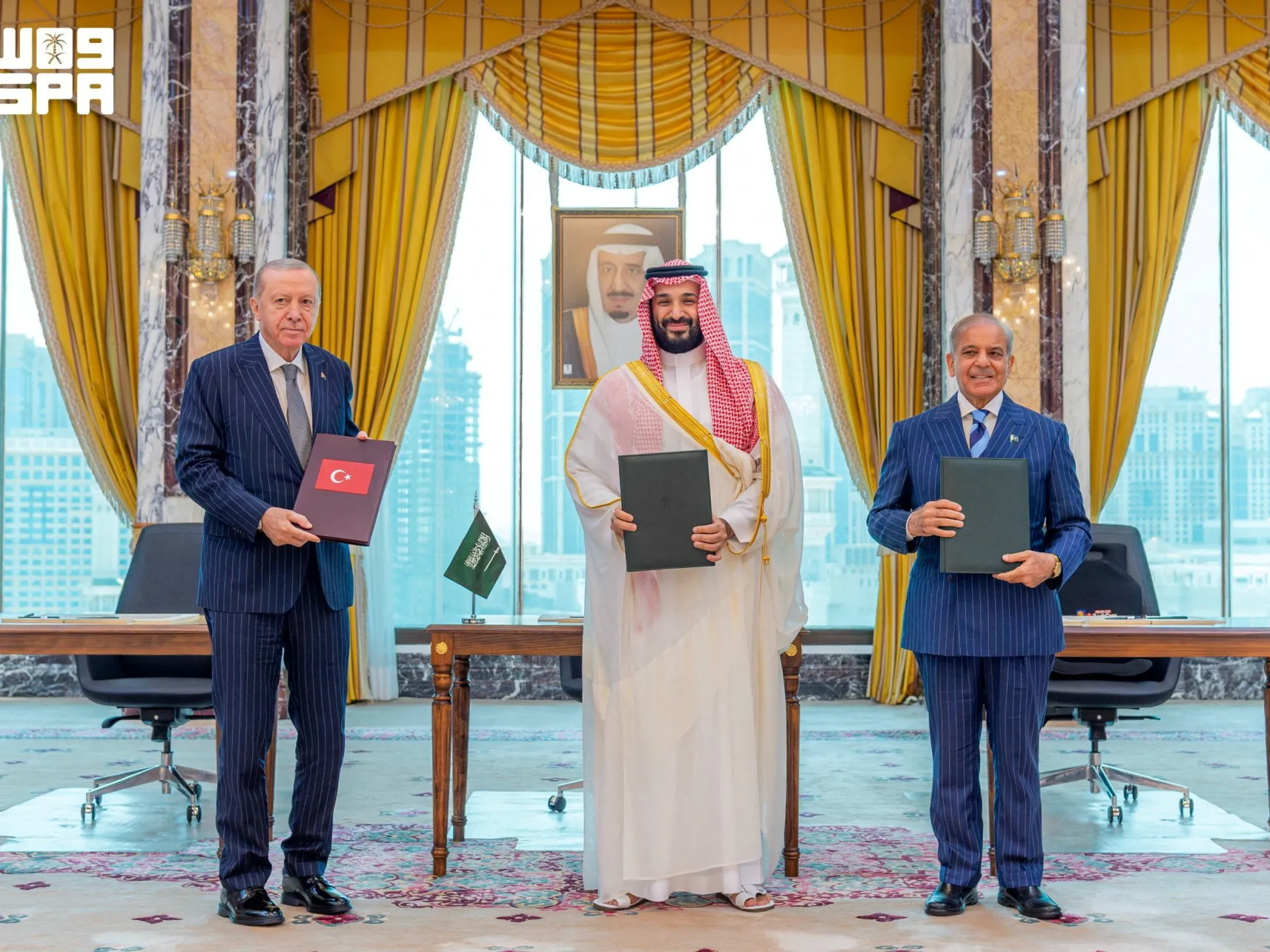
Saudi Arabia, Pakistan and Turkiye have signed the Makkah Joint Defence Agreement in Mecca, establishing a collective defence mechanism where an armed attack on any one signatory is treated as an attack on all three. The accord was signed by Saudi Crown Prince Mohammed bin Salman, Turkiye President Recep Tayyip Erdogan and Pakistan Prime Minister Shehbaz Sharif at al-Safa Palace. While the leaders described the pact as a shield of peace that does not target any specific country, analysts indicate it aims to deter Iran and its regional networks amid the ongoing US-Israel conflict with Iran.
The agreement builds on a bilateral Saudi-Pakistan defence agreement signed in 2025 and integrates Turkiye’s NATO-standard military and defence industry. It comes more than five months into the US-Israel war on Iran, a conflict that has involved missile and drone fire onto Gulf oil exporters and disrupted the Strait of Hormuz. Saudi officials stressed the agreement does not pose a threat to regional security and does not come at the expense of the kingdom’s ties with other allies, including the US and Gulf states.
Analysts view the pact as a strategic signal designed to create uncertainty for adversaries rather than an operational alliance with fixed military obligations. Muhammad Faisal, a security and foreign policy analyst, noted the agreement’s value lies in strengthening collective deterrence. Kamran Bokhari, a senior resident fellow at the Middle East Policy Council, called it a strategic signal, adding that any integrated military capacity is years away. The pact also follows a separate nuclear cooperation deal signed by Saudi Arabia and the US last month to establish a civilian nuclear programme.
The signing occurs against a backdrop of heightened regional instability, including renewed Houthi attacks on Saudi energy infrastructure and oil tankers in the Red Sea. Aziz Alghasian, a Saudi researcher, described the Houthi threat as an accelerant for the pact, which he termed Saudi-centric deterrence. Experts suggest the alliance may expand to include Gulf states such as Qatar and Kuwait, with Qatar and Kuwait identified as the most plausible candidates due to existing defence ties with Pakistan and Turkiye respectively.
Iran’s response has been dismissive, with parliament member Ebrahim Rezaei calling the pact a paper agreement that will not bring security to Saudi Arabia. However, analysts warn the collective-defence clause changes how separate relationships function. The signing also raises questions about Pakistan’s role as a mediator between the US and Iran, with experts noting its presence provides diplomatic insulation for the trilateral arrangement.
Pakistan’s State Bank confirmed Saudi Arabia rolled over more than $5bn in deposits for three years, part of an $8bn package supporting Pakistan’s external accounts. This financial support underscores the economic dimensions of the security partnership. Meanwhile, Supreme Leader Mojtaba Khamenei has yet to make a public appearance, raising questions about decision-making authority within Iran’s leadership.