Russian President Putin sets final peace treaty as precondition for Ukraine summit
According to NHK News Japan, Vladimir Putin has stated that talks with Volodymyr Zelenskyy will only proceed if Russia's stipulated terms are accepted
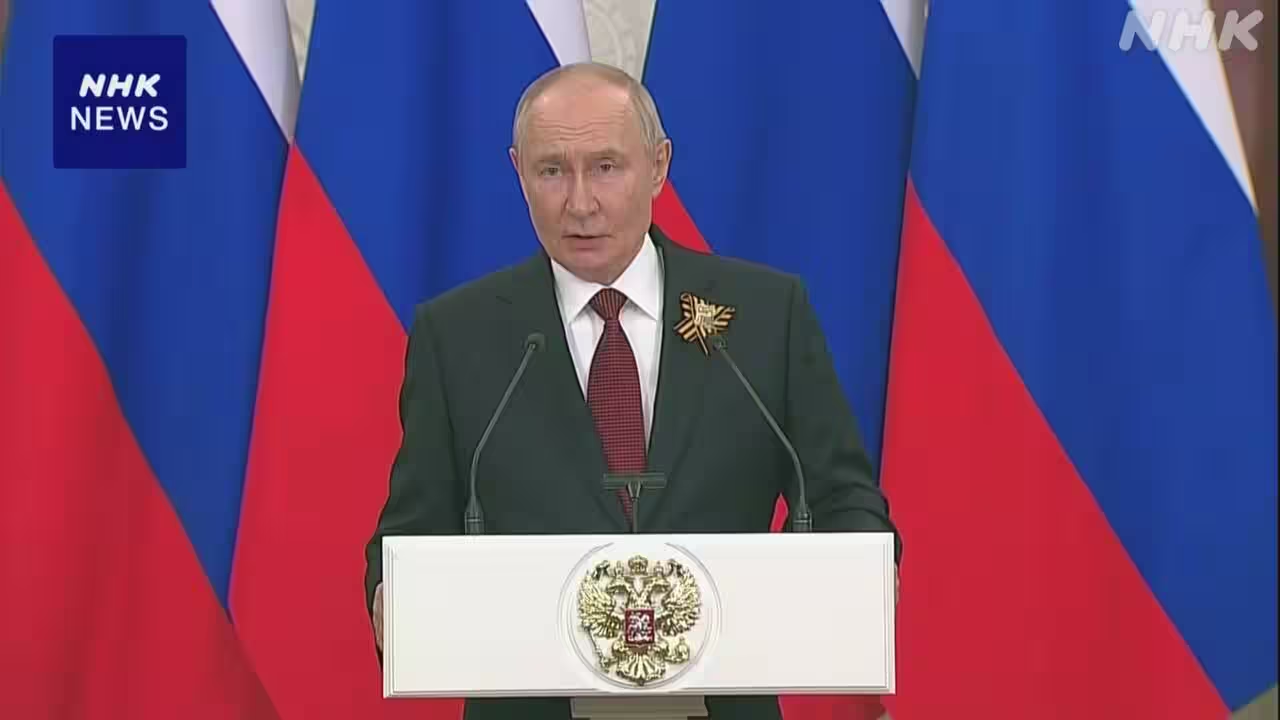
Russian President Vladimir Putin has declared that a high-level summit with his Ukrainian counterpart, Volodymyr Zelenskyy, is strictly contingent upon the existence of a final peace treaty agreement. This rigid precondition was outlined in reporting by NHK News Japan, which captured the Kremlin's stance on the feasibility of direct diplomatic engagement at the current juncture.
The statement, delivered on 10 May 2026, suggests that negotiations cannot proceed in any meaningful capacity unless Ukraine accedes to the specific conditions demanded by Moscow. Putin indicated that the path to a face-to-face meeting is effectively blocked until a comprehensive settlement is reached, framing the summit not as a platform for new dialogue but as a ceremonial conclusion to a concluded process.
This approach underscores a significant shift in the mechanics of potential diplomatic resolution, where the summit itself becomes a function of the treaty rather than a driver of the agreement. By linking the event directly to the finalisation of a document, the Kremlin appears to be prioritising the outcome of negotiations over the process of discussion, effectively setting a high bar for any future interaction between the two leaders.
The reporting from NHK News Japan highlights that the specific details of the conditions required by Russia were not explicitly detailed in the immediate statement. However, the implication remains clear: without Ukraine accepting these undisclosed stipulations, the prospect of a bilateral meeting is considered non-viable by the Russian leadership.
This development adds to the complexity of the ongoing conflict, as it establishes a binary condition for diplomatic contact. The absence of a final treaty means that, under this framework, the door to a summit remains closed, potentially extending the period of high-level stalemate between the nations involved.
While the statement relies on the primary report from NHK News Japan, the clarity of the conditionality suggests a firm policy position from Moscow. The administration in Moscow is signalling that any movement towards a resolution must first satisfy their own defined parameters before any formal gathering of heads of state can be authorised.