Renaissance masterworks stolen in Messina museum heist during Ferragosto holiday
Perpetrators exploited the Vara procession distraction to breach security, leaving two panels abandoned near the site
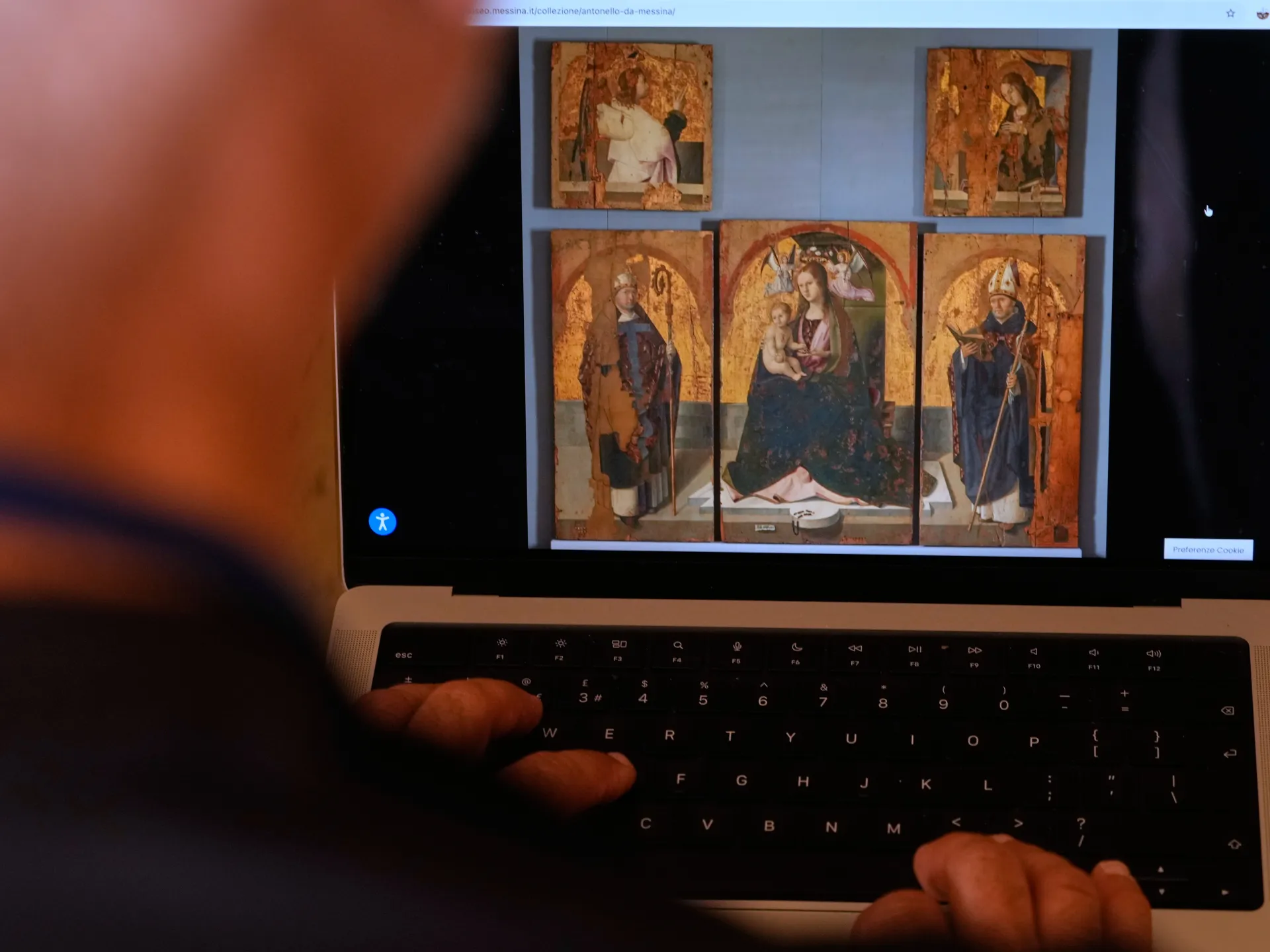
Thieves have stolen four Renaissance masterworks by Antonello da Messina, valued at up to 80 million euros ($93m), from the MuMe Regional Interdisciplinary Museum in Messina, Sicily. Cultural officials and Italian media confirmed the incident occurred at approximately 19:50 GMT on 16 August, during the Ferragosto holiday. The perpetrators exploited the citywide distraction of the traditional Vara procession, which drew police and large crowds to central Messina, to execute the theft.
Italian daily Corriere della Sera reported that the thieves cut through metal perimeter fencing along Viale Annunziata to gain access to the grounds. They then forced open a side door to enter the gallery halls. Once inside, the group breached an armoured glass display case to extract a small, double-sided tempera panel dating back to 1465-1474. The portable devotional piece features the Virgin and Child with a Franciscan Monk on its front and Christ in Pieta on its reverse.
Originally part of the Wilhelm Soldan collection from 1930, the tempera panel was acquired by the Sicilian region at a Christie’s auction in 2003 following its formal attribution to Antonello. The perpetrators also dismantled all five remaining tempera-on-wood panels of the historic San Gregorio Polyptych. Commissioned in 1473 by Abbess Fabria Cirino for the monastery of Santa Maria, which was subsequently destroyed in Messina’s 1908 earthquake, the altarpiece stands as the only surviving masterpiece by Antonello that remained in his hometown.
Italian outlet Repubblica reported that the thieves made off with three key sections of the polyptych. The remaining two panels, depicting Saint Benedict and Saint Gregory, were abandoned resting against a wall near the museum grounds. Museum director Marisa Mercurio told Italian news agency ANSA that the loss was devastating, noting that the works were among Antonello da Messina’s most important and best-known.
Local Culture Councillor Enzo Caruso told outlet Il Tirreno that nobody in Messina could have imagined a real movie-style heist like at the Louvre. Caruso said that international interest in Antonello’s oeuvre had expanded after Italy’s Culture Ministry purchased his Ecce Homo painting for $14.9m earlier in the year.
Lynda Albertson, CEO of the ARCA art crimes research association, told La Repubblica that stealing an Antonello may be far easier than selling one given the high visibility and historic footprint of the stolen panels. She explained that high-profile art of this kind rarely gets sold, often spending years traded within the criminal underworld as leverage for other illegal activities.
Born in Sicily around the year 1430, Antonello da Messina stands as one of the defining masters of the early Italian Renaissance. Because few of his works survive today, his surviving paintings are considered irreplaceable cultural treasures. The theft follows a separate case days earlier in Parma, northern Italy, where police recovered three stolen works by Renoir, Cezanne and Matisse valued at roughly $11.5m.