Record heat dome breaks temperature records across Western US
A strong ridge of high pressure created a heat dome over the northern Rockies on July 12, 2026, triggering a tenfold spike in heat-related emergency visits and setting new records in multiple states.
A powerful ridge of high pressure established a heat dome over the northern Rockies on the weekend of July 11-12, 2026, driving record-breaking temperatures across Montana, Utah, and Wyoming. The phenomenon trapped hot air near the surface, suppressing clouds and precipitation while allowing sunlight to elevate air temperatures significantly. This event occurred early in the Northern Hemisphere summer, yet several parts of North America experienced sweltering conditions well ahead of typical seasonal norms.
Preliminary analysis from the National Weather Service office in Billings indicates that temperature sensors at airports in Billings and Miles City, Montana, recorded new all-time highs of 111°F and 115°F, respectively. Miles City broke its previous record by 4°F, while Billings exceeded its prior high by at least 2°F. In Wyoming, Sheridan recorded a new all-time high of 109°F, topping its previous record by at least 2°F. These Montana records date back to the 1930s, and the Sheridan record begins in 1907.
Multiple locations in Utah also shattered all-time records, according to the National Weather Service office in Salt Lake City. Deseret reached 111°F, Salt Lake City hit 109°F (4°F above its previous record), and Randolph reached 100°F (6°F above its previous record). The temperature stations in Utah maintain records dating back to the 1890s. The National Weather Service described the temperature data as a preliminary analysis, noting that final official records may vary slightly upon full verification.
The extreme heat had immediate health consequences, particularly for older adults with pre-existing conditions such as heart, lung, and kidney disease. Health tracking data from the U.S. Centers for Disease Control and Prevention reveals a tenfold spike in heat-related emergency department visits in Mountain states during the event. Forecasters expect the heat dome to spread east into the Midwest, New England, and the Mid-Atlantic in the coming days, with triple-digit temperatures likely in some areas.
Researchers at NASA’s Goddard Space Flight Center note that such heat waves have become more frequent in the United States in recent decades. Using the MERRA-2 modelling system, one NASA team found that summer heat waves in the U.S. roughly doubled in number between 1980 and 2023, increasing from an average of two to four per month. Concurrently, parts of Western Europe, Central Asia, and East Asia are also experiencing significant heat waves.
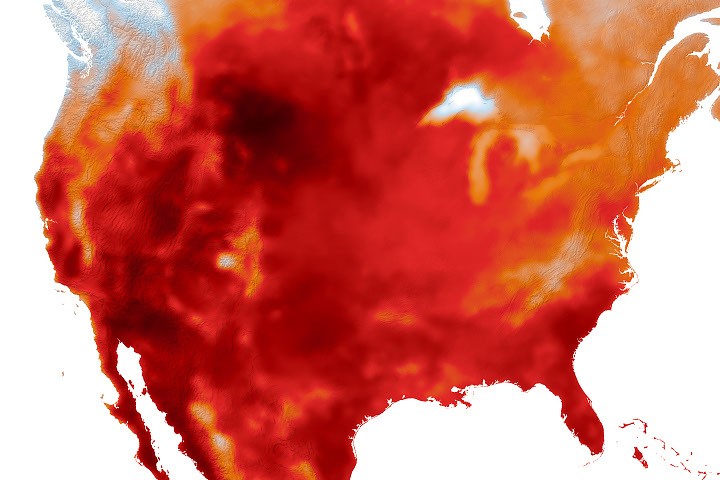
NASA Earth Observatory imagery, produced by combining satellite observations with the GEOS model, shows air temperatures across the United States on July 12, 2026. The darkest reds on the map indicate areas where temperatures approached or exceeded 45 degrees Celsius (113 degrees Fahrenheit). The image was created using GEOS-FP data from the Global Modeling and Assimilation Office at NASA GSFC.