Quantum ‘Jamming’ Tests the Limits of Cryptographic Security and Causality
A re-examination of 1990s research reveals that ‘quantum jamming’ could undermine device-independent key distribution, prompting a global effort to identify fundamental principles governing cause and effect.
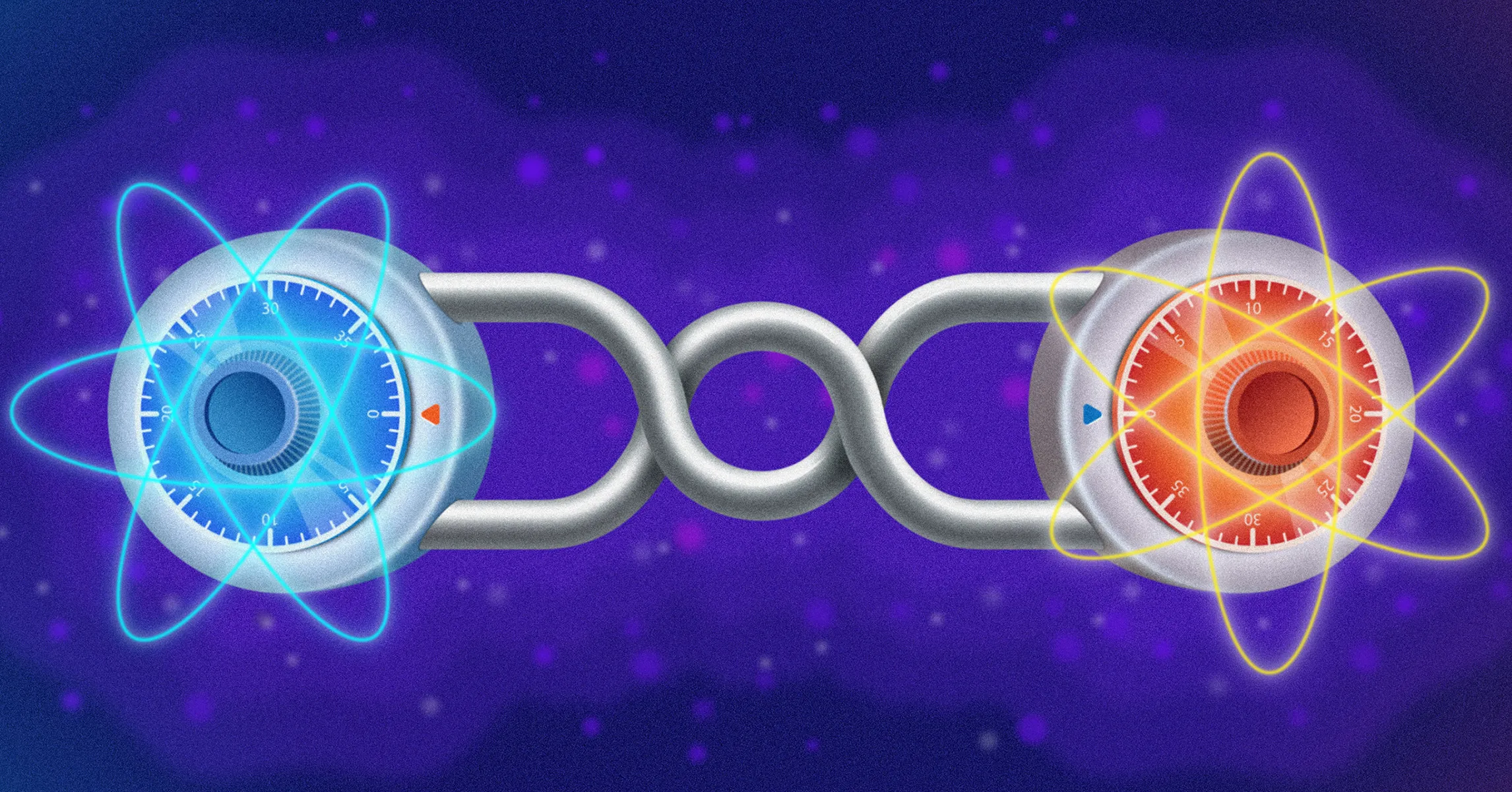
Cryptographers and physicists are increasingly scrutinising a hypothetical phenomenon known as ‘quantum jamming’ to test the resilience of future communication security. The research examines whether a form of ‘super-entanglement’ could disrupt quantum correlations without violating the ‘no-signaling’ principle, potentially undermining the foundations of device-independent quantum key distribution. Led by researchers including Ravishankar Ramanathan and Michał Eckstein, the work aims to identify fundamental principles governing causality and ensure cryptographic protocols remain secure even if current quantum mechanics is superseded by a more fundamental theory.
The concept was initially explored in the mid-1990s by Jacob Grunhaus, Sandu Popescu, and Daniel Rohrlich, who imagined it as a mechanism that could interfere with entangled particles while respecting Einstein’s principle that information cannot travel faster than light. Interest in the topic surged in 2016 when Ravishankar Ramanathan and Paweł Horodecki discovered the earlier paper and realised that the “monogamy of entanglement” principle, which underpins device-independent quantum key distribution, fails if jamming correlations are allowed.
Michał Eckstein of the Jagiellonian University illustrates the concept using a thought experiment involving Alice, Bob, and a magician named Jim, who alters the correlation between entangled particles so they match in colour rather than being opposite, without the parties initially noticing. This interference would allow an outsider to subtly change the particles’ entanglement, disrupting communication without leaving a trace, thereby challenging the assumption that quantum mechanics is the ultimate theory of nature.
Roger Colbeck of King’s College London and V. Vilasini of Inria are using jamming as an edge case to classify how cause and effect operate in different physical theories, seeking a fundamental principle that explains why jamming might be forbidden in reality. They view the discomfort that quantum jamming creates as a tool to hone intuitions about causation, aiming to find a rule beyond no-signaling that restricts such phenomena.
A preprint released in December 2025 by Ramanathan, Horodecki, Eckstein, Tomasz Miller, and Ryszard Horodecki responds to recent work by Weilenmann, with researchers now collaborating to clarify terms and search for underlying physical principles. The group is engaged in active dialogue to resolve misunderstandings and determine if there is any new physics behind jamming, ensuring that cryptographic security does not rely on assumptions that may not hold in a post-quantum world.
