Pyongyang accelerates nuclear expansion amid Quad denuclearisation demands
Kim Jong Un vows exponential growth of arsenal as US intelligence confirms growing sophistication of North Korean strategic capabilities.
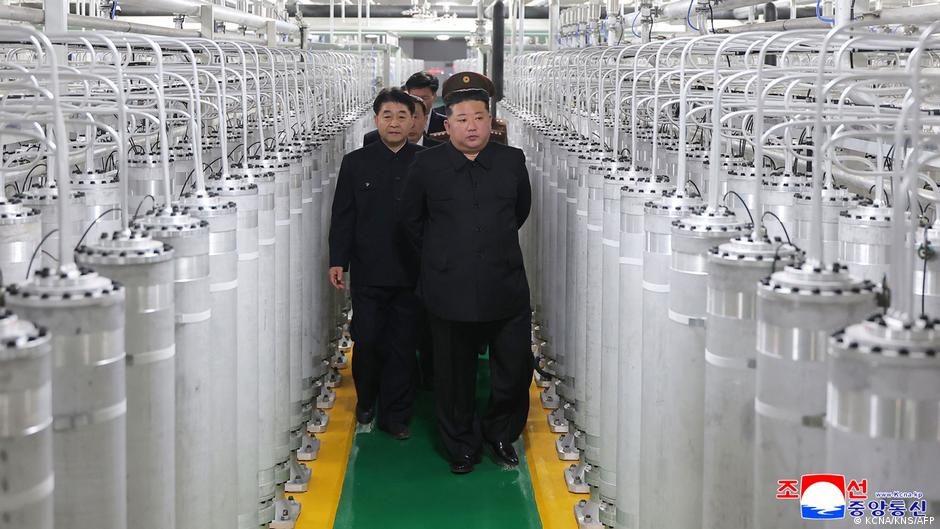
North Korean leader Kim Jong Un has announced plans to bolster the nation’s nuclear forces "at an exponential rate," marking a significant escalation in Pyongyang’s strategic posture. The declaration coincided with state media footage of Kim touring what South Korean intelligence identified as a new uranium enrichment facility. This move follows a joint statement from the Quad—the grouping comprising the US, Japan, India, and Australia—which called for North Korea’s "complete denuclearisation" during a meeting in New Delhi. Pyongyang swiftly rejected the proposal, with its Foreign Ministry vowing that denuclearisation "will never happen."
The escalation comes against a backdrop of shifting geopolitical dynamics, particularly as Washington’s attention appears diverted during the second term of US President Donald Trump. While Trump met Kim three times during his first term, previous summits in 2018 and 2019 failed to yield a breakthrough on disarmament. Since then, North Korea has systematically laid the institutional and physical groundwork for a more robust nuclear programme, amending its constitution in 2023 to enshrine its "nuclear force-building policy" and degrading ties with South Korea by reclassifying it as a "hostile state."
US intelligence assessments indicate that North Korea’s nuclear arsenal is expanding in both size and sophistication. In April 2026, US Assistant Secretary of Defense Robert Kadlec told the Senate Armed Services Committee that North Korean nuclear forces are increasingly capable of targeting the United States, while missile forces can strike South Korea and Japan with nuclear or conventional warheads. Kadlec described these forces as presenting a "clear and present danger of nuclear attack," noting their growing capability to evade defences.
Further complicating the security landscape, South Korean intelligence revealed in early May 2026 that Pyongyang had codified an "automatic nuclear launch" policy into law. This legislation triggers a nuclear response if the central command-and-control apparatus or Kim himself is targeted by "hostile forces." Additionally, US intelligence assesses that North Korea has benefited from Russian know-how and technology in exchange for supporting Moscow’s invasion of Ukraine, further enhancing its strategic capabilities.
Despite the rapid expansion, experts suggest North Korea is unlikely to use these weapons offensively due to deterrence by US and allied forces. Kelsey Davenport of the Arms Control Association noted that while the US lacks an effective engagement policy, the goal of denuclearisation should not be abandoned. She argued that stabilising the relationship and reducing conflict risks are prerequisites for any progress, while noting that Pyongyang remains deterred by the military superiority of the United States and its allies.