Private credit stress deepens as non-accruals hit record highs
Data from LoanClub Data reveals a sharp increase in borrower distress across US Business Development Companies, with adjusted non-accrual exposure jumping to 3.3% in the first quarter of 2026.
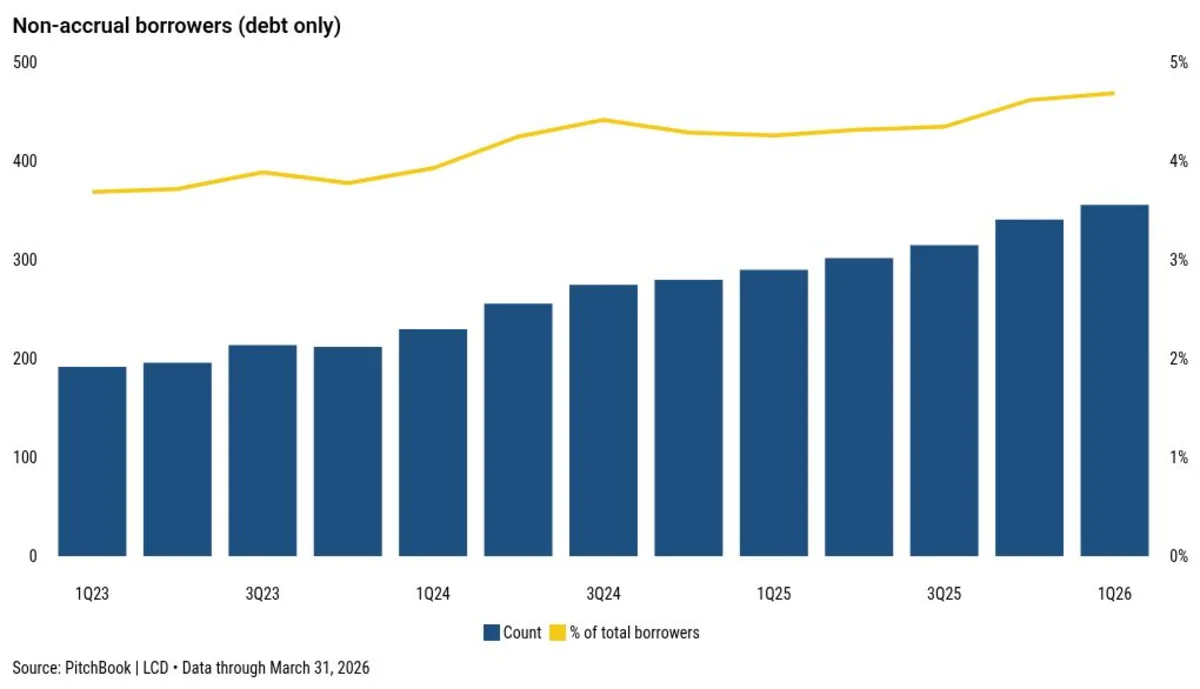
The US private credit market is entering a more challenging phase as signs of borrower distress become increasingly prominent. After years of strong growth supported by expanding assets under management and attractive returns, the credit cycle appears to be turning. According to a new report from LoanClub Data (LCD), rising non-accrual exposure is now a meaningful feature of the market, signalling a shift from expansion to a period of heightened risk for lenders and investors.
LCD’s analysis covers 213 distinct Business Development Companies (BDCs) managed by 109 managers, representing an aggregate debt portfolio of $516 billion as of the first quarter of 2026. The data indicates that reported non-accrual debt rose to 1.9% of total debt at cost in Q1 2026, up 52 basis points from the previous quarter. In dollar terms, non-accrual debt increased by nearly $2.8 billion in Q1 alone, bringing the total to roughly $10 billion. This surge contrasts sharply with the modest 1% increase in total debt investments held by BDCs over the same period.
A more comprehensive view of the risk is provided by LCD’s adjusted non-accrual metric, which counts all debt owed by borrowers with at least one non-accrual tranche. This approach captures the broader credit risk that as-reported figures may understate. Under this lens, adjusted non-accrual exposure jumped by 116 basis points to 3.3% of total debt at cost in Q1 2026. In absolute terms, adjusted non-accrual loans rose by $6.1 billion to reach $17.3 billion, highlighting the extent of distress within the borrower base.
The concentration of risk is notable, with two borrowers, Medallia and Inovalon, accounting for $4.4 billion of the Q1 2026 non-accrual total. The financial impact on lenders is also becoming clearer. BDCs in the aggregate carry a risk of $772 million in interest income that could imminently be in default. This amount represents approximately 204 basis points of total cash interest income, suggesting that the total cash yield for Q1 would fall to 8.1% from 8.3% if these risks materialise.
Among the ten largest publicly traded BDCs, the trend is even more pronounced. For these major players, reported non-accrual debt rose to 3.95% of total debt at cost in Q2 2026, while adjusted exposure increased by 54 basis points to 5.95%. The balance of non-accrual debt at these top ten funds increased slightly to $3.3 billion, despite a 2.3% contraction in their overall debt portfolios. This suggests that credit risk is building rapidly at the most significant institutions in the sector.
Valuations of non-accrual debt tranches have also come under pressure, falling 144 basis points to 55.8% of cost in Q1 2026. However, LCD notes that this gap between non-accrual and performing tranches is near its narrowest measurement in at least three years, partly due to portfolio managers restructuring loans and taking write-offs. As the industry looks ahead to the rest of 2026, the direction of non-accrual exposure remains a clear signal of rising credit risk, even if the immediate impact on interest income is currently manageable.