Perseverance Rover Reveals Ancient Impact History on Mars
New findings published in the Journal of Geophysical Research: Planets identify six distinct rock types, including glassy beads, as evidence of high-energy collisions over 3.9 billion years ago.
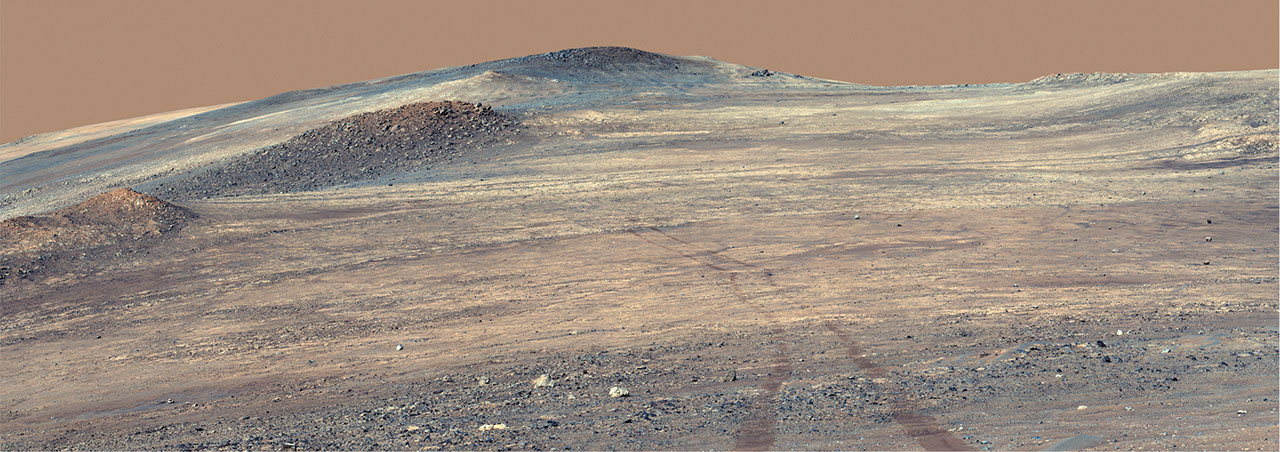
NASA’s Perseverance rover captured a panoramic view of the Broom Point formation on May 15, 2025, during the 1,505th sol of its mission on Mars. The image, recorded by the Mastcam-Z instrument, displays the outside lip of Jezero Crater’s 150-metre rim and the underlying Broom Point member, a 75-metre-thick stack of ancient bedrock. The rover’s tracks are visible in the frame, marking its descent down the steep slope of the crater rim.
The Broom Point member is estimated to be more than 3.9 billion years old, placing it among the oldest terrain examined by a Mars rover. The rock layers within this formation are tilted at nearly vertical angles exceeding 80 degrees. This structural evidence points to repeated asteroid strikes that occurred during the formation of the Isidis Basin and Jezero Crater, rather than gradual geological processes.
A study published in the Journal of Geophysical Research: Planets identifies six distinct rock types within the sequence, including breccias and glassy beads. These features are indicative of high-energy impacts. Rock fragments within the breccias contain gas-bubble cavities, which indicate that the material was once molten. The high abundance of glassy droplets suggests that asteroid impacts were the primary architect of these layers, as volcanic activity rarely produces such quantities.
The tiny, dark, glassy beads found in the layers are comparable to those ejected by the Chicxulub asteroid impact on Earth. While volcanoes can produce similar glassy droplets, the repetition of distinct rock types throughout the thick sequence indicates that high-energy impact events happened repeatedly across this region of early Mars.
NASA’s Jet Propulsion Laboratory, managed by Caltech in Pasadena, California, built and manages operations of the Perseverance rover. Arizona State University leads the operations of the Mastcam-Z instrument, collaborating with Malin Space Science Systems on camera design and operation, and with the Niels Bohr Institute of the University of Copenhagen on calibration targets. The rover is part of NASA’s Mars 2020 mission.