Perseverance rover captures rare transit of Mars moon Phobos
NASA’s Mars rover recorded the silhouette of Phobos crossing the Sun, providing new data to refine our understanding of the moon’s changing orbit.
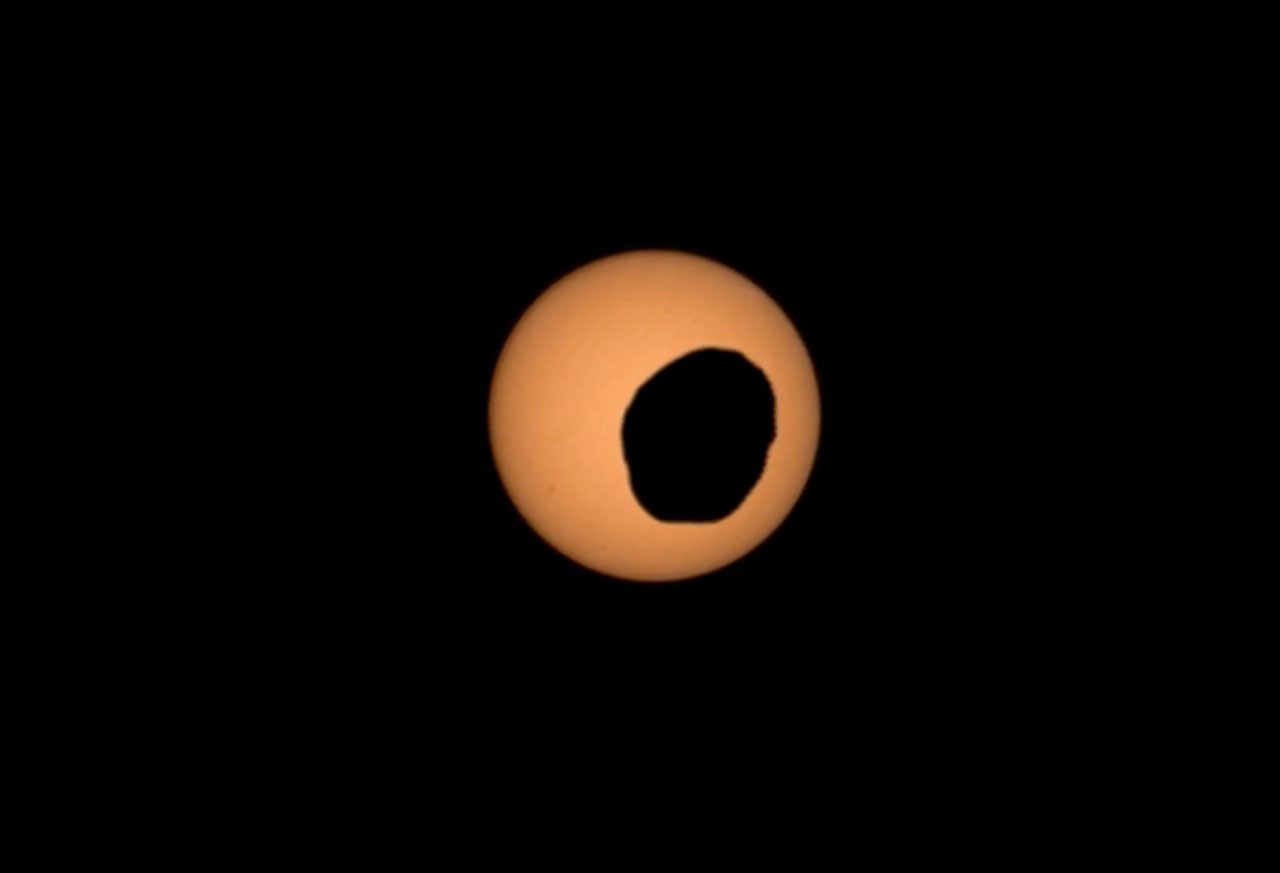
NASA’s Perseverance rover has captured a striking image of Phobos, one of the two moons of Mars, as it transited in front of the Sun. The recording was made on 12 August 2026, marking the 1,948th Martian day, or sol, of the mission.
The image was captured using the rover’s Mastcam-Z camera and has been tinted to simulate the view a human observer would see from the Martian surface while wearing protective solar eclipse glasses. This visualisation helps illustrate the scale of the event as seen from the planet’s surface.
Since landing at Jezero Crater in February 2021, Perseverance has recorded several instances of Phobos crossing the Sun. By comparing these various recordings over time, scientists are able to refine their understanding of the potato-shaped moon’s orbit and track how it is changing.
Long-term projections suggest that Phobos’ orbit is gradually decaying. Eons from now, this orbital shift is expected to eventually bring the moon toward the surface of the Red Planet.
The Mastcam-Z instrument is operated by Arizona State University, which collaborates with Malin Space Science Systems in San Diego on the design, fabrication, testing, and operation of the cameras. The Niels Bohr Institute of the University of Copenhagen also contributed to the design, fabrication, and testing of the calibration targets.
NASA’s Jet Propulsion Laboratory, managed for the agency by Caltech in Pasadena, California, built and manages the overall operations of the Perseverance rover.