Pentagon Chief Hegseth Faces Congress on Iran War Costs and Legal Uncertainty
Secretary of Defense Pete Hegseth and Joint Chiefs Chairman Dan Caine appear before Congress for the first public hearing, defending the administration's strategy while tensions rise over the War Powers Act deadline
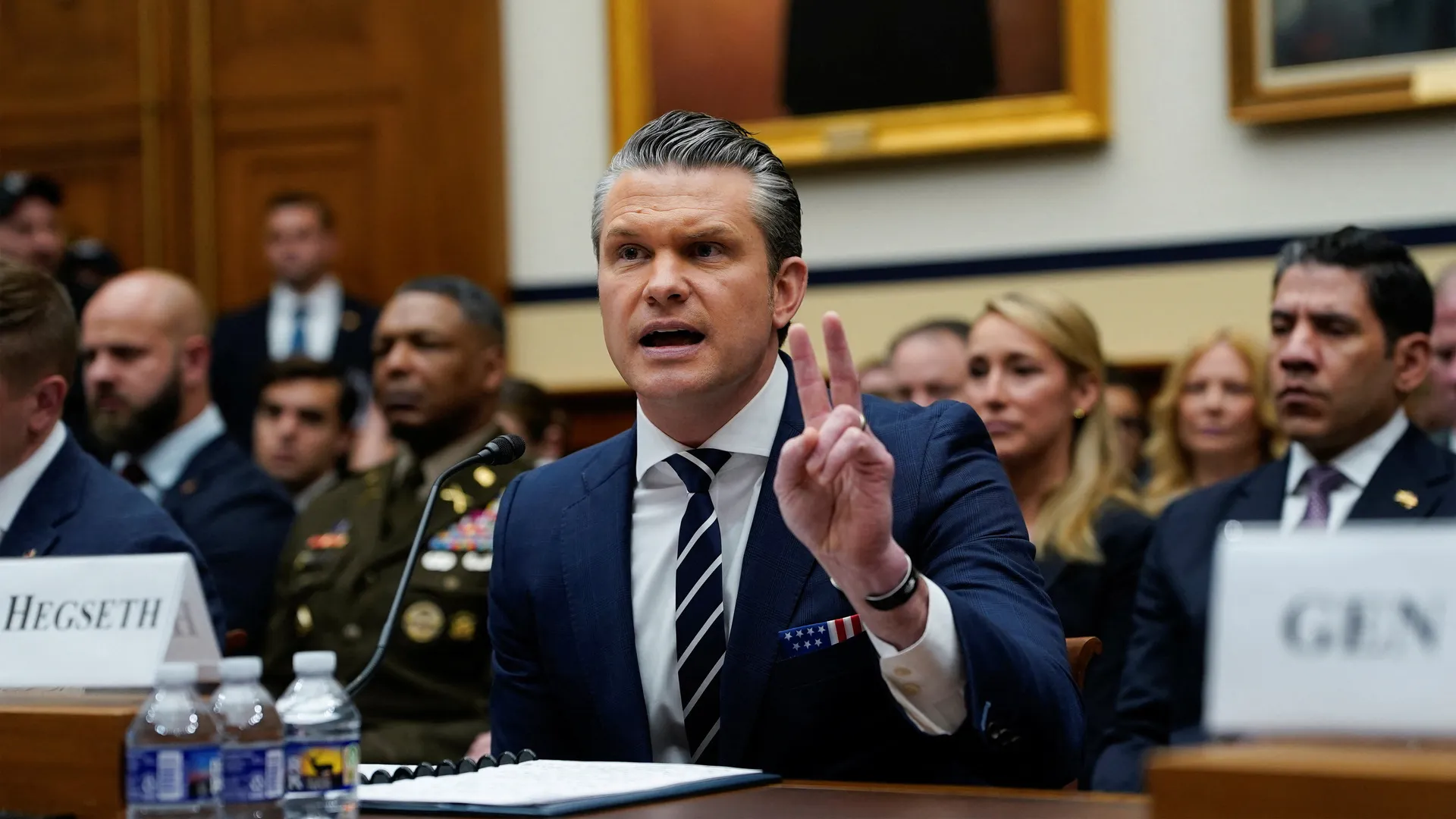
US Secretary of Defense Pete Hegseth and Chairman of the Joint Chiefs of Staff Dan Caine appeared before Congress for the first public hearing regarding the ongoing conflict with Iran. During the testimony, the Pentagon officially placed the current cost of the war at $25bn, a figure attributed largely to munitions and the surge of military assets to the Middle East. Hegseth defended President Donald Trump's policy, including the administration's request for a $1.5 trillion defence budget, and characterised the war as necessary to prevent Iran from acquiring nuclear weapons.
Tensions escalated as lawmakers challenged the legality of US strikes, including an attack on a school in Minab that killed at least 120 children. Representative Ro Khanna questioned Hegseth about the financial cost to taxpayers regarding the incident, but the Pentagon chief declined to attach a specific cost to that event. The hearing also saw intense scrutiny of the status of Iran's nuclear programme, with Hegseth facing contradictions between his previous claim that the programme was obliterated in 2025 and his current assertion that it remains an imminent threat.
With Republicans controlling both chambers of Congress, the conflict remains on an uncertain legal footing as the 60-day limit under the War Powers Act approaches. No indication has been given that Congress will authorise the war, leaving the military operation in a state of ambiguity despite Republican support for the administration's stance. The administration is reportedly considering a separate request to Congress for an additional $200 billion for the war effort, though no official request has been submitted yet.
The testimony occurred shortly after fighting paused on 8 April, following a US naval blockade of the Strait of Hormuz. Concurrently, Brent crude prices have surged past $111 per barrel due to disruptions in the strait and the stalemate in the Iran conflict. Hegseth maintained that the Trump administration had looked at all aspects of the possibility Iran might close the key fossil fuels shipping route, noting Tehran's control of the route as a main point of leverage in the war.
Hegseth characterised the war as essential to ensure Iran never gets a nuclear weapon, a stance that drew sharp criticism from Democrats who described the conflict as a quagmire and a political and economic disaster. He accused lawmakers of handing propaganda to enemies by using defeatist words, while Chairman Caine presented a stout defence of the war, stating that Iran remains a weaker and less capable adversary than in decades. To date, the Pentagon has identified 14 military casualties during the conflict.