Pakistan’s women demand equal respect in traditional tent pegging
Despite financial hurdles and exclusion from international competitions by the Equestrian Federation of Pakistan, women are forming all-female clubs and competing in local melas to assert their place in the sport.
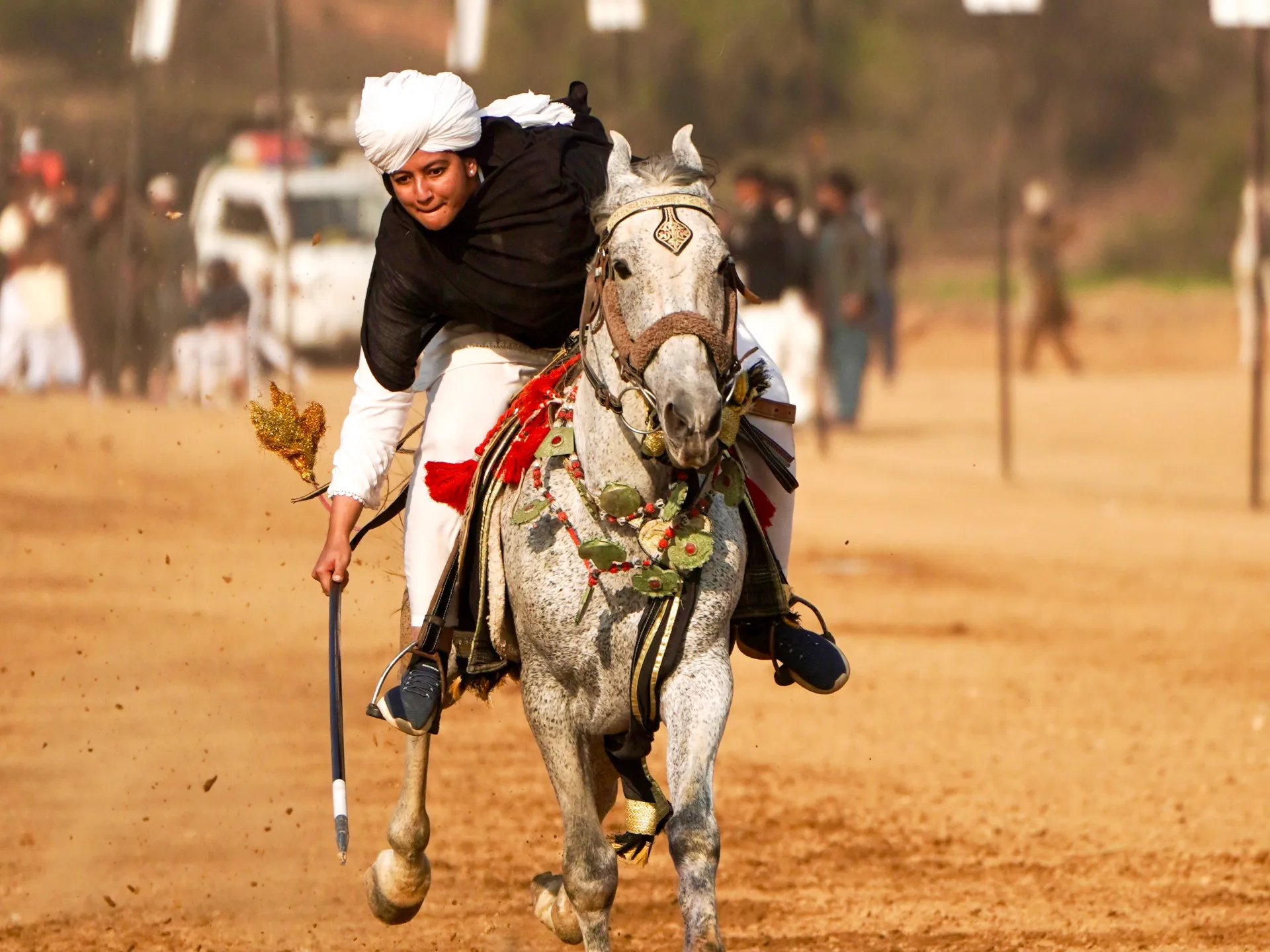
Female riders in Pakistan are increasingly challenging the gender norms of tent pegging, a traditional equestrian sport known locally as neza baazi, to demand equal respect and participation. Despite facing significant social pressure, financial barriers, and limited institutional support from the Equestrian Federation of Pakistan, women have established all-female clubs such as the Bint-e-Zahra Club in Rawalpindi. Riders report that while social media visibility has grown, the sport remains largely inaccessible to women due to the high cost of horse ownership and a lack of separate facilities at competitions.
Anum Shakoor, 30, established the Bint-e-Zahra Club in 2025 as Pakistan’s first female-only tent-pegging club, following frustrations with competing in mixed-gender environments. The club includes riders Eshal Ibrahim and Noor un Nisa Malik, both 16, and Sehrish Awan, 32. Shakoor stated the formation was driven by a desire to provide a dedicated stage for women to train and build community, noting that female riders had previously been confined to mixed clubs where they often faced a "frustrating realisation" of their marginalised status.
Ayesha Khan, captain of Pakistan’s only all-women national team, became the first Pakistani woman to compete against and defeat 70 male riders at a mela in Rawalpindi. Khan was selected for Pakistan’s under-21 mixed-gender team in 2021 and later captained the women’s team to a third-place finish in Jordan in 2022. However, she highlighted a stark contrast in institutional support, noting that the Equestrian Federation of Pakistan sent only male teams to open international competitions, including a 2024 event in Jordan, despite the availability of female athletes.
The financial and structural obstacles to the sport are substantial, with horse ownership and upkeep costing nearly the monthly minimum wage in Punjab. Riders report that many events lack separate enclosures or restrooms for women, and the requirement for competitors to bring their own horses shuts out those without family support or significant resources. Shakoor noted that she missed several events due to the inability to afford transport for her horse, emphasising that the high costs make the sport a privilege largely accessible only to those with financial means.
Social media visibility has provided a platform for riders like Khan and Zoya Mir, who run the joint account ‘Equestrians In Green’, but this exposure has also attracted backlash from traditionalists. Khan recalled a viral video of women riders wearing turbans, a symbol of male authority in the sport, which drew criticism from veteran male riders who claimed women were "polluting the sport." Despite this vitriol, the riders continue to compete, with Shakoor recently finishing in the top seven in the team captains’ round at a Jathli mela, a recent addition to the competition format.