North Korean football delegation arrives in South Korea for historic match
Naegohyang Women’s FC arrives in Suwon ahead of Asian Football Confederation semi-final, with experts divided on whether the event signals a thaw or serves as controlled propaganda.
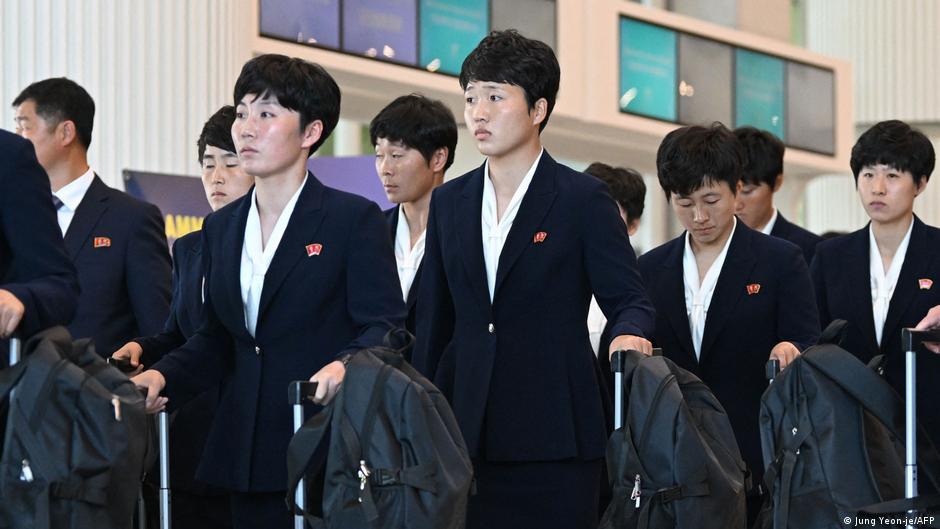
North Korea’s Naegohyang Women’s FC arrived at Incheon airport on Sunday, marking the first time Pyongyang has permitted athletes to travel to the South in more than seven years. The 27-strong team, which had been training in Beijing, travelled to Suwon ahead of their Asian Football Confederation Women’s Champions League semi-final against a South Korean side on May 20. The event has drawn mixed analysis from experts regarding its diplomatic significance, with some viewing it as a potential softening of tensions and others remaining skeptical given recent constitutional changes in Pyongyang.
The match occurs against a backdrop of heightened hostility, with North Korea recently rewriting its constitution to remove notions of reunification and frame the South as its "primary foe and invariable principal enemy." Victor Cha, Korea chair at the Center for Strategic and International Studies, argued that the visit is significant precisely because it contradicts North Korea’s assertion of an enemy-state declaration. He suggested the football match could demonstrate the potential to separate cultural exchanges from politics, noting that sports diplomacy has historically been an important tool of inter-Korean relations.
Despite the symbolic weight of the event, analysts caution against expecting immediate diplomatic breakthroughs. Hyobin Lee, a professor at Sogang University, described the visit as symbolically significant but limited in its potential to alter the broader strategic landscape. She noted that while the likelihood of the match becoming an immediate breakthrough is low, it allows North Korea to project an image of not being completely isolated. Lee suggested that sports exchanges offer a politically less risky method for testing limited engagement and preserving selective channels of communication with the South.
South Korean media reported that Unification Minister Chung Dong-young is considering attending the match, reflecting a degree of official interest in the event. The public response has been swift, with all 7,087 tickets made available to the general public selling out within a day. Leif-Eric Easley, a professor of international studies at Ewha Womans University, acknowledged the optimism surrounding the tournament as a positive case of people-to-people exchange, though he warned it would be premature to label it a successful instance of sports diplomacy.
Historical context suggests that previous sports exchanges have rarely led to lasting diplomatic shifts. The last time North Korean athletes competed in the South was in December 2018, following their participation in the PyeongChang Winter Olympics. That period of diplomatic thaw ultimately failed to produce lasting results, partly due to the collapse of the nuclear summit between US President Donald Trump and North Korean leader Kim Jong Un in Hanoi in 2019. Erwin Tan, a professor of international politics at Hankuk University, remained skeptical, noting that frequent past events have not led to breakthroughs and seeing no reason to view this development as signalling anything new.