New crew join Expedition 74 aboard International Space Station
Flight engineers Anna Kikina, Pyotr Dubrov, and Anil Menon launched from Kazakhstan on July 14 and are now conducting research while familiarising themselves with station systems.
Three new flight engineers have arrived at the International Space Station to join Expedition 74, marking the latest rotation of crew members for the orbiting laboratory. Anna Kikina and Pyotr Dubrov, representing Roscosmos, along with NASA astronaut Anil Menon, launched from the Baikonur Cosmodrome in Kazakhstan on July 14, 2026.
The trio arrived at the station later on the same day, beginning a planned mission duration of eight-and-a-half months. As they settle into their new environment, the crew is balancing immediate operational requirements with long-term scientific objectives, a standard procedure for new arrivals to the orbiting facility.
According to a news release from NASA, the astronauts are currently in the second week of their mission. During this initial period, they are conducting space research while simultaneously familiarising themselves with living and working conditions aboard the station. This dual focus ensures that crew members can safely integrate their new skills into ongoing experiments without compromising station operations.
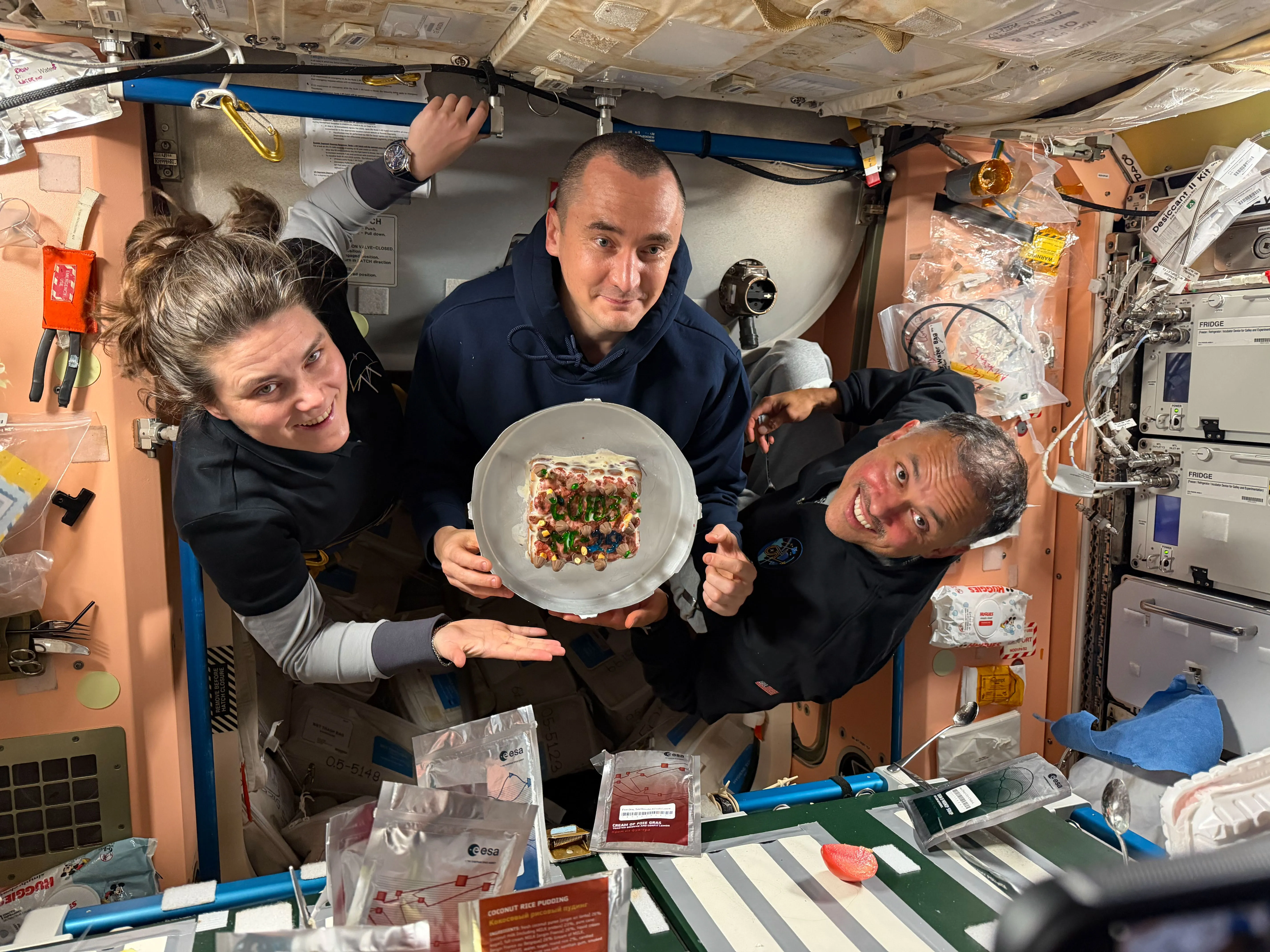
A photograph taken on July 18, 2026, shows the three crew members holding a cake to celebrate their arrival. The image captures the traditional welcome aboard the space station, highlighting the collaborative nature of the mission between international partners Roscosmos and NASA.
The arrival adds to the continuous human presence on the International Space Station, which relies on rotating crews to maintain its systems and conduct a wide array of scientific experiments. The crew will remain in orbit until their mission concludes in late 2026, contributing to the ongoing scientific output of the programme.