NASA’s TESS Satellite Unveils Most Complete Map of the Starry Sky
The Transiting Exoplanet Survey Satellite has released a mosaic combining 96 sectors observed between 2018 and 2025, highlighting nearly 6,000 locations of confirmed or candidate exoplanets.
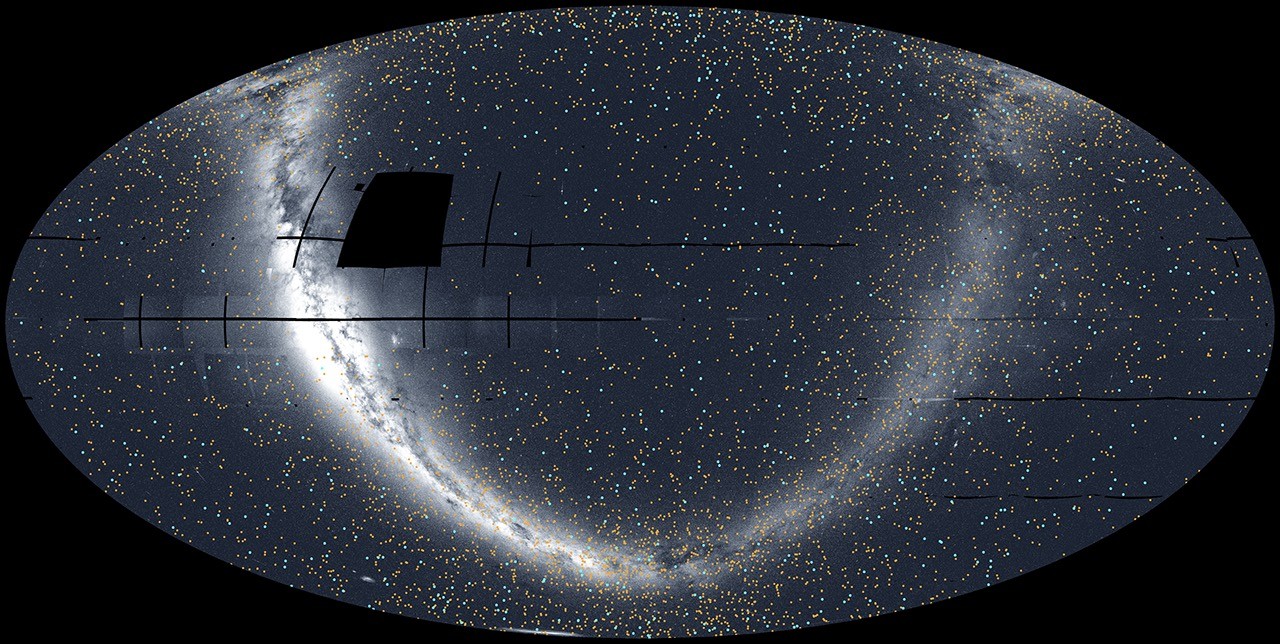
NASA’s Transiting Exoplanet Survey Satellite (TESS) has released its most comprehensive map of the night sky to date, marking the conclusion of its second extended mission. The new mosaic combines 96 sectors observed between April 2018 and September 2025, filling in observational gaps left by previous surveys. The image visualises the locations of nearly 6,000 exoplanets, comprising nearly 700 confirmed worlds and over 5,000 candidates identified by the mission as of September 2025.
The dataset contributes to a global total of over 6,270 confirmed exoplanets, supplementing data from NASA’s retired Kepler Space Telescope and other facilities. In the mosaic, blue dots mark the locations of nearly 700 confirmed planets, while orange dots represent more than 5,000 candidates awaiting verification. These confirmed worlds include diverse types such as Mercury-like planets, Jupiter-sized giants, volcanic worlds, and those orbiting two stars, which experience double sunrises and sunsets.
TESS operates by scanning wide swathes of the sky, known as sectors, for approximately one month at a time using four cameras. This method allows the spacecraft to track brightness variations in tens of thousands of stars, detecting dips in light caused by orbiting planets. The mission has identified planets of varying sizes, including some located within habitable zones where liquid water might be possible on the surface.
Rebekah Hounsell, a TESS associate project scientist at the University of Maryland Baltimore County and NASA’s Goddard Space Flight Center, described the mission’s output as a “fire hose of exoplanet science.” She noted that the data has helped astronomers find planets ranging from tiny Mercury-like ones to those larger than Jupiter, providing critical information for the search for life beyond Earth.
Beyond planet hunting, the mission is utilising automated algorithms to uncover further surprises in the dataset. Scientists are using the data to study stellar rivers, observe dynamic galactic behaviour, and monitor near-Earth asteroids. The mosaic also captures the bright plane of the Milky Way galaxy and the Large and Small Magellanic Clouds, satellite galaxies located 160,000 and 200,000 light-years away respectively.
Allison Youngblood, the TESS project scientist at NASA Goddard, stated that digging into the large dataset continues to reveal unexpected findings. She highlighted that as TESS fills in more of the night sky, the scope for future discoveries remains broad, extending from planetary systems to the behaviour of stars and asteroids within our own solar system.
The public is invited to participate in the Planet Hunters TESS citizen science project, which allows individuals to assist in verifying candidates by analysing light curves. This initiative enables volunteers to read plots of light data from distant stars to identify telltale signals from orbiting exoplanets, contributing to the ongoing verification process for the thousands of candidates identified by the satellite.