NASA’s Roman Space Telescope mirror passes final inspection ahead of September launch
Engineers at Goddard Space Flight Center verify the 2.4-metre primary mirror’s alignment and coating integrity, clearing the way for the observatory’s shipment to Florida.
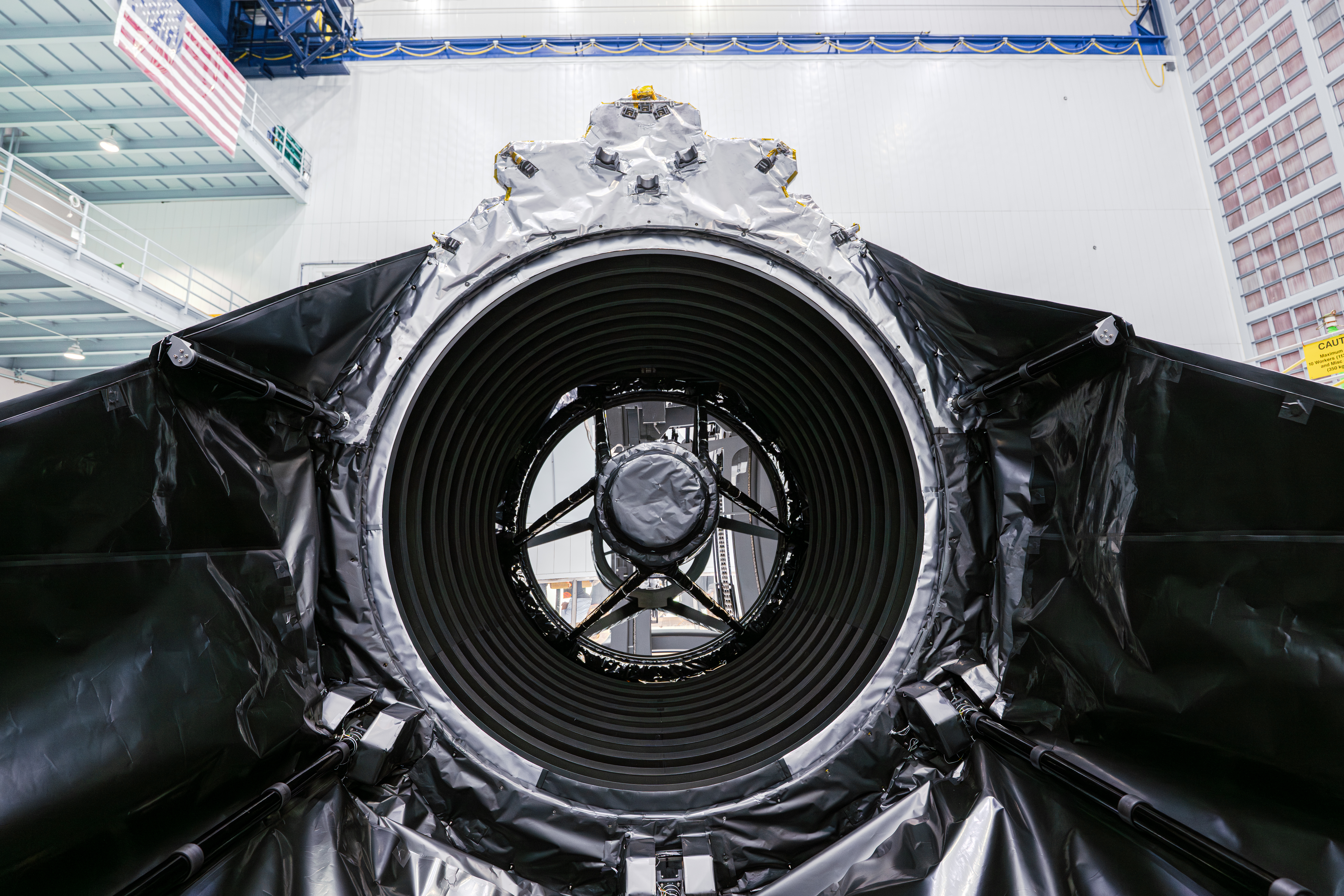
Engineers at NASA’s Goddard Space Flight Center in Greenbelt, Maryland, have completed the final inspection of the primary mirror for the Nancy Grace Roman Space Telescope. The 2.4-metre mirror passed all checks with no defects, confirming proper alignment and coating integrity. The observatory is now scheduled to be shipped to the Kennedy Space Center in Florida for an early September launch.
On May 20, engineers turned the Roman observatory onto its side and deployed a protective hood that will be stowed for launch. The team then conducted a meticulous visual inspection to ensure no specks fell onto the mirrors during testing. Bente Eegholm, optics lead for Roman’s Optical Telescope Assembly at NASA Goddard, said the team used a high-resolution camera with a powerful zoom lens to perform a multi-purpose inspection.
The mirror is made of specialty ultralow-expansion glass to resist flexing during temperature changes between Earth and space. It is coated with a layer of silver less than 400 nanometers thick, chosen for its ability to reflect near-infrared light. This differs from the Hubble Space Telescope, which uses aluminium and magnesium fluoride, and the James Webb Space Telescope, which uses gold.
The mirror’s surface has an average bump height of only 1.2 nanometers, which is more than twice as smooth as the mission requires. The team confirmed the optics along the path to the Wide Field Instrument detector array remain in proper alignment following the observatory shake test.
J. Scott Smith, the Roman telescope manager at NASA Goddard, described the moment as a culmination of hard work from dedicated individuals and partner organizations, including L3Harris. NASA expects the mission to begin returning cosmic vistas within several months after launch.