NASA’s PUEO Balloon Mission Completes Antarctic Flight to Probe Extreme Universe
The inaugural mission of NASA’s Astrophysics Pioneers Program has returned to Earth, carrying data that could reveal the origins of ultra-high energy neutrinos and cosmic rays.
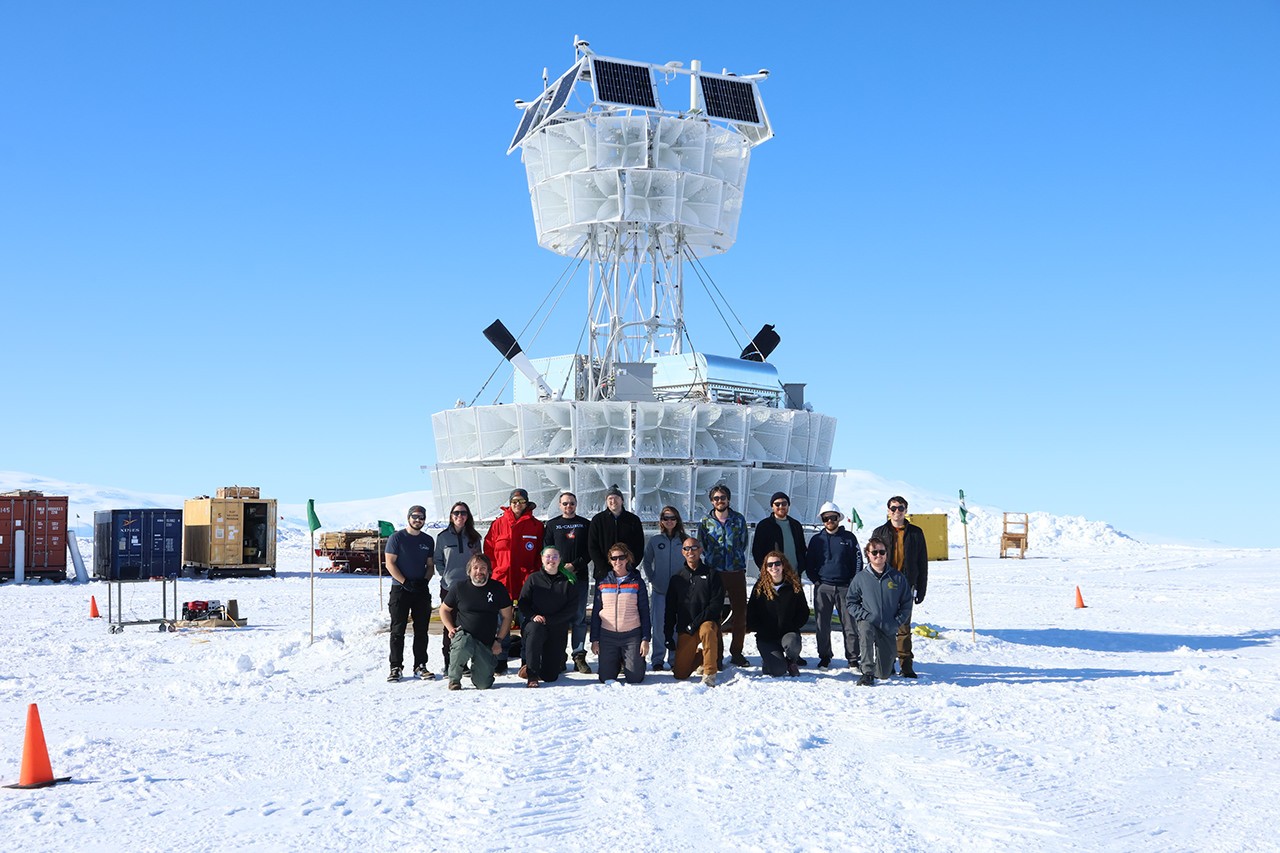
The Payload for Ultrahigh Energy Observations (PUEO), the first mission in NASA’s Astrophysics Pioneers Program, has completed its 23-day flight above Antarctica. Launched on 20 December 2025 from NASA’s Long Duration Balloon Facility near McMurdo Station, the Long Duration Balloon (LDB) mission has landed approximately 120 miles (200 km) from the South Pole. The full payload, including the critical data drives, has been recovered and is now in the possession of the science team.
PUEO utilised the Antarctic ice sheet as an enormous detection volume to search for radio signals generated by ultra-high energy astrophysical neutrinos and high-energy cosmic rays. As these rare particles interact with the ice or shower in Earth’s atmosphere, they emit radio signals that the instrument detected. The mission aims to identify the sources of these particles, which originate from extreme cosmic environments such as supermassive black holes and neutron star mergers. Because these particles travel in straight lines without being absorbed, they offer a unique view of the distant, most energetic universe.
The mission represents a significant technological evolution from its predecessor, the NASA-sponsored Antarctic Impulsive Transient Antenna (ANITA) mission, which conducted four successful flights between 2006 and 2016. PUEO achieved improved sensitivity through the implementation of a new interferometric phased array trigger. This system coherently sums signals from multiple antennas in real time, allowing the instrument to detect weaker signals by lowering the trigger threshold and digging deeper into background noise.
Additional hardware upgrades included doubling the antenna collecting area for frequencies above 300 MHz compared to ANITA. To accommodate the payload within the balloon platform’s constrained launch volume, the team increased the low-frequency cutoff of the antennas, enabling them to be smaller. Furthermore, PUEO incorporated a new low-frequency instrument that deployed once the payload reached float altitude. This instrument features antennas sensitive down to 50 MHz, extending the mission’s sensitivity to extensive air showers produced by cosmic rays.
The PUEO team, led by Dr Abigail Vieregg, David N. Schramm Director of the Kavli Institute for Cosmological Physics at the University of Chicago, is currently analysing the collected data. This process is expected to take up to a year due to the complexity of the task. The data analysis will not only help reveal the origin and composition of the highest-energy cosmic rays but also test fundamental physics at energies far beyond those achievable in human-made particle accelerators on Earth.
Many of the technology advancements developed for PUEO may be applicable to future mission concepts that propose using lunar regolith as a detector for ultra-high energy cosmic rays, as well as other potential radio missions on the moon. The mission was sponsored by the NASA Astrophysics Division Pioneers Program, with Dr Vieregg assisted by graduate student Rachel Scrandis.