NASA’s Psyche spacecraft captures natural-colour images of Mars during gravity assist flyby
Newly released imagery from May 15, 2026, reveals wind streaks and impact craters in the Syrtis Major region, while calibration efforts leverage data from multiple orbital and surface missions.
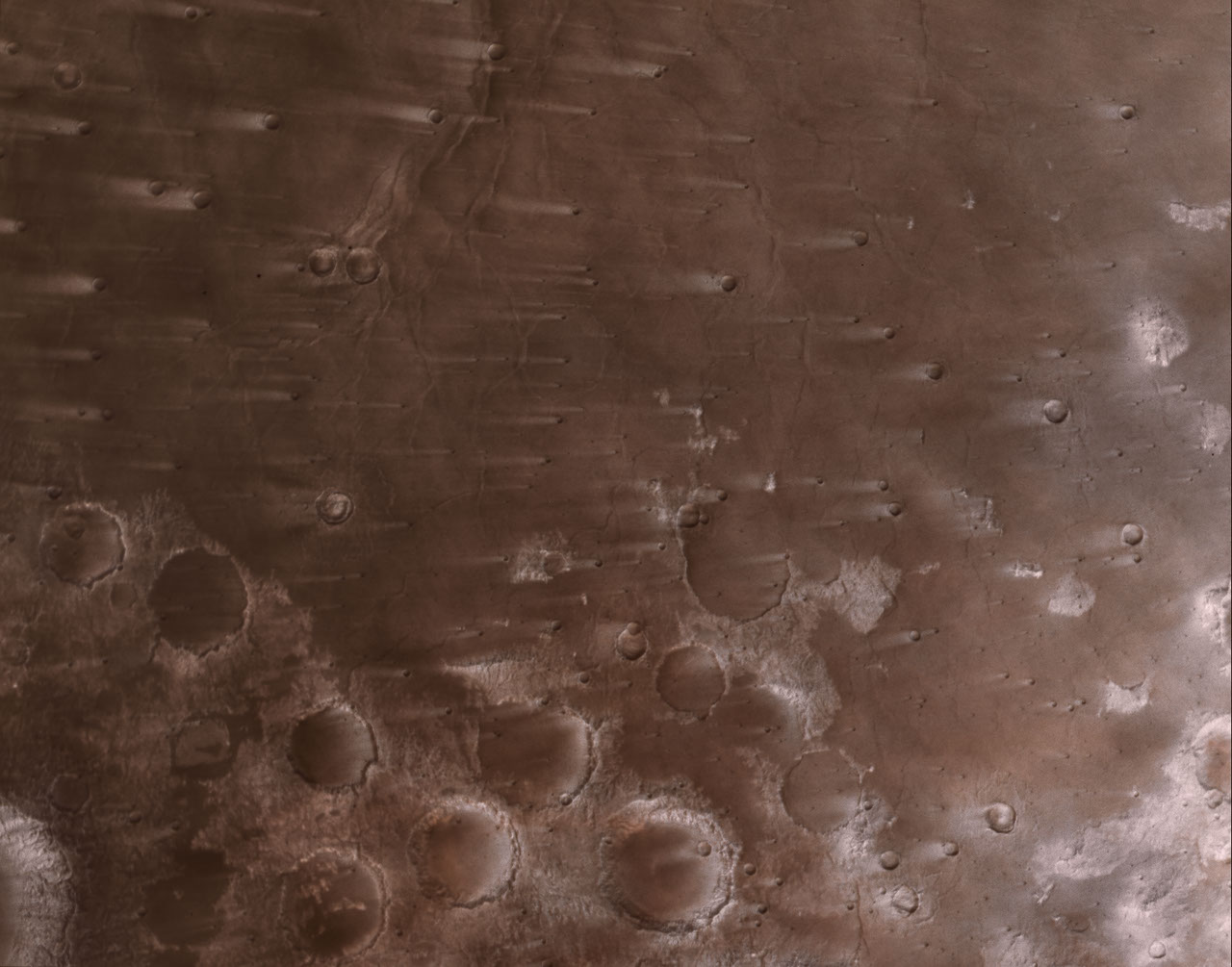
NASA’s Psyche spacecraft captured detailed images of the Martian surface on 15 May 2026 during a close approach within 2,864 miles (4,609 kilometres) of the planet. The flyby served as a critical gravity assist maneuver, allowing the spacecraft to adjust its orbital plane and increase its speed without consuming onboard propellant. This trajectory correction sets the mission on its direct course toward its primary destination: the metal-rich asteroid Psyche.
The released imagery provides a natural-colour view of the Syrtis Major region, processed using red, green, and blue data from the spacecraft’s imager filters to approximate human vision. The image scale is recorded at nearly 1,200 feet (360 metres) per pixel. Within the frame, wind streaks formed by atmospheric activity extend up to 50 kilometres in length, sweeping over impact craters that average 30 kilometres in diameter.
Calibration for the flyby images relied on complementary data from a network of existing missions. NASA’s Perseverance rover, Mars Reconnaissance Orbiter, 2001 Mars Odyssey orbiter, and Curiosity rover provided surface and atmospheric imaging alongside navigation data. European Space Agency missions also contributed to the calibration efforts, ensuring the accuracy of the new observations.
The successful flyby highlights the operational efficiency of the current mission architecture. By utilising a gravity assist, Psyche achieved necessary trajectory adjustments without propellant expenditure, a strategy that conserves resources for the long journey ahead. The spacecraft is now proceeding toward the asteroid, carrying instruments designed to study its unique metallic composition.
This event occurs against a broader backdrop of NASA’s strategic shifts in mission management. The agency is currently investigating methods to reduce operating costs for legacy missions, potentially through the use of artificial intelligence to combine operations. Simultaneously, NASA is exploring the use of mass-produced satellites for future science missions to boost frequency and efficiency, while maintaining custom-built spacecraft for ambitious targets such as interstellar probes.