NASA’s Psyche spacecraft captures enhanced view of Mars’ Huygens crater
The image, acquired shortly after the spacecraft’s closest approach to the planet, highlights variations in dust, sand, and bedrock within the 470-kilometre-diameter crater.
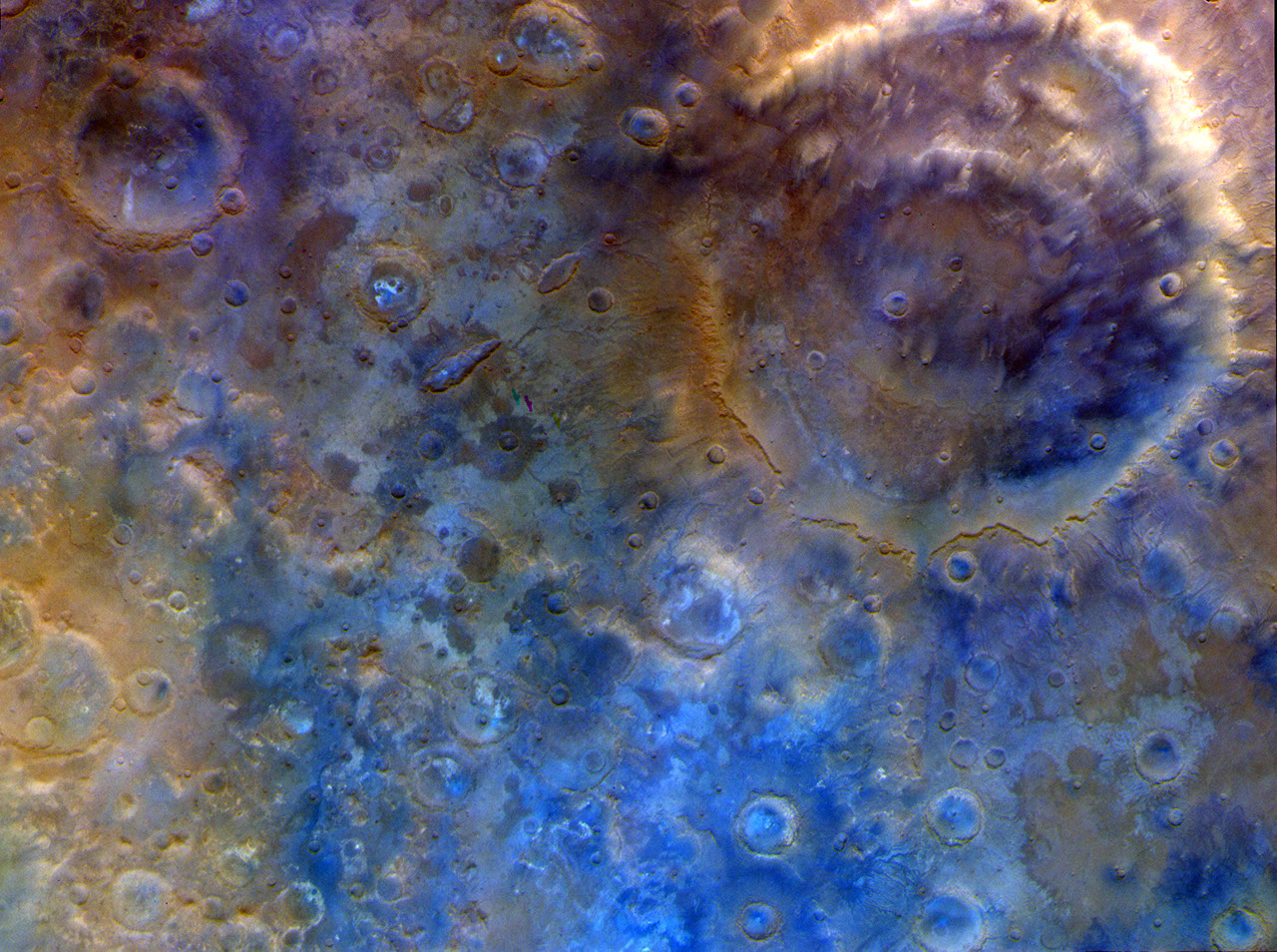
NASA’s Psyche mission has returned an enhanced-colour image of Mars’ Huygens crater, captured using the spacecraft’s multispectral imager. The image was acquired on May 15, 2026, at approximately 1:18 p.m. PDT, shortly after the spacecraft’s closest approach to the planet. It depicts the 470-kilometre-diameter double-ring crater and the surrounding heavily cratered southern highlands near 15 degrees south latitude.
The view, processed using red, green, and blue data from imager filters, highlights compositional differences in dust, sand, and bedrock within this ancient terrain. According to NASA, the various colours in the scene are likely due to differences in the compositional properties of these materials. The image scale is approximately 2,200 feet (670 meters) per pixel.
Huygens crater is located in the upper left of the enhanced view. The enhanced-colour processing was designed to bring out colour details beyond what the human eye can see, allowing for a clearer distinction between surface materials. The image was acquired with Imager A on the Psyche mission’s multispectral imager.
This flyby served as a calibration opportunity for the spacecraft, which is en route to a metal-rich asteroid. Other missions provided complementary surface and atmospheric imaging as well as navigation data to assist with calibration efforts. These included NASA’s Perseverance rover, the Mars Reconnaissance Orbiter, the 2001 Mars Odyssey orbiter, and the Curiosity rover.
ESA’s missions were also involved in the calibration efforts during the flyby. Bell, who leads the Mastcam-Z imaging investigation on NASA’s Perseverance Mars rover mission team, noted the collaborative nature of the data collection. The enhanced image provides a detailed look at the Martian surface as Psyche continues its journey to its primary destination.
For more information about NASA’s Psyche mission, visit the NASA Science website. The mission continues to gather data as it travels through the solar system, with this flyby marking a significant step in its calibration and navigation procedures.