NASA’s Perseverance Rover Reaches Ancient ‘Broom Point’ on Mars
The Perseverance rover has arrived at a site dubbed the “Broom Point member,” where it will examine a thick sequence of layered bedrock formed by high-energy asteroid impacts.
NASA’s Perseverance Mars rover has reached a location on the outer edge of Jezero Crater’s rim that the science team has designated the “Broom Point member.” The site features a sequence of layered bedrock estimated to be more than 3.9 billion years old, representing some of the oldest terrain examined by a Mars rover.
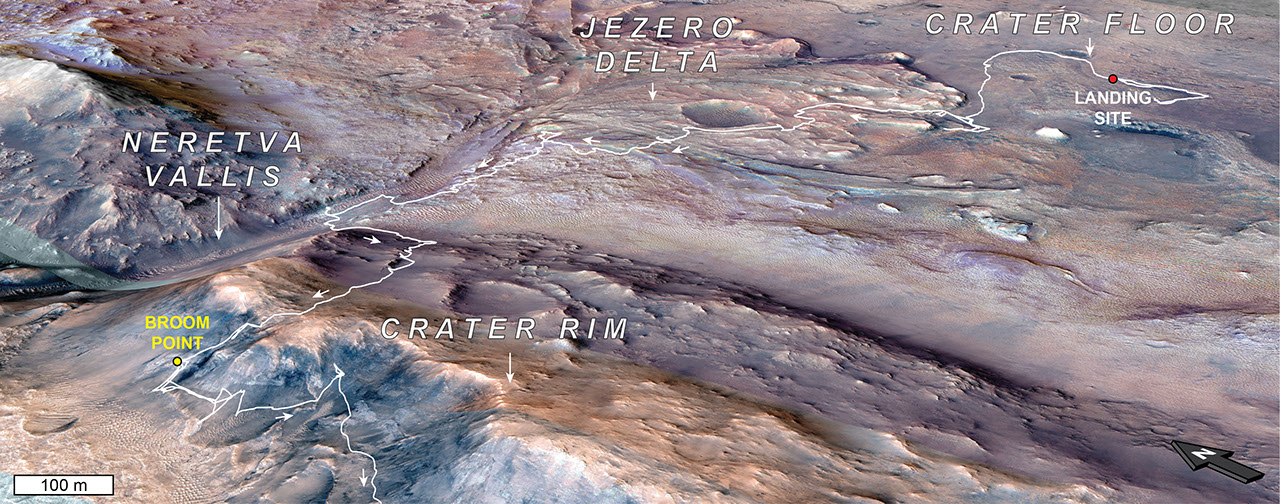
An orbital map released by NASA illustrates the rover’s path to this destination, with a yellow dot marking the location where the rover captured a selfie. The Broom Point region is situated on the crater’s outer rim and was visited by the rover in mid-2025, following its ascent of the crater rim in December 2024.
The rover’s journey to this high-altitude site involved a significant climb of 2,620 feet (800 meters) from the crater floor to the crest. Prior to this summit, Perseverance investigated the western delta and the inlet river valley known as Neretva Vallis after landing inside Jezero Crater on 18 February 2021.
Historical context indicates that the Broom Point member consists of a 75-metre-thick sequence of ancient rock formed by repeated asteroid impacts over 3.9 billion years ago. The rock contains breccias and glassy beads indicative of high-energy impacts rather than volcanic activity. Fragments within the breccias show gas-bubble cavities, suggesting they were once molten, while tiny, dark glassy beads rival those ejected by the Chicxulub asteroid impact on Earth.
NASA’s Jet Propulsion Laboratory, which is managed for the agency by Caltech in Pasadena, California, built and manages operations of the Perseverance rover. The Mars Reconnaissance Orbiter, which captured the orbital map used to track the rover’s path, is also managed by JPL. Lockheed Martin Space built the orbiter, while the University of Arizona operates its HiRISE camera, which was constructed by Ball Aerospace & Technologies Corp.
Arizona State University leads the operations of the Mastcam-Z instrument on the rover, collaborating with Malin Space Science Systems and the Niels Bohr Institute of the University of Copenhagen on the design, fabrication, and testing of the cameras and calibration targets. The findings regarding the rock’s composition were published in the Journal of Geophysical Research: Planets.