NASA’s MAVEN Spacecraft Detects Rare Atmospheric Phenomenon at Mars
Data from a December 2023 solar storm reveals charged particles being squeezed along magnetic flux tubes in the Martian ionosphere, challenging previous assumptions about unmagnetised bodies.
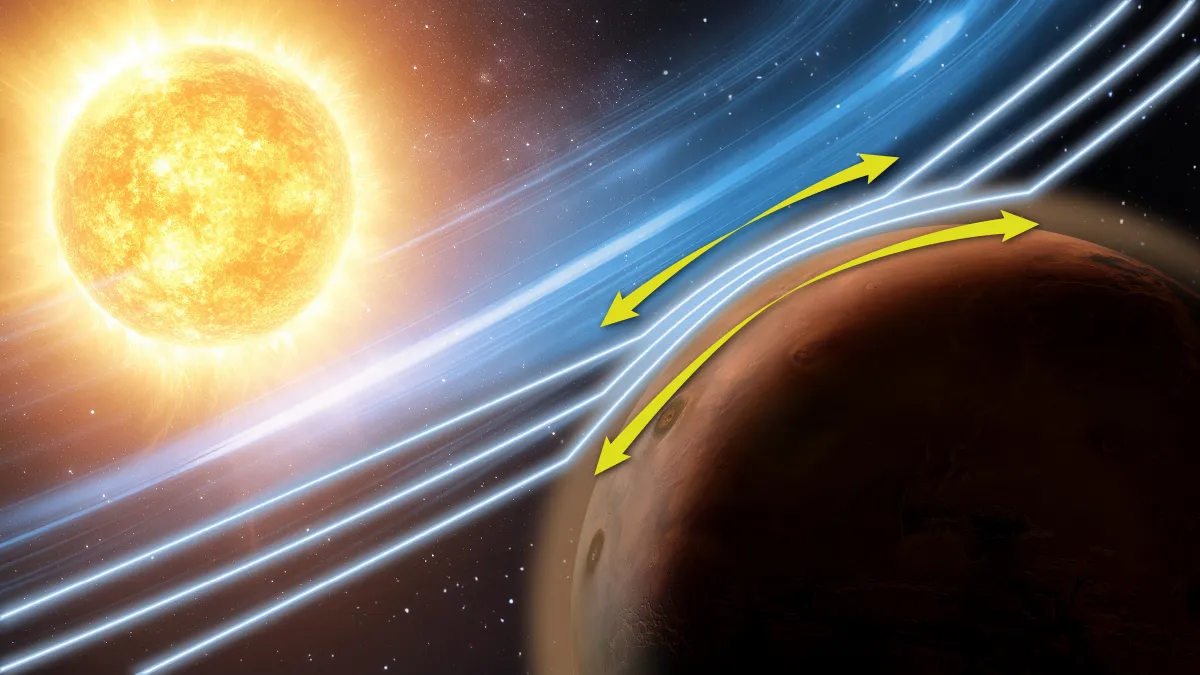
Scientists utilising data from NASA’s Mars Atmosphere and Volatile Evolution (MAVEN) mission have identified the Zwan-Wolf effect within the Martian atmosphere for the first time. Previously observed only in Earth’s magnetosphere, this phenomenon involves charged particles being squeezed along magnetic flux tubes. The discovery, published in Nature Communications, provides new context for how space weather interacts with unmagnetised planetary bodies.
The effect was detected in data collected during a significant solar storm in December 2023. The storm amplified the phenomenon within Mars’ ionosphere, specifically below 200 km, where significant numbers of electrically charged particles are present. Lead author Christopher Fowler, a research assistant professor at West Virginia University, noted that the team initially noticed unusual fluctuations in magnetic field measurements that did not align with existing models.
Unlike Earth, Mars lacks a global magnetic field, relying instead on an induced magnetosphere generated by the solar wind interacting with its ionosphere. This induced field can change size and shape during large space weather events. The December 2023 storm provided the necessary conditions to amplify the Zwan-Wolf effect to detectable levels, suggesting the phenomenon may occur constantly at lower, undetectable intensities.
Fowler described the initial data as showing "interesting wiggles" in the magnetic field readings. After ruling out other possibilities, the team determined that the Zwan-Wolf effect explained the observed features. Shannon Curry, the principal investigator of MAVEN and a research scientist at the University of Colorado Boulder, emphasised that understanding these interactions is essential for assessing how space weather affects the planet and its potential assets.
The MAVEN spacecraft, which launched in November 2013, has been instrumental in exploring the loss of the Martian atmosphere to space. However, the mission faced a significant operational challenge on 6 December 2025, when it experienced a loss of signal with ground stations on Earth. In February 2026, NASA launched an anomaly review board to assess the spacecraft's current state and the likelihood of recovery.
This finding not only confirms the presence of the Zwan-Wolf effect in a planetary atmosphere but also highlights the importance of monitoring space weather. The research offers insights into how similar effects might occur at other unmagnetised bodies, such as Venus and Saturn’s moon Titan, and underscores the dynamic nature of the Martian environment.
The MAVEN mission is part of NASA’s Mars Exploration Program portfolio. The mission’s principal investigator is based at the Laboratory for Atmospheric and Space Physics at the University of Colorado Boulder, which manages science operations and public outreach. NASA’s Goddard Space Flight Center in Greenbelt, Maryland, manages the MAVEN mission, while Lockheed Martin Space built the spacecraft and handles mission operations. NASA’s Jet Propulsion Laboratory in Southern California provides navigation and Deep Space Network support.