NASA’s MAVEN mission reveals miniature Dungey cycle drives Martian auroras
Scientists have confirmed that the same process powering Earth’s auroras operates on a smaller scale at Mars, offering new insights into planetary evolution and solar interactions.
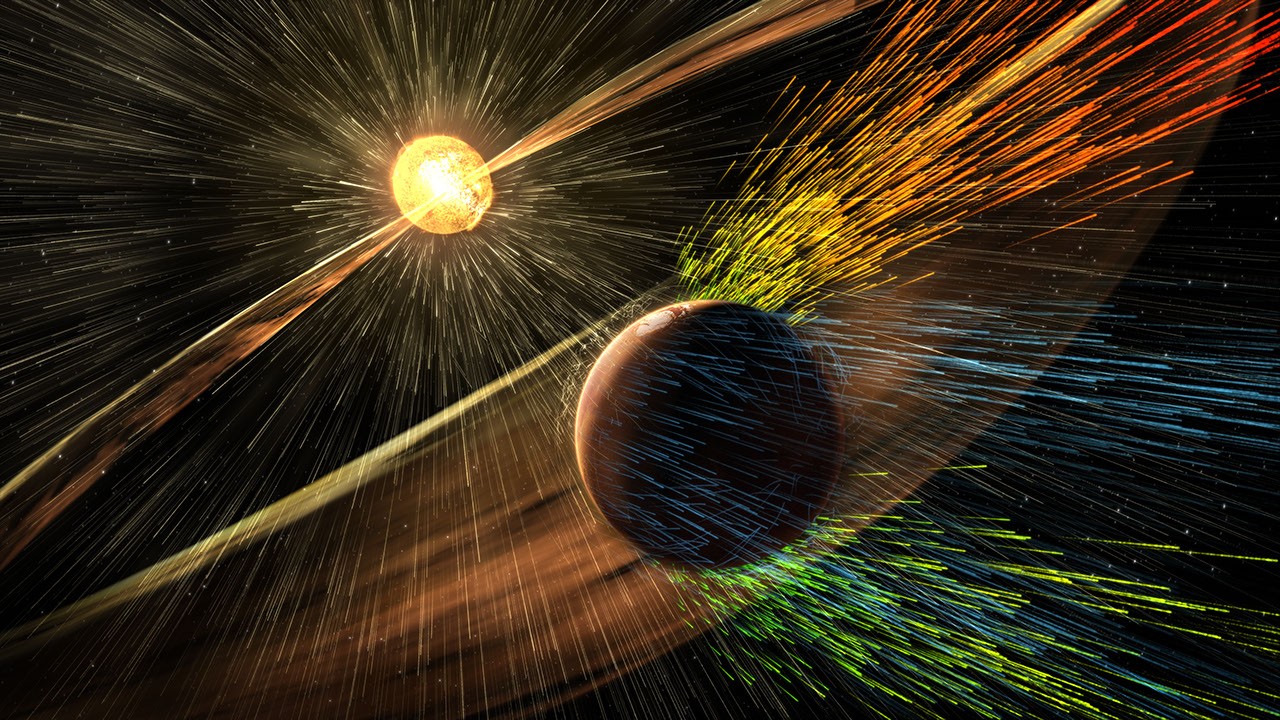
Scientists from NASA’s Mars Atmosphere and Volatile Evolution (MAVEN) mission have identified that Martian auroras are generated by a miniature version of the Dungey cycle, the magnetic reconnection process previously understood to drive auroras on Earth. The findings, published in Nature Communications, indicate that this mechanism occurs over Mars’ localized crustal magnetic fields, despite the planet lacking a global magnetic field.
The study utilised data from MAVEN’s Magnetometer, Solar Wind Electron Analyzer, and STATIC (Suprathermal and Thermal Ion Composition) instruments to map magnetic configurations, derive electrical currents, and measure plasma flows. Lead author Shaosui Xu, an associate research physicist at the University of California, Berkeley, noted that while magnetic reconnection was known to occur at Mars, the specific resemblance to the Earth’s cycle was unexpected.
Mars does not possess a global magnetic field like Earth, which is generated by its churning core. Instead, the Red Planet has numerous miniature magnetospheres arising from intensely magnetised crust scattered across its surface. These regions formed around 4 billion years ago when lava cooled in the presence of Mars’ ancient global magnetic field, which has since disappeared due to intense solar wind stripping the planet’s atmosphere.
The MAVEN spacecraft, which experienced a loss of signal with ground stations on Earth on 6 December 2025 and was declared unrecoverable on 3 June, provided the critical data needed to understand these localized auroras. The instruments allowed scientists to determine how electrons were energised to create the auroras, confirming that a Dungey-like mechanism can happen on both large and small scales.
Principal Investigator Shannon Curry, a research scientist at the University of Colorado Boulder, stated that the result changes the understanding of Martian auroras and offers insight into why Mars and Earth evolved differently despite similar underlying physics. The discovery aids in understanding solar environment interactions, which is essential for planning future robotic and crewed missions to Mars.
The MAVEN mission is part of NASA’s Mars Exploration Program portfolio. NASA’s Goddard Space Flight Center manages the mission, while Lockheed Martin Space built the spacecraft and is responsible for mission operations. NASA’s Jet Propulsion Laboratory in Southern California provides navigation and Deep Space Network support.