NASA’s Juno spacecraft maps thermal emissions from Jupiter’s moon Io
Two close flybys in late 2023 and early 2024 provide detailed thermal mapping of the volcanic moon’s northern and equatorial regions.
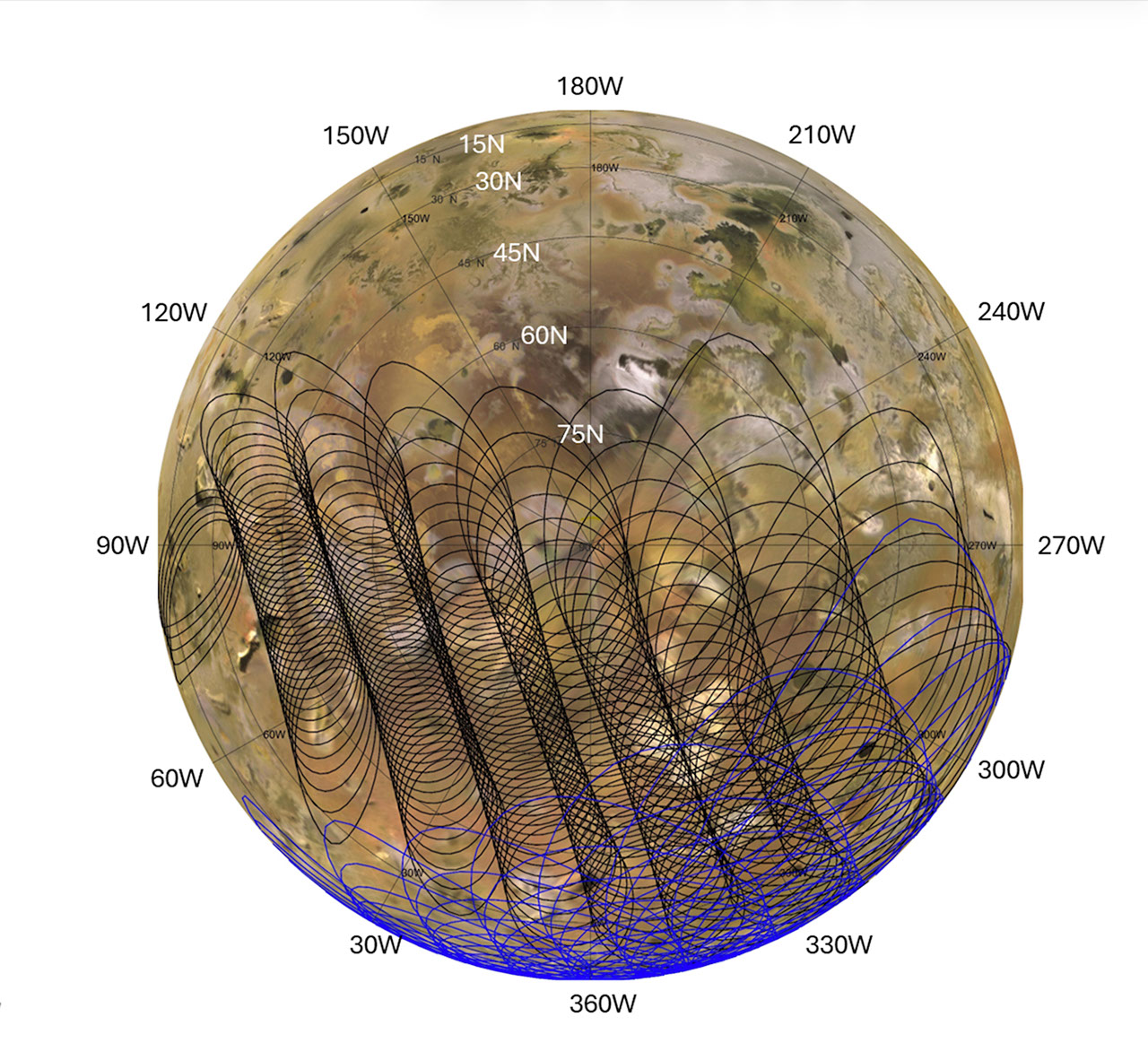
NASA’s Juno spacecraft has successfully mapped thermal emissions from Jupiter’s moon Io using its Microwave Radiometer (MWR) instrument during two close flybys in late 2023 and early 2024. The data collection focused on the hemisphere of Io that is tidally locked to face Jupiter, capturing sweeping, overlapping patterns created by the spacecraft’s rotation.
Perijove 57, conducted on 30 December 2023, primarily mapped the northern hemisphere of the moon. This was followed by Perijove 58 on 3 February 2024, which concentrated on Io’s mid-latitudes and equatorial regions. Both passes sampled the same side of the moon, ensuring consistent coverage of the hemisphere constantly oriented toward Jupiter.
During these operations, the spacecraft flew at a distance of approximately 1,500 kilometres (930 miles) from the moon’s surface. The sweeping footprints of the MWR instrument were generated as Juno spun at two revolutions per minute, allowing the radiometer to sample thermal data across the targeted latitudes.
Io is a moon of Jupiter known for its intense volcanic activity, which generates significant internal heat. The MWR instrument is designed to detect this thermal energy, providing insights into the moon’s internal structure and volcanic processes. The data collected during these flybys adds to the understanding of the thermal dynamics driving Io’s surface activity.
The Juno mission is managed by NASA’s Jet Propulsion Laboratory (JPL), a division of Caltech in Pasadena, California, for principal investigator Scott Bolton of the Southwest Research Institute in San Antonio. JPL also built the Microwave Radiometer instrument. The Juno spacecraft was built and operates by Lockheed Martin Space in Denver.
Juno is part of NASA’s New Frontiers Program, which is managed at the Marshall Space Flight Center in Huntsville, Alabama, for the agency’s Science Mission Directorate in Washington. Further information about the mission is available through NASA’s official channels.