NASA’s Fermi Telescope Confirms First Gamma-Ray Detection from Superluminous Supernova
International team using 16 years of data identifies magnetar as power source for exceptionally bright supernova, marking a milestone in high-energy astronomy.
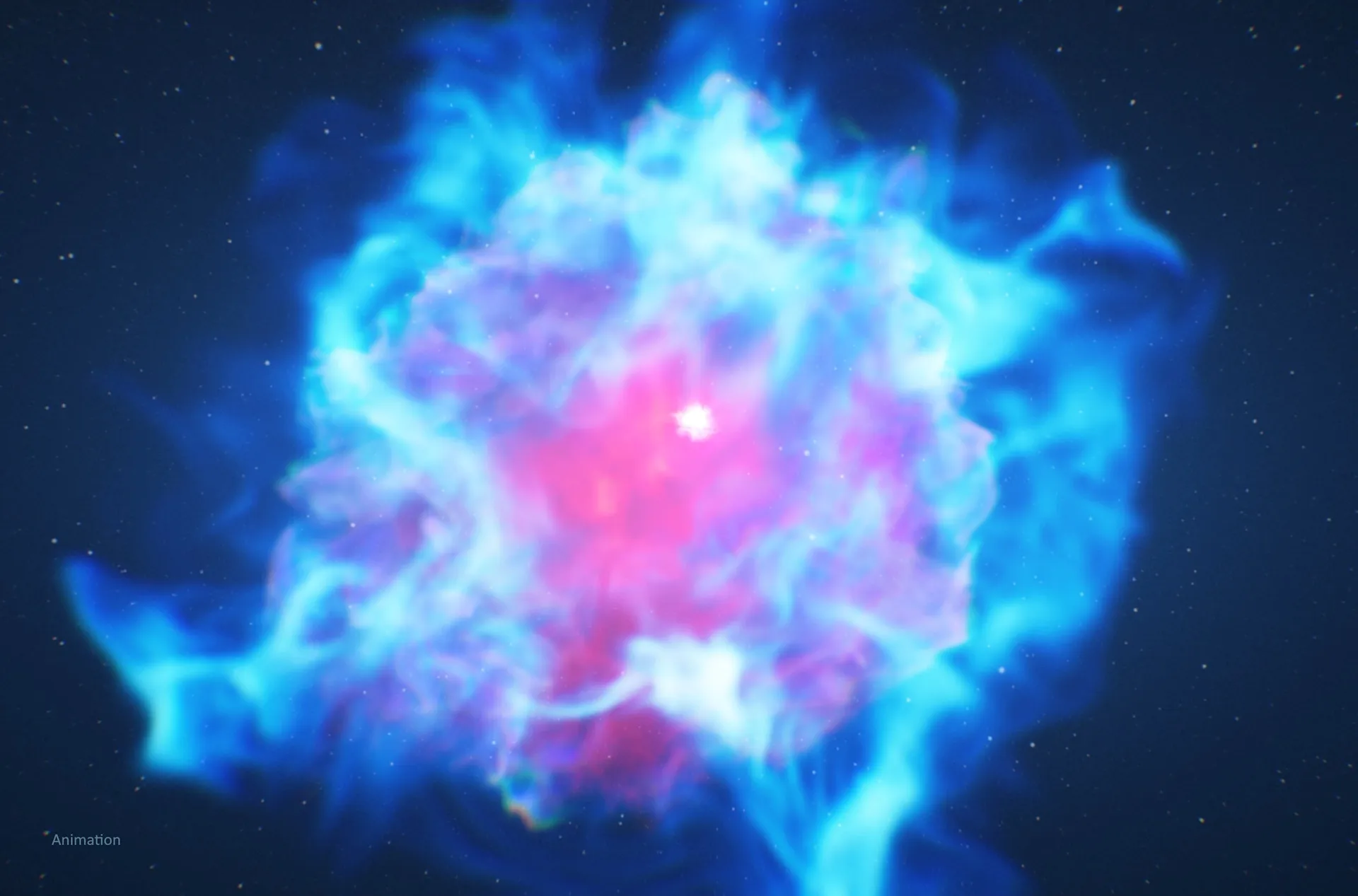
An international team of astronomers has confirmed the first definitive detection of gamma rays from a superluminous supernova, resolving a search that has occupied Fermi mission scientists for nearly 20 years. The study, published in Astronomy & Astrophysics, utilises data from the first 16 years of NASA’s Fermi Gamma-ray Space Telescope mission to analyse the rare event known as SN 2017egm. Located in the galaxy NGC 3191 approximately 440 million light-years away in the constellation Ursa Major, the supernova’s exceptional luminosity is now understood to be powered by a magnetar, a supermagnetised neutron star formed during the stellar collapse.
Core-collapse supernovae occur when the energy-producing centre of a massive star runs out of fuel and explodes. While nearly 400 exceptional core-collapse events have been identified in recent decades, superluminous supernovae produce 10 or more times the visible light of standard explosions. Guillem Martí-Devesa, a researcher at the Institute of Space Sciences in Barcelona, Spain, noted that the team searched for gamma rays from the six nearest superluminous supernovae observed during Fermi’s first 16 years. Only SN 2017egm showed evidence for gamma rays, confirming earlier hints that some supernovae can be as luminous in gamma rays as they are in visible light.
The findings suggest that the supernova’s power source is a magnetar, a type of neutron star with magnetic fields up to 1,000 times stronger than typical neutron stars. A theoretical model developed by Indrek Vurm of the University of Tartu and Brian Metzger of Columbia University traced how light and particles from a newborn magnetar interact with the supernova’s expanding debris. The model indicates that gamma rays produced in the magnetar wind nebula are reprocessed into lower-energy visible light, boosting the supernova’s luminosity. This reprocessing explains the intense brightness observed in the visible spectrum.
Gamma rays began to leak out from the debris about three months after the collapse, a timing that the magnetar model best reproduces. Fabio Acero of the French National Centre for Scientific Research and the University of Paris-Saclay, who led the study, stated that while the model accurately reproduces the supernova’s luminosity and the arrival time of its gamma rays during the first months, there is room for improvement at later times. The team suggests that additional processes, such as debris falling back onto the magnetar and interactions with matter ejected by the star centuries prior, likely contributed to the supernova’s irregular fade-out.
The research also examined the capabilities of future ground-based facilities, such as the Cerenkov Telescope Array Observatory. Simulations indicate that with approximately 50 hours of observing time, a similar supernova could be detected out to about 500 million light-years. Judy Racusin, a deputy project scientist for the Fermi mission at NASA’s Goddard Space Flight Center, noted that observing gamma rays from supernovae provides a new way to explore their inner workings, building upon observational and theoretical advances in magnetar research over the last 20 years.