NASA’s AI model predicts solar storms 12 hours before they appear
New research published in the Journal of Geophysical Research: Machine Learning and Computation details a sliding-window transformer architecture capable of identifying subtle changes in the Sun’s acoustic waves and magnetic fields.
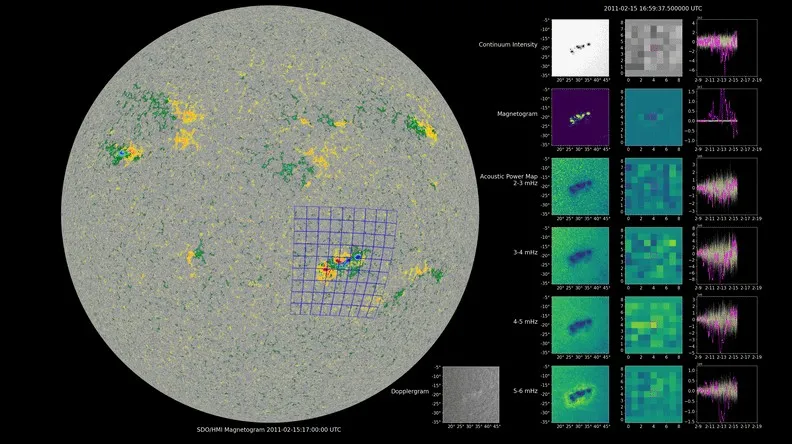
A team of researchers from NASA’s COFFIES (Consequence Of Fields and Flows in the Interior and Exterior of the Sun) DRIVE Science Center has developed a machine-learning model capable of predicting the emergence of active regions on the Sun up to 12 hours before they become visible on the solar surface. The research, published in the Journal of Geophysical Research: Machine Learning and Computation, utilises a sliding-window transformer architecture to analyse data from the Solar Dynamics Observatory.
Active regions are visible manifestations of intense magnetic fields that form sunspots and serve as the primary drivers of severe space weather events, including solar flares and coronal mass ejections. These eruptions send high-energy radiation and charged particles across space, posing risks to astronauts, satellites, and radio communications on Earth. By identifying these regions before they breach the surface, the model aims to provide early warnings for space weather forecasting.
The model detects subtle reductions in the Sun’s acoustic activity and magnetic fields beneath the solar surface. Alexander Kosovichev, a COFFIES co-investigator at the New Jersey Institute of Technology, explained that the technique looks for indirect effects of magnetic structures rising through the solar interior. He described the detection of these precursors as identifying a slight change in rhythm within the Sun’s acoustic power, akin to noticing a shift in a noisy orchestra.
The COFFIES team, comprising researchers from the New Jersey Institute of Technology, Princeton University, and NASA’s Ames Research Center, utilised NASA Ames’ supercomputing resources to process long sequences of data. Unlike previous deep learning approaches that view all solar activity simultaneously, this new model moves a fixed-size viewing window across a timeline of activity. This allows the system to focus on recent data while retaining memory of overall patterns, enabling the prediction of approximate sunspot locations rather than relying on counting already visible spots.
Currently, operational forecasts by the National Oceanic and Atmospheric Administration’s Space Weather Prediction Center and the US Air Force monitor active regions only after they are visible on the Sun. Michelangelo Romano, deputy director of NASA’s Moon to Mars Space Weather Analysis Office, stated that the model could provide new capabilities for predicting potential flaring locations ahead of time, offering additional support for NASA missions such as Artemis and future crewed missions to Mars.
While the model shows promise, it is not yet ready for operational real-time forecasting. The team plans to validate the approach across many more known solar events to fine-tune the system. The research highlights the potential of deep machine learning in heliophysics, contributing to the broader understanding of the Sun’s 11-year activity cycle and improving tools for safeguarding deep-space explorers.