NASA Study Reveals Ancient Brines in Pristine Hillsborough Meteorite
Findings published in Science Advances suggest salt-rich brines were widespread in primitive asteroids, offering new insights into the distribution of life’s building blocks in the early solar system.
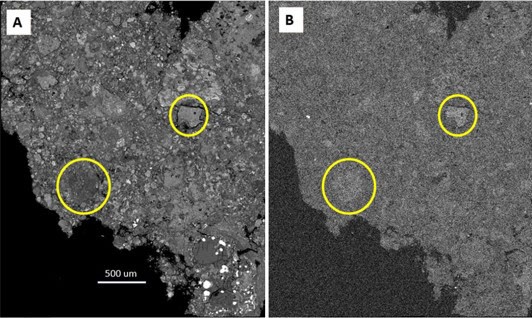
NASA scientists have published new findings in the journal Science Advances regarding the Hillsborough meteorite, which fell in New Jersey, United States, on 16 July 2024. The study reveals that ancient salty brines altered minerals within the meteorite’s parent asteroid, preserving unique chemical signatures that offer clues about the distribution of water and organic compounds in the early solar system.
The meteorite’s scientific value lies in its rapid recovery. An amateur astronomer in New Jersey identified the fireball and collected the fragments using protective gloves, storing them in aluminium foil and glass containers. This swift action prevented the delicate minerals and organic compounds from being altered by moisture, weather, or contamination, allowing researchers to analyse the sample in a pristine condition.
Classified as a CM carbonaceous chondrite, the Hillsborough meteorite contains complex organic compounds and amino acids comparable to those found in the Murchison meteorite, which fell in Australia in 1969. Electron microscope analysis identified microscopic fractures filled with sodium-rich material, including fragile sodium-carbonate salts left behind by ancient brines. This marks the first time such salts have been identified in a CM carbonaceous chondrite, although similar salts were found in samples from the OSIRIS-REx and Hayabusa2 missions.
Peter Jenniskens, a meteor astronomer at NASA’s Ames Research Center and the SETI Institute, noted that the documented fireball and quick recovery allowed scientists to determine the rock’s origin. The analysis suggests the meteorite likely originated from the Erigone asteroid family in the inner asteroid belt, which includes the asteroid Donaldjohanson, visited by NASA’s Lucy spacecraft in 2025.
The findings indicate that salt-rich brines were more widespread among primitive asteroids than previously recognised. Danny Glavin, a senior scientist at NASA’s Goddard Space Flight Center, described the diversity of amino acids as a surprise, reinforcing the idea that chemical building blocks of life could have been delivered to Earth by carbonaceous asteroid fragments.
Researchers continue to study the Hillsborough meteorite to understand how water transformed primitive asteroids. By tracing the history of water through the solar system, scientists aim to clarify how the chemical ingredients for life were distributed throughout the early solar system.