NASA study explores quantum method for detecting low-frequency gravitational waves
A new concept led by Brookhaven Science Associates aims to observe micro-Hertz to nano-Hertz gravitational waves without the complex optical links required by standard interferometric missions.
NASA’s Innovative Advanced Concepts (NIAC) program has selected a study led by Loura Hall of Brookhaven Science Associates to investigate a novel approach for detecting low-frequency gravitational waves. The research focuses on precision astrometry, a technique that measures the apparent motion of celestial objects, to identify the subtle signatures left by passing gravitational waves.
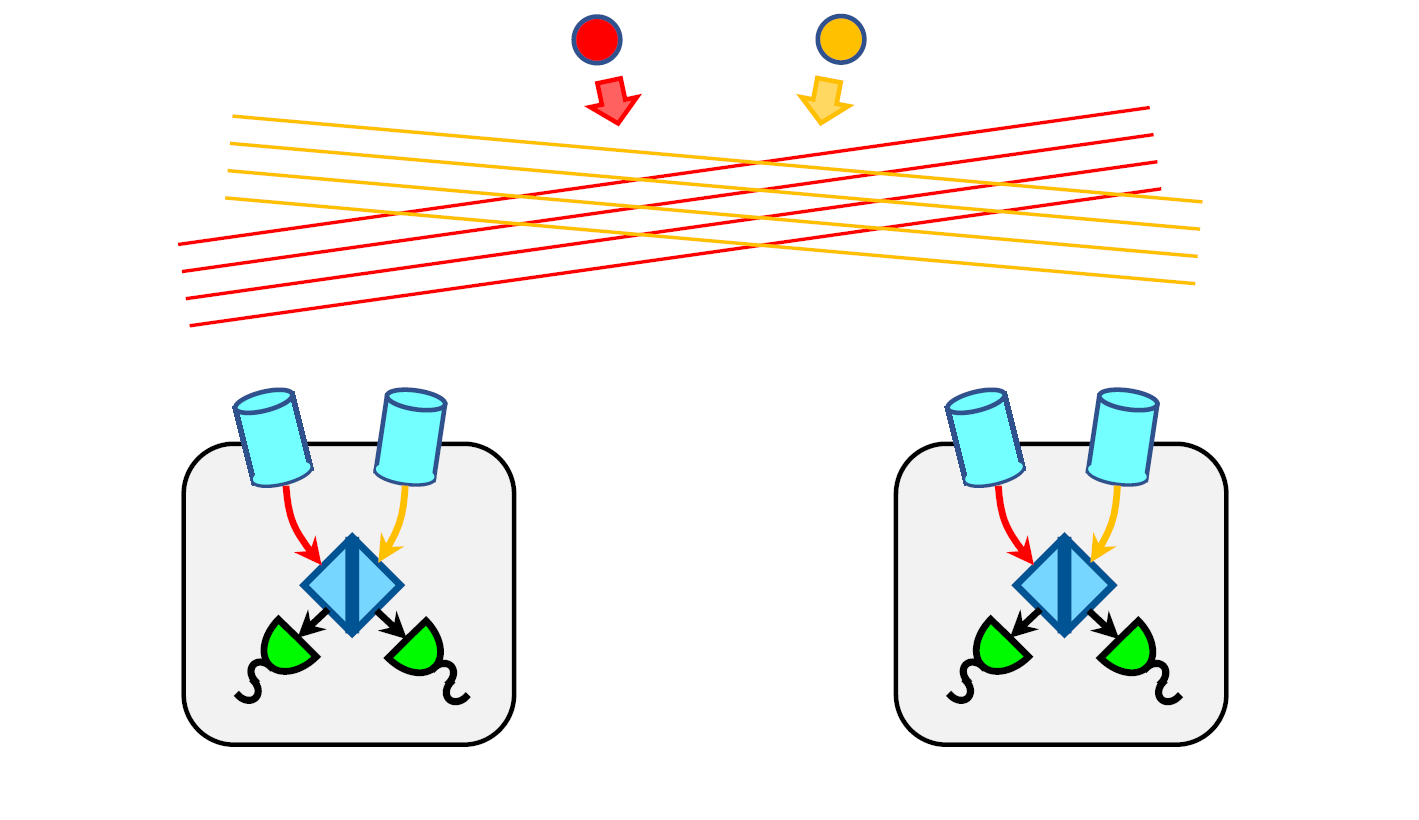
The proposed method utilises quantum mechanical two-photon interference to enable precision astrometry using two optically independent spacecraft. This design allows the stations to operate without optical connections between them, a significant departure from standard space-based interferometric designs which typically require such links. By removing the need for these connections, the concept aims to simplify spacecraft requirements and reduce mission complexity.
Gravitational waves passing near Earth cause a very small, coordinated apparent motion of all sky objects, known as the astrometric gravitational wave signature. The study proposes detecting these waves in the micro-Hertz to nano-Hertz range, a frequency band for which there are currently essentially no alternative detection approaches. The researchers note that achieving detection in this specific band would provide valuable insights into galaxy formation and supermassive black hole physics.
The concept involves a straightforward mission architecture using two modest-sized spacecraft in free-fall orbits. While the study highlights the potential for this method to excite public imagination, it remains an early-stage conceptual investigation. NIAC selections typically represent initial feasibility studies rather than fully funded, operational missions, and the timeline for potential deployment has not been specified.
The study addresses a gap in current gravitational wave observation capabilities. Standard interferometric missions often struggle with the complexity of maintaining optical links over vast distances. By leveraging recent advances in quantum mechanical two-photon interference, the proposed design offers a simplified pathway to accessing a previously difficult-to-observe segment of the gravitational wave spectrum.
The research team, including Paul Stankus, has outlined the technical basis for this approach, which was published recently. The primary scientific goal is to enable a new method for observing gravitational waves at low frequencies. The study serves as a proof-of-concept for how independent spacecraft could collaborate to measure these cosmic ripples without the infrastructure demands of traditional interferometry.
As an early-stage study, the project does not yet guarantee the feasibility of achieving the proposed sensitivity levels with modest-sized spacecraft. However, it provides a structured framework for exploring whether quantum interference can be effectively applied to astrometric measurements in space. The findings will contribute to the broader understanding of low-frequency gravitational wave detection methods.