NASA scientists link mysterious 'little red dots' to supermassive black hole growth
By combining decades of data from the Chandra X-ray Observatory with new observations from the James Webb Space Telescope, researchers have proposed a transitional phase for a distant object that could explain the nature of little red dots
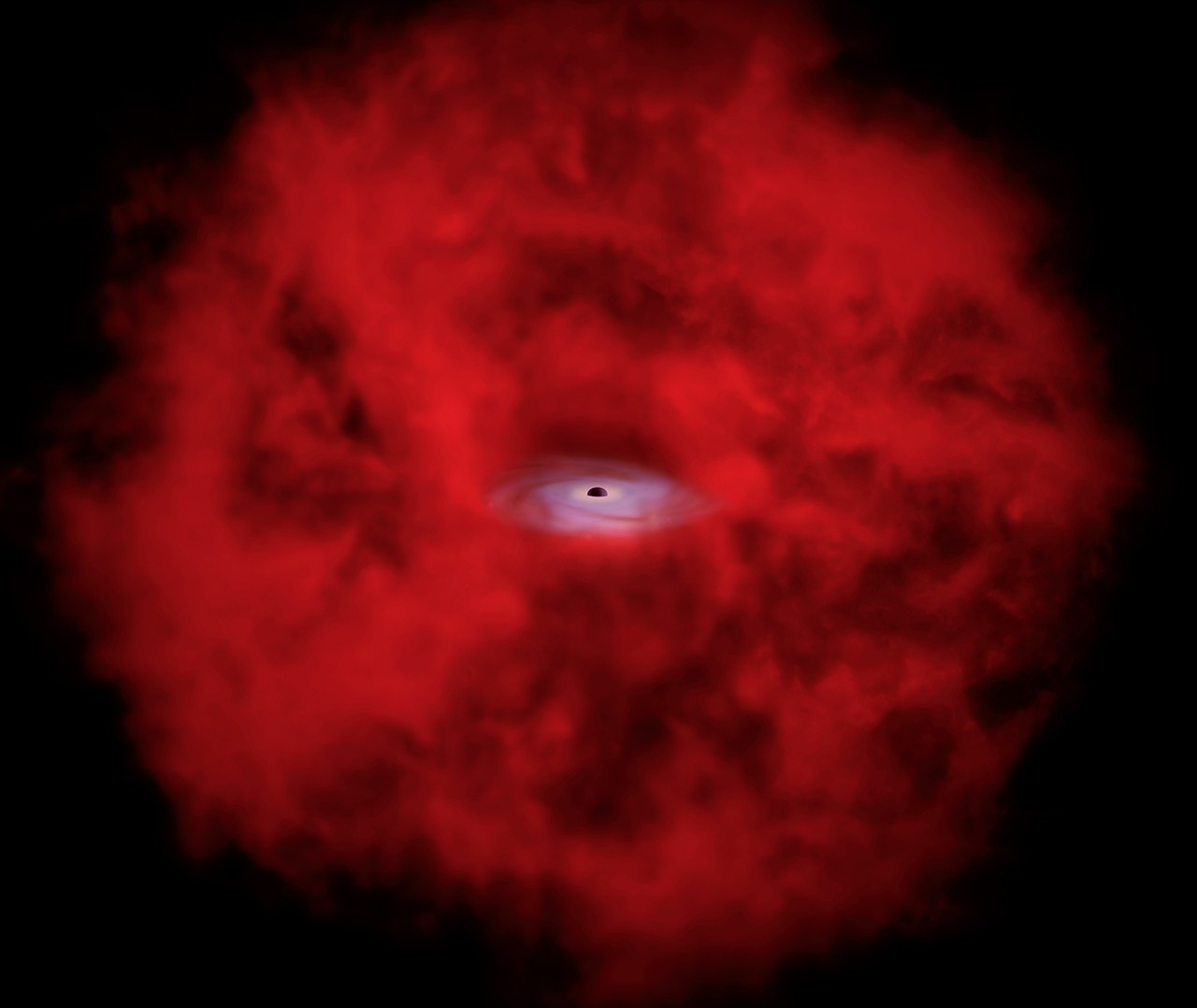
NASA scientists have identified a specific X-ray source, designated 3DHST-AEGIS-12014, situated approximately 11.8 billion light-years from Earth. This discovery marks a significant step in understanding a class of mysterious objects known as little red dots, or LRDs, which were first observed shortly after the James Webb Space Telescope began its science operations. While these distant objects appear small and red, their true nature has remained elusive for years, prompting astronomers to develop theories about their composition and evolution.
The study, published in The Astrophysical Journal Letters, suggests that this particular object represents a crucial transition phase where a supermassive black hole is actively consuming its surrounding gas. Researchers propose that the object functions as a "black hole star," a state where a supermassive black hole is embedded within dense clouds of gas that typically mask its usual signatures. As the black hole star consumes this material, patchy gaps appear in the gas clouds, allowing X-rays from the accretion disk to escape for the first time and be detected by the Chandra X-ray Observatory.
This finding provides vital evidence linking the growth of supermassive black holes to the mysterious LRD population. Although the object exhibits most visual characteristics of an LRD, including its small size, red colour, and vast distance, it differs significantly by glowing in X-ray light. The team found this unique object after cross-referencing new data from the James Webb Space Telescope with a deep survey previously performed by Chandra, revealing details that had remained hidden for over a decade.
Variations in the X-ray brightness of the source further support the hypothesis that the black hole is partly obscured by rotating gas clouds. As the cloud of gas spins, patches of denser and less dense material move across the black hole, causing observable changes in the X-ray output. This dynamic behaviour indicates that the object is not static but is in the process of evolving from an obscured state toward that of a typical growing supermassive black hole, which would emit bright ultraviolet light and X-rays freely.
The research was conducted by an international collaboration involving the Max Planck Institute for Astronomy, the Center for Astrophysics | Harvard & Smithsonian, Princeton University, and NASA's Marshall Space Flight Center. Lead author Raphael Hviding of the Max Planck Institute for Astronomy noted that this single X-ray object may provide the connection needed to unlock the true nature of the hundreds or potentially thousands of LRDs discovered in the early universe. Co-author Anna de Graaff of the Center for Astrophysics | Harvard & Smithsonian added that finding an LRD that looks different from the others offers important new insight into what could power these distant phenomena.
While the "black hole star" scenario is the prevailing theory, the researchers acknowledge an alternate possibility that the object is a more common type of growing supermassive black hole veiled in an exotic type of dust previously unseen by astronomers. Future observations are planned to shed light on the truth and confirm whether this discovery represents the first instance of seeing into the heart of a little red dot. The study highlights the power of collaboration between two great observatories, noting that the X-ray dot had been sitting in Chandra survey data for over ten years before the integration with Webb revealed its remarkable nature.