NASA satellite detects warm water swell in Pacific, indicating likely El Niño
Data from the joint NASA-European mission shows a swell of warm water has arrived in the Pacific Ocean off the coast of South America, suggesting an El Niño event will likely emerge later in 2026.
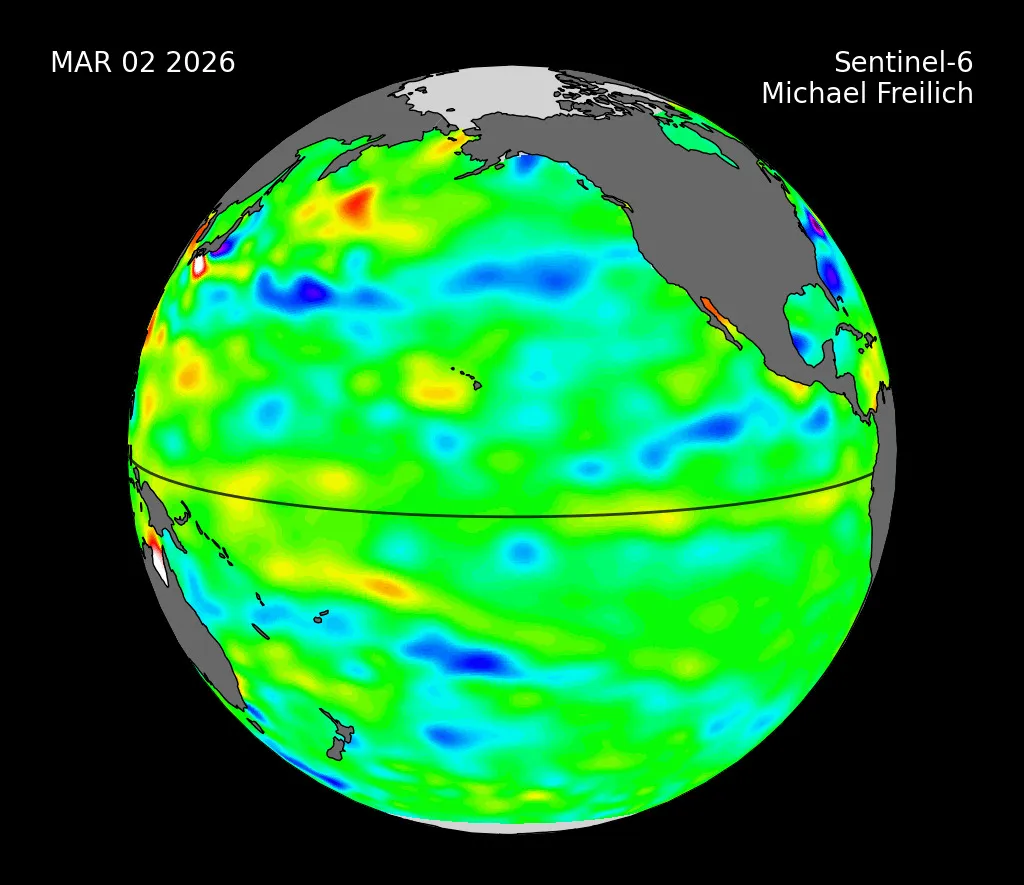
Data from the Sentinel-6 Michael Freilich satellite indicates a swell of warm water has arrived in the Pacific Ocean off the coast of South America. This observation suggests an El Niño event is likely to emerge later in 2026. By mid-May, sea levels around Peru were recorded as more than 5.9 inches (15 centimetres) higher than long-term averages.
The Sentinel-6 Michael Freilich satellite, launched in 2020, tracks warm Kelvin waves that propagate eastward across the Pacific. These waves form when winds over the far western equatorial Pacific shift from easterlies to westerlies, causing water in the western tropics to warm and sea levels to rise. A small Kelvin wave formed around Micronesia in late January and dissipated by mid-February; a new wave emerged in early March and moved eastward.
The satellite measures ocean water height every 10 days with precision down to fractions of an inch. Because water expands as it warms, a rise in elevation of an area of the ocean indicates increasing ocean temperatures. El Niños can cause heavy precipitation in some regions and deficits in others, influencing daily life and commerce around the world.
El Niño events are characterised by warmer sea surface temperatures in the central and eastern Pacific, which shift atmospheric circulation patterns and the jet stream, impacting global storm tracks. Historical context: The name "El Niño" (Spanish for "the boy") was coined by 17th-century fishermen because the phenomenon tended to intensify around Christmastime, often resulting in reduced fish catches.
The Sentinel-6 Michael Freilich mission continues a legacy of sea level observation started in 1992 by the TOPEX/Poseidon satellite. The mission is a joint effort involving NASA, the European Space Agency (ESA), EUMETSAT, NOAA, and the European Commission, with technical support from CNES. Previous significant El Niño events occurred in 1997, 2015-2016, 2018, and 2023.