NASA research suggests Sun’s ancient history shaped Earth’s climate
Two new studies propose that the shrinking of the solar system’s protective bubble and superflares from the young Sun played key roles in driving ice ages and sustaining early life.
Two recent studies funded by the National Aeronautics and Space Administration (NASA) suggest that ancient events in the Sun’s history significantly influenced the evolution of Earth’s climate. The research indicates that changes in the solar environment, rather than just internal planetary factors, may have driven previously unexplained climatic shifts and helped create the conditions necessary for life.
The first study, published in the Annual Review of Astronomy and Astrophysics, focuses on the heliosphere, the massive protective bubble created by the Sun that envelops the solar system. Researchers at NASA’s SHIELD centre, a DRIVE Science Centre, used computer modelling to trace the heliosphere’s trajectory through the Milky Way. Their simulations revealed that the Sun has encountered frigid expanses of gas and dust at least three times in the past few million years.
During these encounters, massive interstellar cold clouds pushed against the heliosphere, causing it to shrink below Earth’s orbit. This left the planet stranded outside the Sun’s protective shield, exposing its atmosphere to different galactic surroundings. These events occurred approximately 2 to 3 million years ago, 6 to 7 million years ago, and 13 to 14 million years ago. The simulation results align with geologic evidence, as elements prevalent in interstellar dust have been found in deep-sea sediment cores, Antarctic snow, and lunar samples during these specific timelines.
The exposure to these cold, dense galactic hydrogen clouds may have increased water vapour content and shifted upper-atmospheric dynamics, ultimately altering surface conditions. These changes could explain ancient climatic patterns, including the triggering of ice ages where global average temperatures temporarily dropped by several degrees. The SHIELD centre aims to develop a digital twin of the heliosphere to better understand how it interacts with its surroundings.
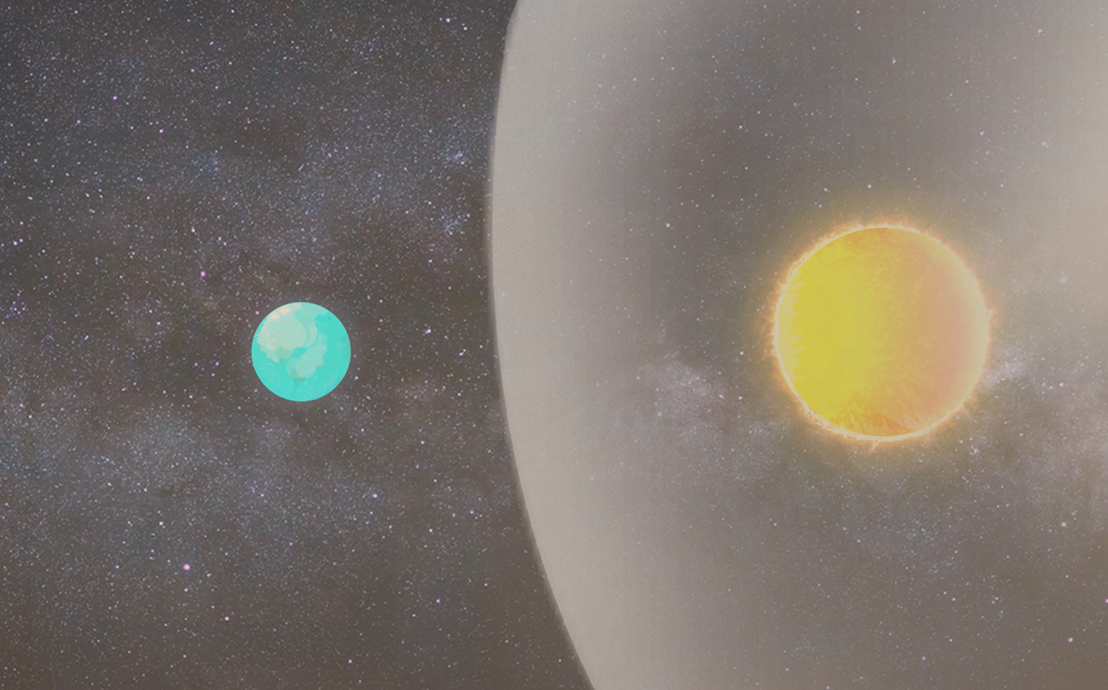
A second study, published in Astrophysical Journal Letters, addresses the Faint Young Sun paradox. This long-standing mystery concerns how early Earth maintained stable liquid water despite the young Sun being only 70 per cent as bright as it is today. Under such dim conditions, Earth should have been frozen solid, yet geological evidence shows liquid water existed long before the Sun reached its current brightness.
NASA scientist Vladimir Airapetian and his coauthors propose that the young Sun, like other young Sun-like stars, regularly erupted with massive superflares. These eruptions flung high-energy particles in all directions. Airapetian’s team simulated early Earth’s atmosphere in a sealed chamber by mixing molecular nitrogen, ammonia, carbon dioxide, and carbon monoxide, then firing protons into the mixture to mimic the onslaught of particles from superflares.
This proton bombardment triggered chemical reactions that produced nitrous oxide, a greenhouse gas 300 times more potent than carbon dioxide. Although the young Sun’s intense ultraviolet radiation would have broken down some of this gas, computer simulations confirmed that even if only 10 per cent survived, it would have warmed Earth’s equatorial regions to about five degrees Celsius. This temperature is above water’s freezing point and may have accelerated prebiotic synthesis, helping to sustain the early development of life.