NASA instruments map pulsar magnetic fields for first time
Data from Chandra and IXPE reveal structure of extreme cosmic object, with radio emissions captured by Australian telescope
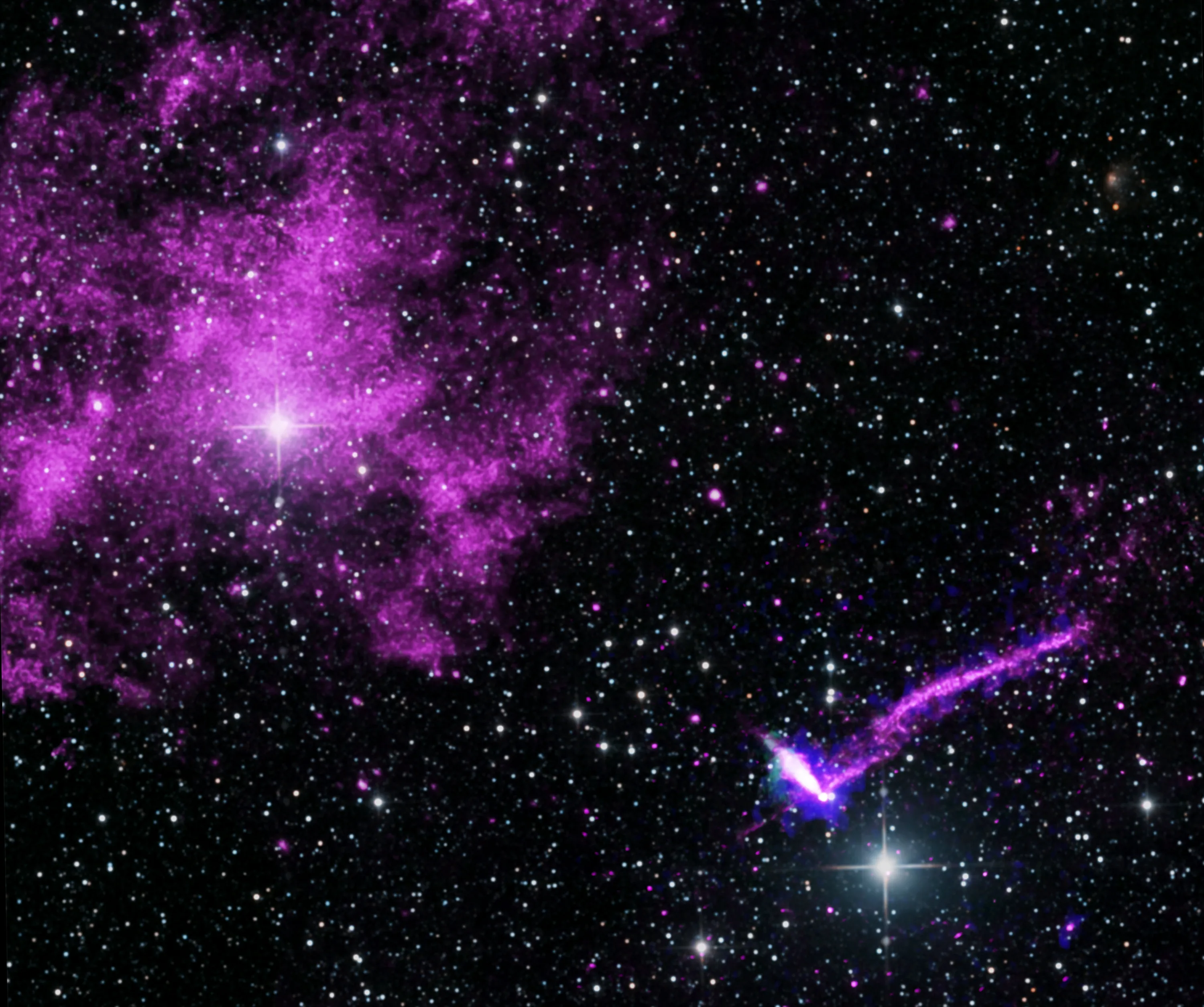
Scientists have utilised the Imaging X-ray Polarimetry Explorer (IXPE) to directly measure the magnetic fields of a pulsar within the Lighthouse Nebula for the first time. The findings, released on 9 July 2026, offer new insights into the structure of some of the most extreme objects in the cosmos.
The study involved a joint analysis using NASA’s Chandra X-ray Observatory and IXPE. The resulting composite image displays X-ray data from Chandra in purple and X-rays from IXPE in blue. Radio emission from the same region was captured by the Australia Compact Telescope Array and is shown in green.
A pulsar is defined as a neutron star with a strong magnetic field that spins incredibly fast. By directly measuring the magnetic fields of the pulsar in the Lighthouse Nebula, researchers have gained a clearer understanding of these dense stellar remnants. The results provide new insight into the structure of these extreme cosmic objects, as NASA continues to explore the secrets of how the universe works.
The findings were published on 9 July 2026 in the Astrophysical Journal. The paper describes the results of the multi-wavelength observation, which combines high-energy X-ray data with radio observations to paint a comprehensive picture of the nebula.
The composite image also includes optical data from the 2MASS survey, managed by UMass, IPAC-Caltech, NASA, and the NSF. Image processing was conducted by NASA/CXC/SAO/L. Frattare, with X-ray data contributions from NASA/CXC/Stanford Univ./J. Dinsmore et al. for Chandra and NASA/MSFC/J. Dinsmore et al. for IXPE. Radio data credit is attributed to CSIRO/ATNF/ATCA.