NASA instrument captures space weather microbursts on compact CubeSat
Scientists report that the Relativistic Electron Atmospheric Loss instrument, launched in July 2025, uses three sensor heads to measure energetic particles in real-time without requiring the satellite to rotate.
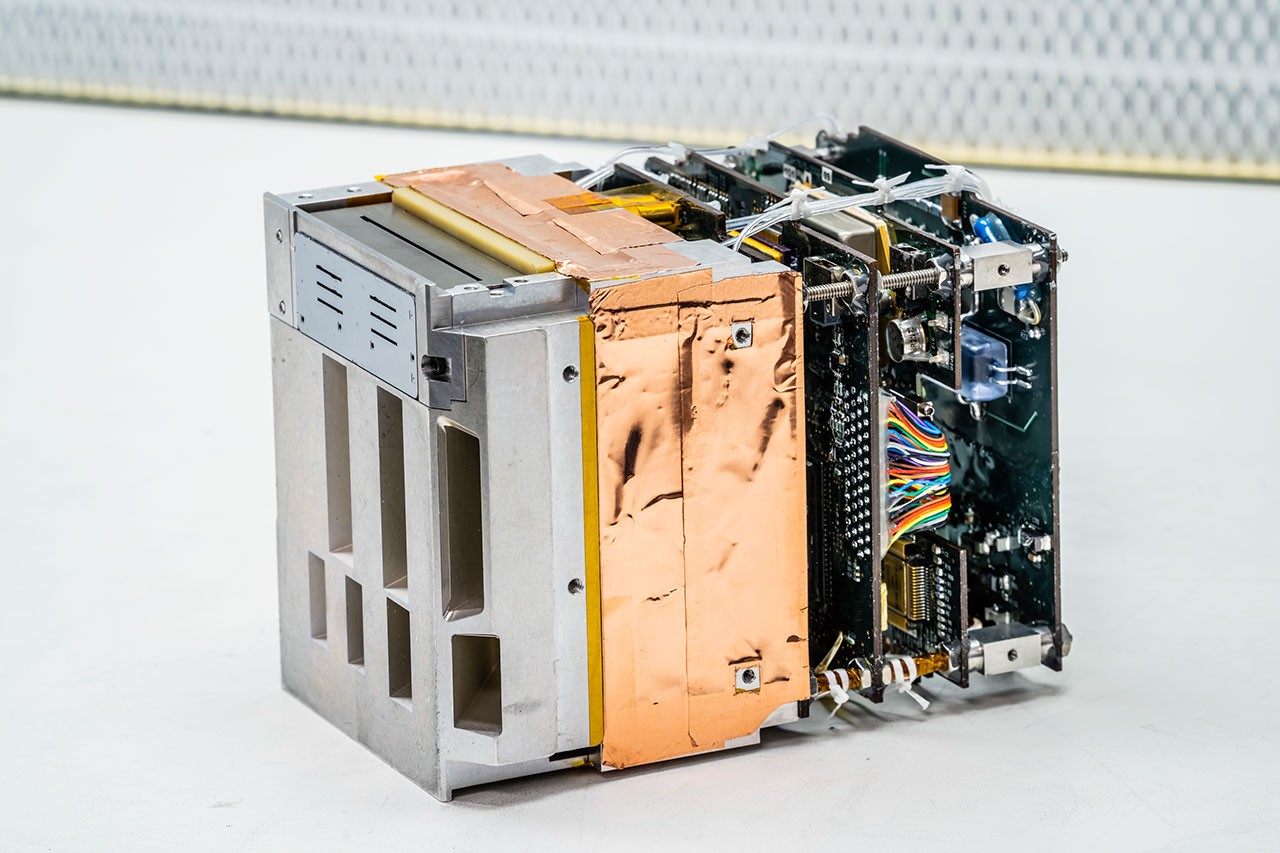
A team of NASA-sponsored scientists and engineers has successfully deployed a novel, compact multi-view particle detection instrument for the Relativistic Electron Atmospheric Loss (REAL) CubeSat mission. Launched on July 23, 2025, aboard a 3U CubeSat, the REAL instrument enables high-fidelity, simultaneous measurements of energetic particles in Earth’s near-space environment. The development was supported by NASA’s Heliophysics Division’s Heliophysics Flight Opportunities in Research and Technology (H-FORT) program.
The instrument addresses a significant limitation in traditional CubeSat design, which typically requires satellites to spin to build a full directional picture of particle data. This spinning process takes several seconds, a duration too slow to capture rapid changes in the radiation environment. In contrast, the REAL instrument uses three sensor heads with multiple look directions to measure particle quantity, energy, and angle in real-time. This capability allows for the resolution of electron microbursts lasting as short as 100 milliseconds, with a time resolution of 20 milliseconds.
Billions of high-energy charged particles are magnetically trapped around Earth in the Van Allen radiation belts. These belts pose a persistent hazard to satellites, including those providing GPS, telephone, and internet services. The outer belt contains so-called killer electrons, which are energetic enough to penetrate satellite shielding and trigger damaging electrical discharges. Understanding how these electrons are lost from the belts is critical for predicting space weather effects in low Earth orbit.
The REAL instrument covers electron energies from 40 keV up to 2 MeV. It distinguishes between precipitating, quasi-trapped, and trapped electron populations, helping scientists determine whether electron scattering occurs gradually through diffusive processes or rapidly through nonlinear interactions. The instrument occupies approximately half of the 3U CubeSat volume and includes a high-energy head, a medium-energy head, and a low-energy head.
All three sensor heads are functioning nominally, and the team has recently fine-tuned threshold settings to improve sensitivity. The high-energy head uses a 30-millimetre-thick aluminium collimator with four apertures, while the medium-energy head uses a 22-millimetre-thick aluminium collimator with five apertures. The low-energy head is a miniature electrostatic analyzer with titanium electrodes and etched silicon selector slits.
Thomas Sotirelis of the Johns Hopkins Applied Physics Laboratory, who developed the instrument concept, noted that the pitch-angle-resolved measurements allow for accurate quantification of electron loss rates. Robyn Millan of Dartmouth College, the mission principal investigator, stated that the team is proud of squeezing three sensors with multiple look directions into the satellite’s top section.
This capability demonstrates that measurements once requiring large, resource-intensive missions can now be achieved with compact, cost-effective instruments on small satellites. The REAL mission paves the way for CubeSat constellations that could continuously observe Earth’s radiation environment and help protect the space-based systems modern society depends on.