NASA identifies mysterious solar crossing as contrail during Perseids peak
Initial observations suggested a meteor due to trajectory alignment, but flight database checks confirm the object was an airplane contrail reflecting sunlight.
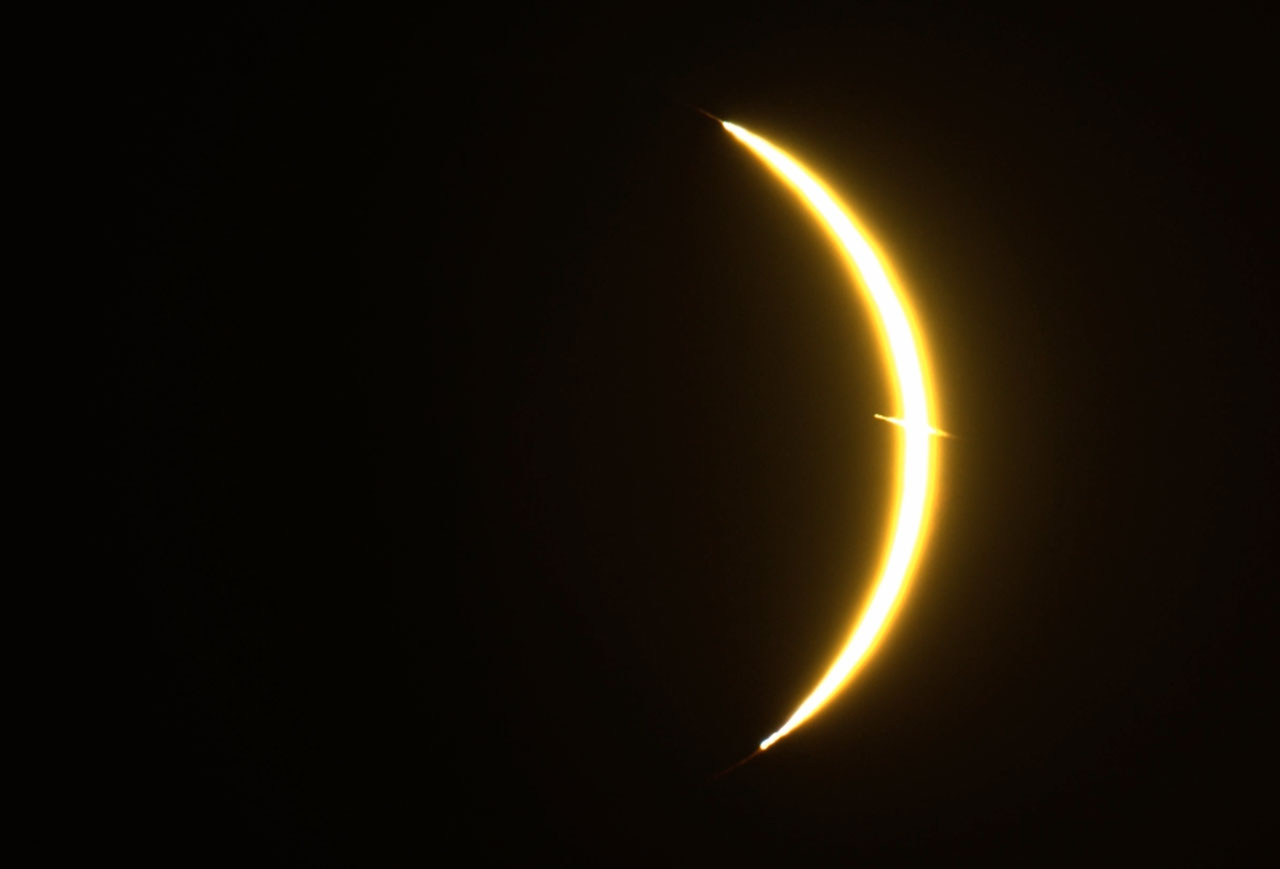
NASA’s Astronomy Picture of the Day for 19 August 2026 has resolved a visual anomaly captured during the peak of the Perseids meteor shower. The service, a collaboration between NASA’s Astrophysics Science Division, NASA Science Activation, and Michigan Technological University, analysed footage recorded in Spain that initially appeared to show a celestial object traversing the Sun.
The video, recorded at 20:28 local time on 12 August 2026, was captured by Juan Pablo Castañeda at coordinates 40°34’30.3”N 1°12’28.8”W. It depicts a bright object moving across a partially eclipsed Sun while the Perseids shower was at its maximum activity. The object’s path seemed to originate from the radiant point in the Perseus constellation, the area from which Perseid meteors appear to radiate as Earth crosses the comet’s debris trail.
Despite the trajectory’s alignment with the meteor shower, several physical characteristics contradicted the meteor hypothesis. The object’s angular size was smaller than the 0.5-degree diameter of the Sun and Moon, which is inconsistent with typical meteors. Furthermore, the object’s brightness was limited to sunlight reflection, whereas meteors are visible due to atmospheric friction and do not require external illumination to be seen.
To determine the object’s true nature, the APOD team cross-referenced the video’s location, time, and sky position with a flight database. The data confirmed the object was an airplane contrail. The bright line observed was likely sunlight reflecting off the ice crystals in the contrail as it passed in front of the solar disc.
The explanation for the image was authored by Keighley Rockcliffe, Robert Nemiroff, Jerry Bonnell, and Cecilia Chirenti. The report acknowledged contributions from William Cooke, David Lee, Peter Brown, Denis Vida, and Peter Jenniskens.