NASA highlights colourful aurora over Iceland’s Skógafoss waterfall
A photograph captured in April 2025 has been selected for NASA’s Astronomy Picture of the Day, illustrating the complex atmospheric physics behind the northern lights.
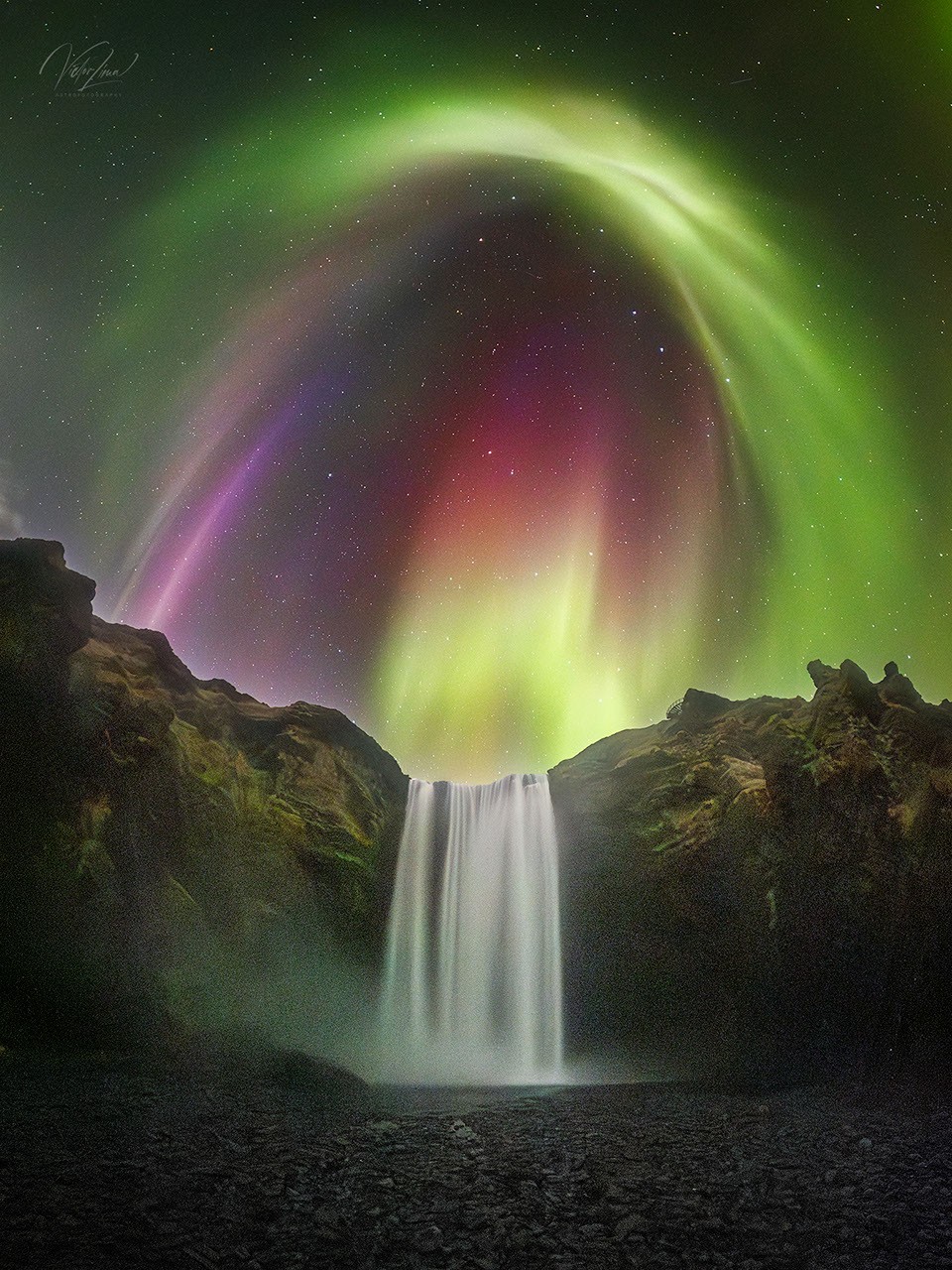
NASA’s Astronomy Picture of the Day (APOD) series has featured a striking image of the northern lights dancing above the Skógafoss waterfall in Iceland. The photograph, captured by Victor Lima in April 2025 using a single five-second exposure, depicts a night sky filled with colours that appear to rain down over the cascading water.
The feature, published on 27 August 2026, provides a scientific explanation for the phenomenon. According to NASA, auroras are generated when charged particles from the solar wind are captured by Earth’s magnetosphere. These particles are then guided by the magnetic field toward the polar regions, where they collide with gas particles in the atmosphere.
The specific hues observed in the sky are determined by the type of gas involved and the altitude of the collision. The APOD entry notes that oxygen produces red and green light, while nitrogen results in blue and pink tones. This interaction creates the distinct visual spectrum characteristic of auroral displays.
Observing these events remains a challenge for many, requiring a combination of high solar activity, dark and clear skies, and a location at high latitude. The source material highlights that northern lights are generally easier to observe than their southern counterparts. This disparity is largely due to the greater landmass in the Northern Hemisphere, whereas the Southern Hemisphere has significantly less land, particularly around the Antarctic Circle.
The image serves as a visual reminder of the dynamic relationship between solar activity and Earth’s atmosphere. It underscores the specific conditions required to witness such a display, which many consider a bucket-list experience.
NASA has also noted that the main website for the APOD service is transitioning from apod.nasa.gov to science.nasa.gov/apod, consolidating its astronomical content under a single domain.