NASA funds 19 advanced space concepts in 2026 NIAC selection
The agency has announced the initial phase of research for projects ranging from controllable dust clouds to photonic interferometry, marking a broad push into speculative but potentially transformative space technologies.
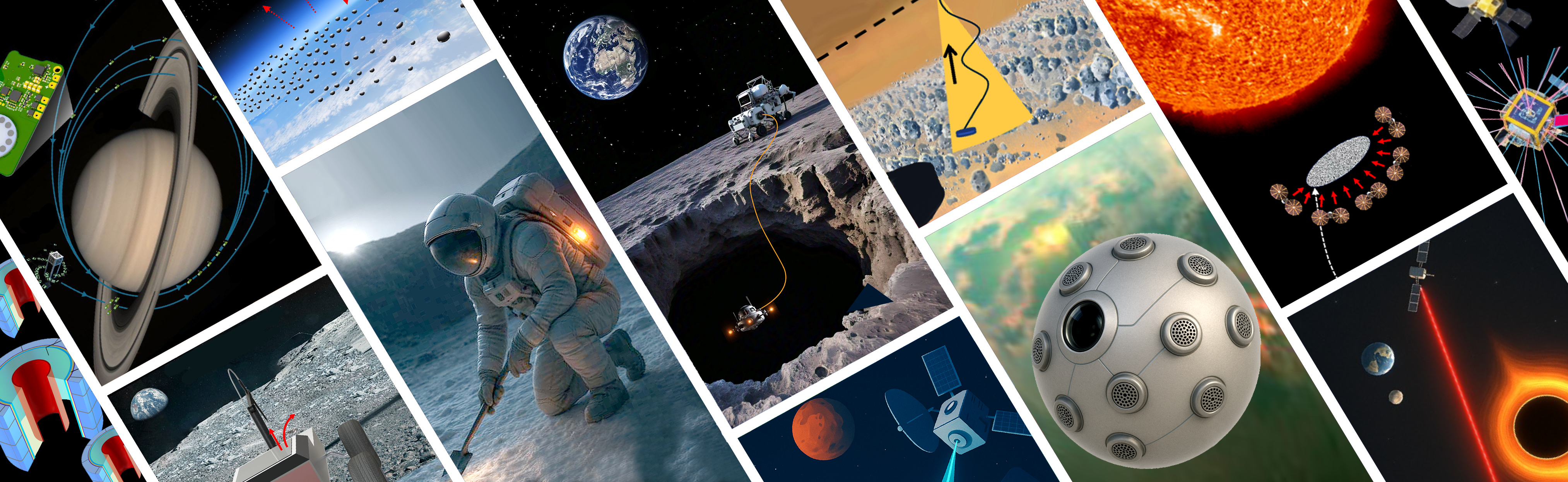
NASA has announced the 2026 selections for its Innovative Advanced Concepts (NIAC) Phase I studies, identifying 19 projects that will receive funding for early-stage feasibility research. The selections span a wide array of disciplines, including planetary defence, deep-space propulsion, advanced sensing, and power generation systems. This phase represents the initial stage of the NIAC programme, where researchers conduct preliminary studies on high-risk, high-payoff technologies before they may progress to further development.
Among the selected studies is research led by Saptarshi Bandyopadhyay at the NASA Jet Propulsion Laboratory in Pasadena, California, which proposes dimming the sun using controllable dust clouds to reduce solar insolation. Another JPL-led project, spearheaded by David Bugby, focuses on combinatorial architecture designed to offer neomobility, on-Venus adaptability, and survivability for future missions to the planet.
The programme also supports advancements in observational astronomy and interferometry. Anish Damodaran from the University of Central Florida will explore transforming submillimeter space interferometry with photonic technologies, while Paul Stankus of Brookhaven Science Associates in Upton, New York, has been selected for two distinct studies. These include mapping alien continents through optical very long baseline interferometry (VLBI) for exoplanet imaging, and achieving precision astrometry using optically independent spacecraft for gravitational wave detection.
Propulsion and power generation technologies feature prominently in the 2026 cohort. Artur Davoyan from the University of California, Los Angeles, will investigate coilable stacked solar sails for very high delta-V missions. Meanwhile, Keunhan Park at the University of Utah is studying plasmon-enhanced radioisotope thermophotovoltaic power generation for interstellar missions, and Daniel Drew from the University of Hawaii is developing solid-state propulsion for the autonomous reconnaissance of karst environments.
Other selected studies address diverse operational challenges in space exploration. These include Zhaoyan Liu’s work on quantum wind lidar applications for planetary and Earth science missions at NASA Ames Research Center, and Gilly Elor’s research on power-over-fiber to enable a lunar underground explorer. The selections also cover autonomous exploration of planetary rings, actively steerable femtosat constellations for Saturn, and robotically assembled electromagnetic metamaterials for space situational awareness.
The NIAC programme continues to serve as a mechanism for NASA to fund foundational technologies that could revolutionise space exploration. By supporting these speculative ideas, the agency aims to identify capabilities that may mature into future mission components. The 2026 Phase I selections reflect a strategic interest in technologies that address everything from solar management and Venus exploration to deep-space power and exoplanet observation.
The full list of selected studies includes contributions from institutions such as Zeno Power Systems, Stone Aerospace, Orbital Velocity LLC, Virginia Polytechnic Institute and State University, Northwestern University, Duke University, and the SETI Institute. Each project represents a distinct approach to solving complex challenges in space science and engineering, with the potential to inform future mission architectures and technological standards.