NASA features image of Elephant’s Trunk Nebula in Cepheus
A detailed view of the vdB 142 nebula highlights the interstellar dust and gas ridges that serve as the raw material for new star formation.
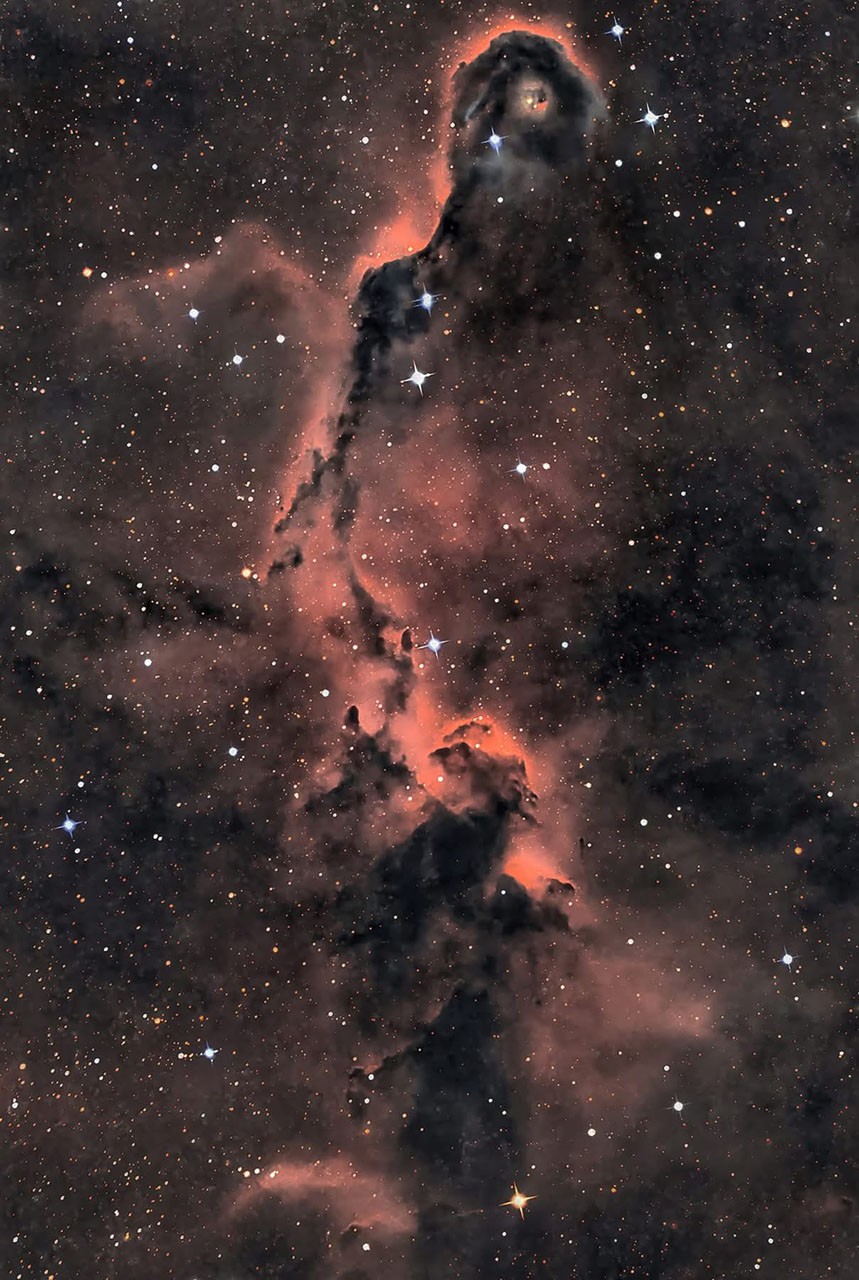
NASA’s Astronomy Picture of the Day (APOD) has featured a detailed image of the Elephant’s Trunk Nebula, a cosmic structure located within the constellation Cepheus. The photograph, credited to Eddie Sgarbossa, was published on 20 August 2026 and offers a close look at the emission region and young star cluster complex known as IC 1396.
The nebula, also designated as vdB 142, is situated approximately 3,000 light-years from Earth. Despite its distance, the image reveals a structure that is over 20 light-years long. The visual description compares the formation to an illustration in a galactic story, noting how the trunk winds through the surrounding complex.
The detailed telescopic view captures bright, swept-back ridges and pockets of cool interstellar dust and gas. These dark, tendril-shaped clouds are significant to astronomers as they contain the raw material required for star formation. Within these dense regions, protostars are hidden, marking the early stages of stellar development.
The broader IC 1396 complex is relatively faint to the naked eye but covers a substantial area of the sky, spanning over five degrees. In contrast, the specific field of view for the Elephant’s Trunk Nebula is nearly one degree wide. This angular size is slightly less than that of two full moons placed side by side.
The APOD series, a service of the Astrophysics Sciences Division at NASA’s Goddard Space Flight Center, features a different image or photograph of the universe each day. Each entry is accompanied by a brief explanation written by a professional astronomer, providing context for the featured celestial object.
This feature highlights the ongoing efforts to document and explain the structures of the universe, making complex astronomical data accessible to a global audience. The image serves as a reminder of the active processes occurring in distant parts of the galaxy, where new stars are born within clouds of dust and gas.