NASA Earth Observatory reveals UAE’s geological and human history
Analysis of Landsat 8 data shows how marine deposits and ancient oceanic lithosphere underpin one of the earliest known Homo sapiens sites on the Arabian Peninsula.
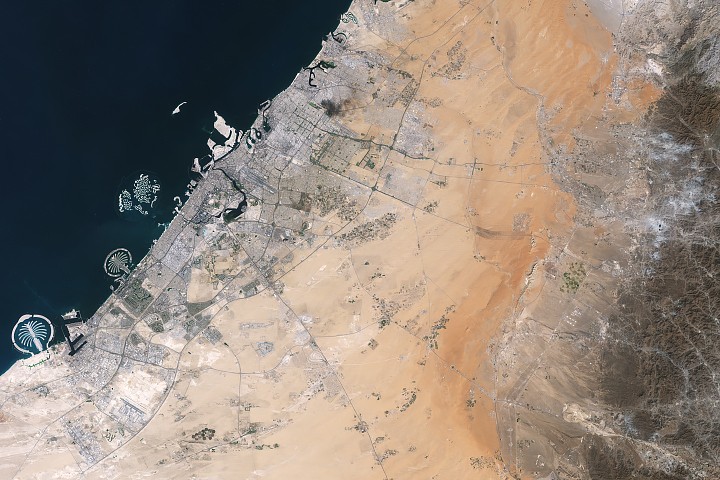
NASA’s Earth Observatory has published a detailed analysis of Jabal al Fāyah in the United Arab Emirates, utilising Landsat 8 satellite imagery captured on 23 October 2025. The report examines the region’s transformation from a shallow sea to desert, highlighting limestone ridges formed from marine deposits over the Samail Ophiolite. The site, inscribed as a UNESCO World Heritage site in 2025, contains archaeological evidence of Homo sapiens occupation dating back between 210,000 and 120,000 years.
Jabal al Fāyah stands 412 metres above sea level at the far northern edge of the Rub’ al Khali, near the Al-Hajar Mountains. The pale ridges rise finlike from the desert plain, functioning as a barrier that traps windblown sand in dune fields to the west. The weathering of iron-bearing minerals in these sand grains gives the dune fields their characteristic orange hue. To the east, branching channels of overlapping alluvial fans extend from the mountains, carrying gravels and eroded sediments from basalts and other dark mafic rocks.
The dark rocks to the east are part of the Samail Ophiolite, recognised by geologists as one of the world's largest, best-preserved, and most accessible exposures of ancient oceanic lithosphere. This rigid outer layer of Earth, including the crust and upper mantle, is typically subducted and recycled when tectonic plates collide. In this region, however, a large section from beneath the Tethys Sea was scraped off and thrust onto the Arabian plate through a process known as obduction.
The limestone ridges themselves were deposited on top of the ophiolite over tens of millions of years, spanning the late Cretaceous through the early to mid-Paleocene. Limestone typically forms in warm, shallow oceans from the calcium carbonate found in marine life shells and skeletons. Coral fragments and marine invertebrate fossils are visible embedded in the rock, while a feature called Fossil Rock, located a few kilometres north of Jabal al Fāyah, contains an abundance of snail, clam, and sea urchin remains.
For archaeologists, the ridges are central to understanding human adaptation and survival. The site traces human occupation on the Arabian Peninsula back to the Middle Paleolithic, a period when anatomically modern humans migrated out of Africa. Dozens of archaeological sites within the area contain stone flakes, blades, scrapers, and hand axes. Geological evidence suggests that lakes periodically formed on the east side of the ridge, providing critical resources, while rocky overhangs offered shelter from the harsh climate.
The analysis was written by Adam Voiland, with images by Lauren Dauphin using data from the U.S. Geological Survey. The findings offer early evidence of modern humans surviving in a desert environment and raise questions about the routes taken during their journey out of Africa. Some sites show evidence of intermittent occupation beginning as early as 210,000 years ago, marking one of the earliest signs of human habitation on the peninsula.