NASA data reveals tidal forces driving biodiversity in Guinea-Bissau archipelago
New analysis of satellite altimetry confirms extreme tidal ranges of up to 7 metres shape the unique ecosystem of the Bijagós Archipelago.
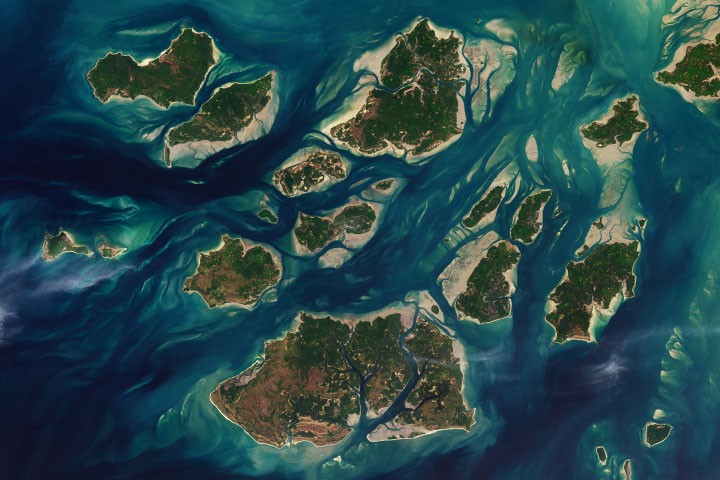
NASA’s Earth Observatory has published a detailed report on the Bijagós Archipelago in Guinea-Bissau, highlighting how extreme tidal dynamics sustain one of Africa’s most biodiverse ecosystems. The archipelago, which comprises 88 islands and islets, was inscribed as a UNESCO World Heritage site in 2025, recognising its status as the only active deltaic archipelago on the continent’s Atlantic coast.
The region’s landscape undergoes stark transformations twice daily as tides ebb and flow through sandy channels and mangrove forests. During low tide, intertidal mudflats and sandflats emerge, significantly expanding the visible landmass before the sea returns hours later. This rhythmic exposure of nutrients supports a vast array of marine life, including hundreds of bird species that feed on marine worms, crustaceans, and small fish.
UNESCO estimates that the islands support approximately 870,000 migratory shorebirds, making the area a critical feeding station along the East Atlantic Flyway. The convergence of tides, river sediments, coastal upwelling, and coastal currents creates a highly productive environment that also attracts manatees, dolphins, and schools of fish into the mangrove forests during high tides.
A 2025 analysis utilised altimetry data from NASA/CNES satellites, including TOPEX/Poseidon, Jason-1, and Jason-2, to validate the hydrodynamic conditions of the region. Researchers concluded that the wide, shallow shelf and specific estuary geometry generate tidal ranges of up to 7 metres. This is substantially higher than the 1-metre average observed in other parts of the West African coast.
The archipelago also hosts a significant population of nesting green sea turtles, particularly on the tiny island of Poilão within the João Vieira and Poilão Marine National Park. While tens of thousands of turtles swim inland to sandy beaches to nest, the survival rate for hatchlings is estimated at less than 1 percent due to predation by crabs, lizards, birds, and various marine species ranging from jacks to sharks.
The report, authored by Adam Voiland with imagery by Lauren Dauphin using Landsat data from the U.S. Geological Survey, underscores the scientific value of monitoring these remote ecosystems. The findings provide further context for the ecological importance of the Bijagós Archipelago as a protected heritage site and a vital node in global migratory routes.