NASA captures sunflower field during Spain’s 2026 total solar eclipse
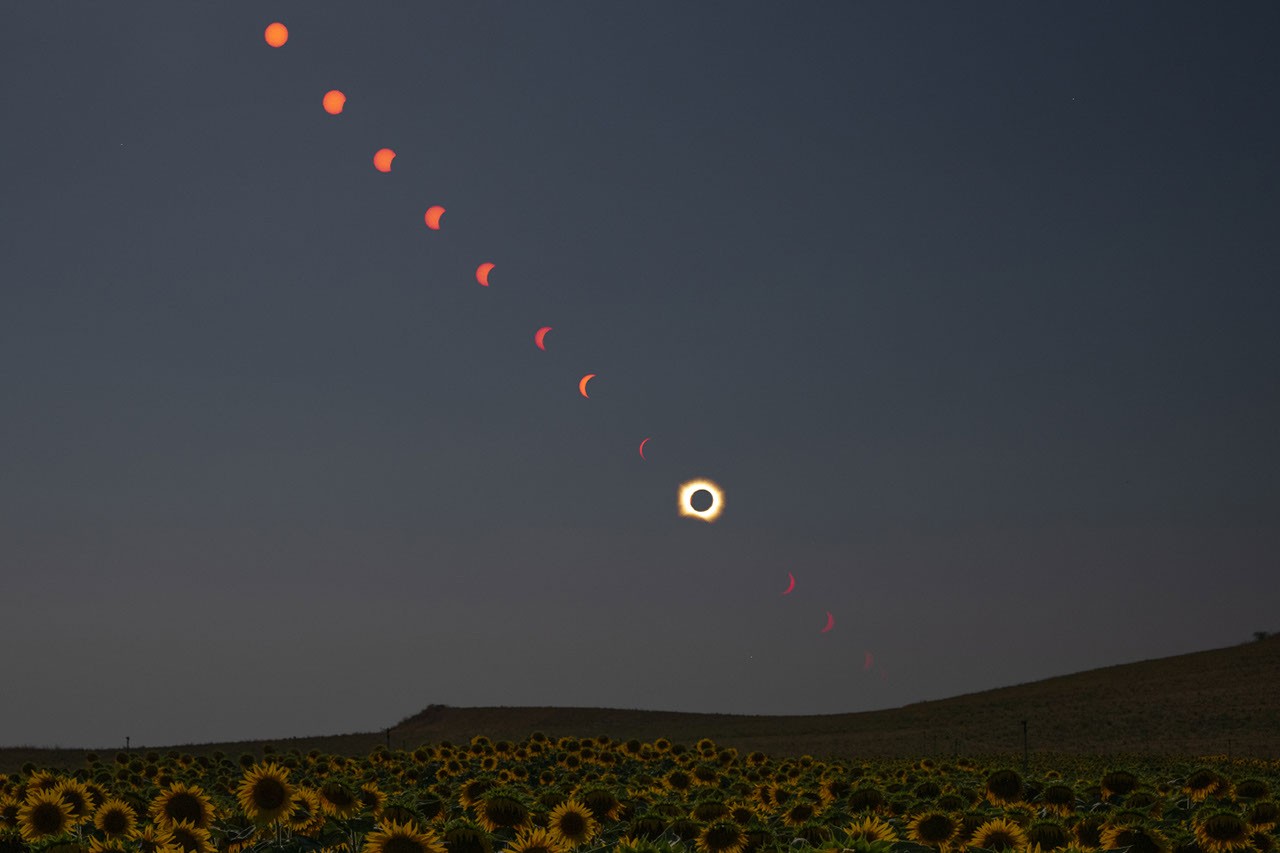
A composite image taken in San Millán de los Caballeros reveals a solar prominence during the August 12 event, while NASA instruments track atmospheric shifts from Iceland and the ground.
The Moon slid between the Sun and Earth on August 12, 2026, producing a total solar eclipse visible from northern Spain, Iceland, and parts of Greenland. Skywatchers within the path of totality witnessed the Sun’s active outer atmosphere, known as the corona, as the Moon blocked the solar disc. This event marked the first total solar eclipse visible in northern Spain since 2006.
A composite photograph taken in San Millán de los Caballeros, a town approximately 40 kilometres south of León, captured a sunflower field during the eclipse. The image, assembled from footage taken before, during, and after the event, shows a glowing loop of plasma called a solar prominence extending into the corona. These prominences, composed of super-hot ionised hydrogen and helium, can measure many times higher than Earth’s width and are occasionally visible to the naked eye during eclipses.
In León, the partial eclipse began at 7:32 p.m. and ended at 9:22 p.m. local time, with totality lasting approximately two minutes starting at 8:28 p.m. Sunset occurred shortly after the eclipse concluded in León, while in eastern Spain, the Sun set before the eclipse ended. Northern Spain was one of the few land locations within the eclipse’s path, alongside parts of Greenland and Iceland.
NASA conducted scientific observations to study atmospheric changes during the event. Science teams stationed in Iceland used a WB-57 high-altitude jet to chase the Moon’s shadow and image the corona in visible and infrared light. Additionally, the NASA-supported Nationwide Eclipse Ballooning Project launched scientific balloons before, during, and after the eclipse to measure how Earth’s atmosphere responded to the temporary blockage of sunlight.
While viewing opportunities in the path of totality were limited, parts of Europe, Africa, Canada, and the United States experienced a partial eclipse. The next total solar eclipse is scheduled for August 2, 2027, with the path of totality crossing southern Spain, North Africa, Saudi Arabia, and Yemen. Photos and video from the event are available in NASA’s image library.