NASA APOD showcases bright Perseid meteors captured in Sweden
The latest Astronomy Picture of the Day features a photograph taken near Grisslehamn, revealing the mechanics of the annual meteor shower and its timing against a New Moon.
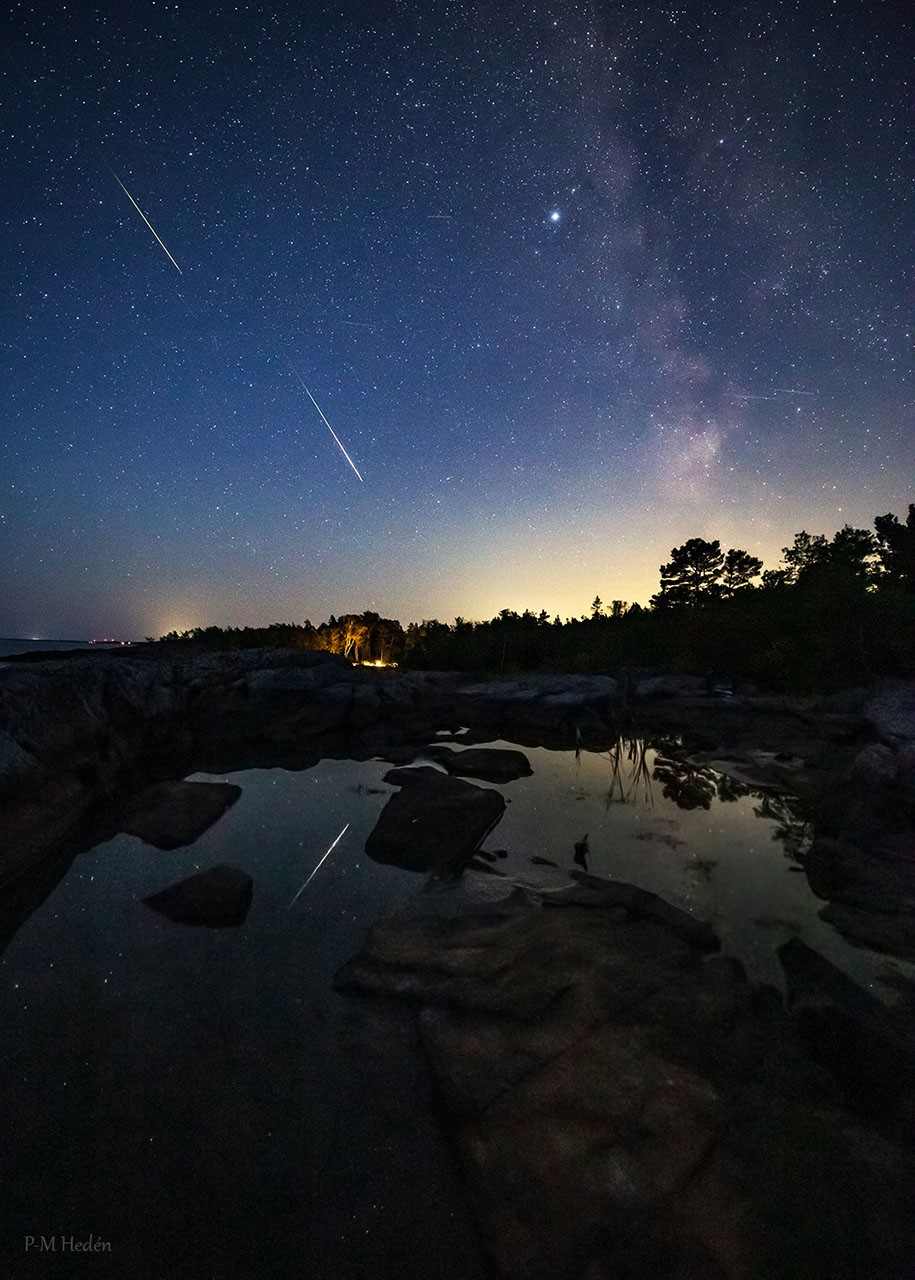
NASA’s Astronomy Picture of the Day (APOD) service has featured a composite image of bright Perseid meteors captured near the coastal village of Grisslehamn, Sweden. The photograph, taken by P-M Hedén on 12 August 2026, displays two meteors and a watery reflection against the backdrop of the Milky Way.
The image was recorded near the peak of the Perseid Meteor Shower’s activity. This annual northern summer spectacle is known for its bright and fast meteors, which originate from a radiant in the constellation Perseus. The streaks are created as grains of dust cast off along the orbit of periodic comet 109P/Swift-Tuttle vaporise in Earth’s dense atmosphere.
In the featured photograph, the meteors appear almost as bright as Altair, the brightest star in the scene. The composite image captures the faint, diffuse background of the Milky Way alongside the meteor trails and a reflection of one meteor in the water.
The shower’s peak activity this year coincided with a New Moon, allowing for undiminished visibility of the meteor flashes. For many skywatchers, this night of meteor activity followed their observation of the total solar eclipse on 12 August, which traversed regions including Greenland, Iceland, and northern Spain.
The APOD service is a daily feature showcasing an image or photograph of the universe, accompanied by an explanation written by a professional astronomer. It is a collaboration between the Astrophysics Science Division at NASA Goddard Space Flight Center, NASA Science Activation, and Michigan Technological University.