Moon and Venus align above Washington Monument in optical illusion
Photographs taken on Monday reveal the Moon and Venus appearing close together above the Washington Monument, a visual effect created by their alignment from Earth’s perspective despite vast physical distances.
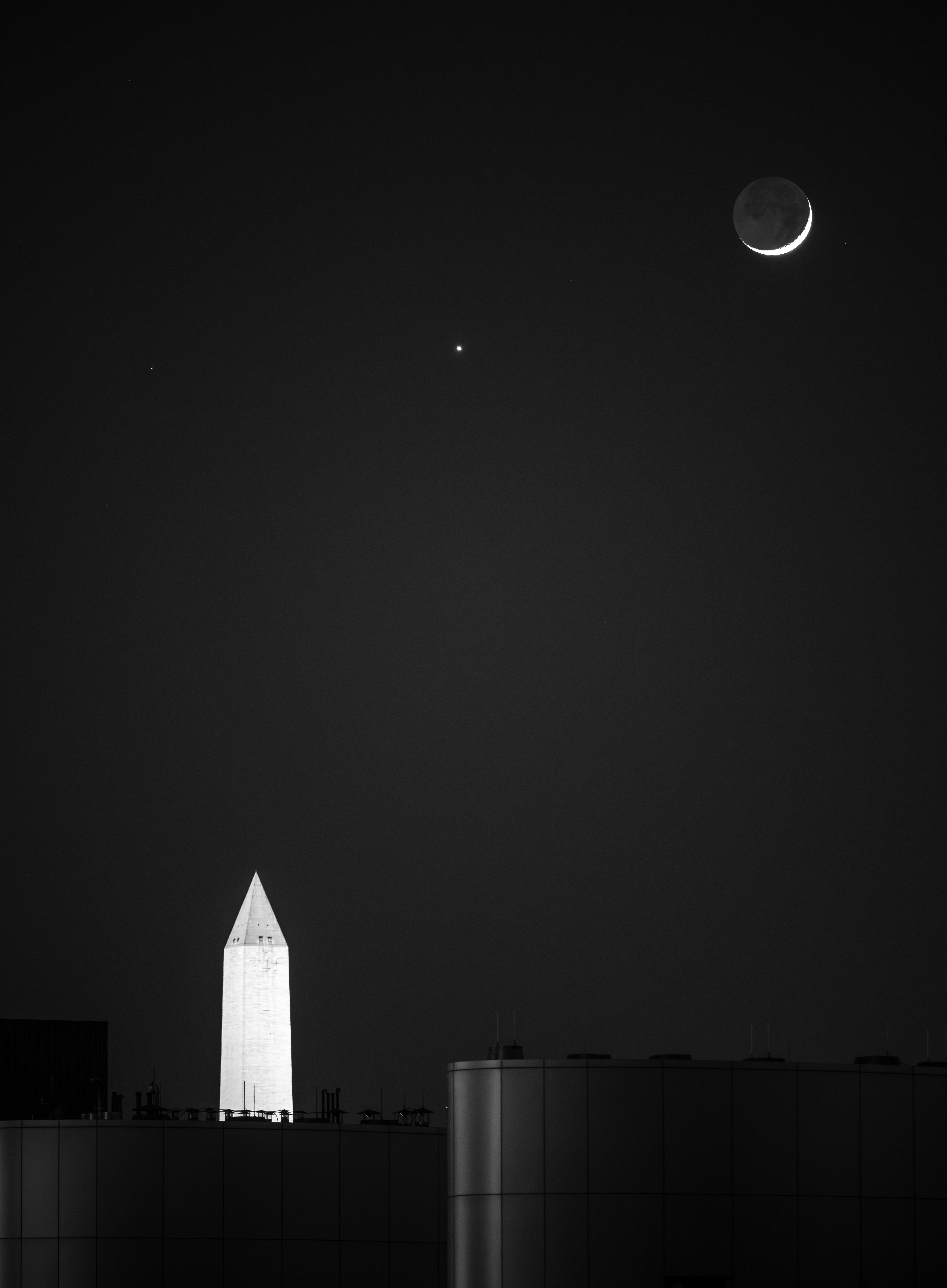
On Monday, 18 May 2026, the Moon and Venus appeared in conjunction above the Washington Monument in Washington, as viewed from the Mary W. Jackson NASA Headquarters Building. The celestial alignment was captured in photographs by NASA photographer Bill Ingalls, offering a clear view of the two bodies positioned centrally above the landmark.
The image highlights a common astronomical phenomenon where two celestial objects appear close together in the sky from the perspective of an observer on Earth. In this specific instance, the Moon and Venus look close together because they line up from our point of view on Earth.
Despite their apparent proximity in the photograph, the two bodies are not physically near each other. In reality, they are separated by millions of miles in space. This distinction underscores the difference between visual alignment in the sky and actual physical distance in the solar system.
The event was documented by the NASA HQ Web Team and published on 19 May 2026. The agency provided the image credit to Bill Ingalls, noting that the photograph illustrates the visual effect of the conjunction without implying physical closeness between the celestial bodies.
Observers viewing the sky from the vicinity of the Mary W. Jackson NASA Headquarters Building would have seen this alignment, which serves as a reminder of the vast scale of space and the nature of planetary orbits.