Medieval combat world championship draws 600 fighters to Denmark
Competitors from 30 nations gather for four-day tournament blending 14th-century techniques with modern safety protocols
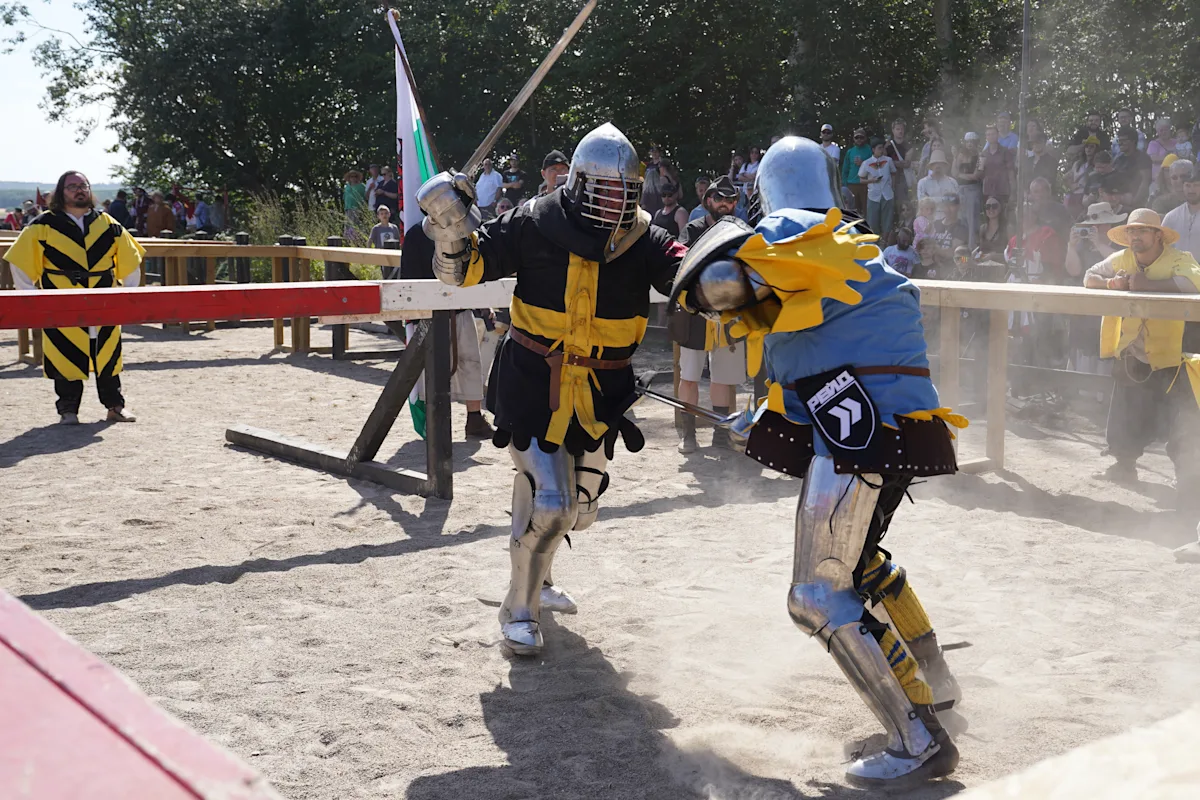
Nearly 600 competitors from 30 countries have gathered at Spøttrup Castle in Denmark for the International Medieval Combat Federation’s annual world championship. The four-day tournament, which opened on Thursday, features armour-clad fighters using blunted 14th-century weapons in one-on-one duels and mass-team 'Buhurt' matches. Organisers describe the sport as a historically inspired mix of modern techniques and historical manuscripts, with strict safety rules and marshals in place to manage the physical demands of the contest.
The event, first staged in Spain in 2014, is held in the shadow of Spøttrup Castle, a fortress completed around 1520. Combat federation spokesperson Kamila Studencka described the competition as a blend of modern combat sports and fencing, noting that while the swords and axes are blunted, the battles are not harmless reenactments. Participants are drawn to the event for various reasons, ranging from the technical aspects of face-to-face duels to the camaraderie of team membership.
Competitors engage in one-on-one "duels" consisting of two one-minute rounds. Elimination occurs after hitting the ground three times or via submission, with marshals awarding points if neither condition is met. Mass-team events, known as "Buhurt," involve up to 10 competitors per side in chaotic matches. Fighters from the United States, Canada, China, and Brazil are among those participating, with notable competitors such as Rodrigo Sinckevicius from Brazil and Martin Gill from England.
Safety protocols are central to the sport’s governance. Fighters wear thick, shock-absorbing padded garments beneath their armour to distribute the force of impact, and trained marshals strictly enforce the rules of engagement. The IMCF states that overall injury rates are comparable to those in mainstream full-contact martial arts. Martin Gill, a 37-year-old geotechnical engineer from England, noted that his 30-kilogram suit of armour is historically accurate, with techniques informed by the writings of 14th-century Italian knight Fiore Dei Liberi and German fencing master Johannes Liechtenauer.
The sport has seen significant growth in popularity, particularly in the United States and among women competitors. Alex King, a financial crime specialist from Minnesota, reported that his local team expanded from approximately 10 to over 50 members in recent years, driven by interest from short videos highlighting the sport. Miisa Kaivos, a bartender from Helsinki, Finland, noted that the women’s side is also growing globally, describing the events as a celebration of female participation in the discipline. Men and women compete in separate events throughout the tournament.