Mecca pact signals shift to 'elastic defense' amid regional power struggle
Analysts describe the new trilateral alliance as a strategic deterrent rather than a mutual defence clause, leveraging complementary economic and military strengths to create a 'third pole' in the Middle East.
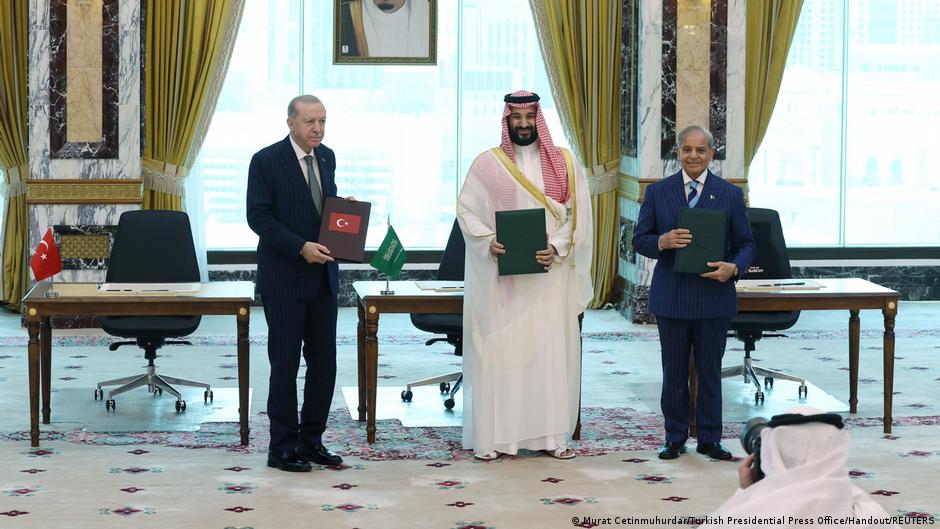
Saudi Arabia, Turkey and Pakistan have formalised a strategic security partnership with the signing of the Mecca Joint Defense Agreement in Mecca. The pact, sealed by Saudi Crown Prince Mohammed bin Salman, Turkish President Recep Tayyip Erdogan and Pakistani Prime Minister Shehbaz Sharif, is designed to strengthen collective deterrence against aggression in a region marked by ongoing conflict and shifting alliances.
While the Pakistani foreign ministry stated that an attack on any member would be regarded as an attack on all, experts characterise the arrangement as an "elastic defense" strategy rather than a traditional mutual defence clause requiring immediate military intervention. This distinction was underscored when Houthi attacks on Saudi oil facilities did not trigger immediate military responses from Ankara or Islamabad, suggesting the alliance functions primarily as a deterrent rather than a reactive combat force.
The agreement seeks to balance regional power dynamics by combining Saudi financial resources with Turkish defence-industrial capacity and Pakistan’s military institutions and nuclear deterrent. Analysts argue the pact aims to prevent regional hegemony by Iran and Israel, creating a "third pole" in the Middle East to deny either nation a monopoly over regional affairs. This approach reflects Saudi Arabia’s broader effort to diversify its security partnerships beyond its historical reliance on the United States.
The trilateral alliance leverages complementary strengths to address shared strategic concerns. Saudi Arabia provides the necessary capital and sits at the centre of the regional conflict, while Turkey offers advanced production capabilities and Pakistan contributes a large workforce and nuclear capabilities. Both Turkey and Pakistan maintain diplomatic and economic relations with Iran and the United States, allowing the alliance to serve as an extra layer of deterrence without necessarily committing signatories to direct confrontation.
Iranian Foreign Minister Abbas Araghchi responded to the development by posting on X that Muslim unity allows the region to face "malicious outsiders," a statement interpreted by some observers as a positive stance on regional solidarity, while others viewed it as a critique of Saudi reliance on Western allies. Despite the strategic realignment, the agreement does not negate previous bilateral or multilateral commitments, and Egypt remains a potential future partner, though its relations with the United Arab Emirates remain strained.