LG Display unveils FLiPP OLED technology to overcome size and efficiency limits
The new manufacturing method replaces the fine metal mask with photolithography, promising brighter, longer-lasting, and more efficient displays for a wider range of applications.
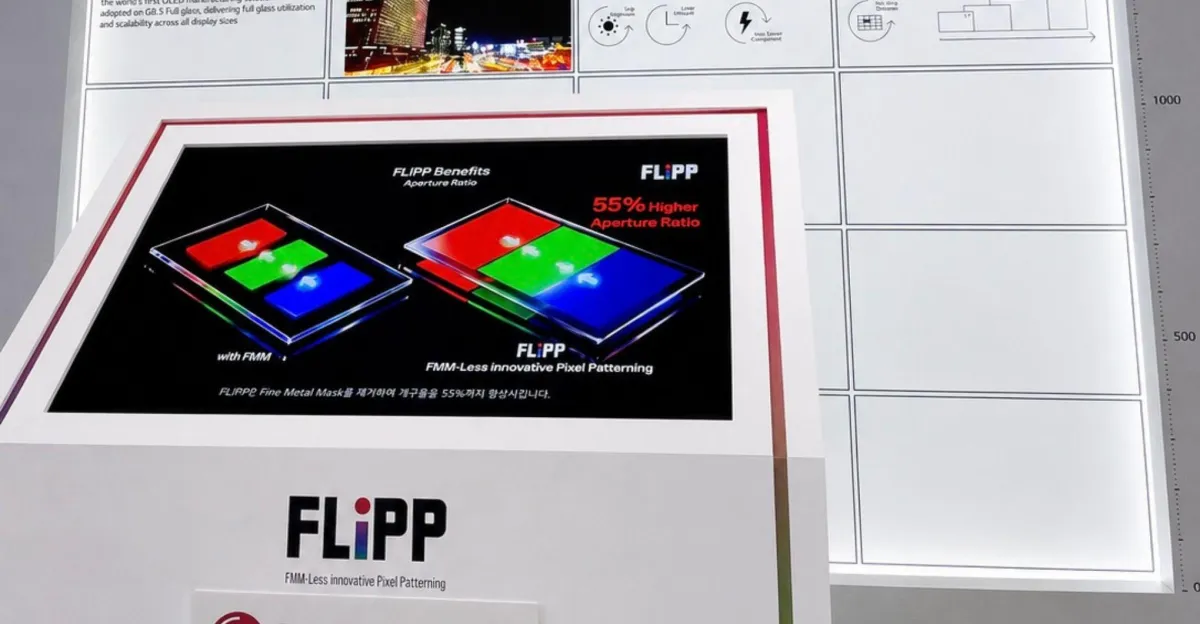
LG Display has introduced a new OLED manufacturing method called FLiPP, or FMM-Less innovative Pixel Patterning. The technology is designed to address the limitations of conventional RGB OLED panels by eliminating the use of a fine metal mask, or FMM. Instead of using a metal plate with tiny holes to stencil light-emitting materials, the FLiPP process employs photolithography and UV light to remove unneeded areas and position RGB pixels.
The traditional FMM manufacturing process is often costly and can lead to sagging and alignment problems, particularly in larger panels. By removing this dependency, LG Display states that FLiPP is free from panel size and resolution constraints. This flexibility allows the technology to be applied to a broad spectrum of devices, including virtual reality and augmented reality headsets, tablets, monitors, and ultra-large televisions.
LG Display reports that FLiPP panels offer significant performance improvements over conventional RGB OLEDs. The company claims the new technology results in panels that are 1.6 times brighter and have a lifespan 2.4 times longer. Additionally, FLiPP panels are said to consume 13 percent less power than their FMM-based counterparts, addressing key efficiency concerns for both manufacturers and end-users.
The company plans to roll out the technology in phases, starting with IT applications such as tablets and monitors. Following this initial deployment, LG Display intends to expand the use of FLiPP to ultra-large TVs and small wearable devices, including 1-inch displays. This strategic approach aims to validate the technology in established markets before pushing into more complex or niche hardware categories.
Despite the technical advantages, LG Display has not announced a production start date or a timeline for when the first consumer products will be available. The absence of a specific launch schedule means that investors and industry observers will need to monitor the company’s future disclosures for concrete milestones in the manufacturing rollout.
The introduction of FLiPP represents a shift in how high-end display panels are produced, potentially reducing the barriers to scaling OLED technology across different form factors. As the industry continues to seek ways to improve brightness and efficiency without increasing costs, the removal of the FMM constraint could have significant implications for the future of display manufacturing.