Lebanese NGO accuses Israeli forces of erasing cultural heritage in southern Lebanon
Satellite imagery and eyewitness accounts allege that the Israeli Army has razed historic mosques, convents and sanctuaries in the Jabal Amel region, contradicting military claims that civilian and religious infrastructure are being spared.
The Lebanese non-governmental organisation Green Southerners has accused the Israeli Army of systematically destroying religious and cultural heritage sites in southern Lebanon, alleging the actions form part of a broader campaign to establish a "forward defence zone". The NGO documents the demolition of churches, mosques and archaeological sites, arguing that the operations constitute a calculated attack on local identity and a violation of international law.
These allegations emerge one month after Israel and Lebanon agreed to a ceasefire on April 19, 2026. During this period, the Israeli Defence Forces (IDF) have been enforcing a ban on Lebanese civilians entering an area encompassing 55 villages, which Israel describes as a buffer zone intended to thwart future Hezbollah attacks. In this restricted area, the IDF has conducted widespread demolition using bulldozers and dynamite, destroying buildings and, in some instances, entire villages.
Israeli authorities maintain that they have no intention of striking civilian infrastructure or religious buildings, stating their focus remains on dismantling Hezbollah infrastructure. However, Green Southerners has published photographic and satellite evidence contradicting these denials. The NGO reports that the Salvatorian Sisters convent and school in Yaroun were bulldozed on May 1. While the Israeli military admitted to damaging a building within the complex, it claimed the structure lacked external signs indicating it was religious. Hicham Younès, who runs Green Southerners, dismissed this justification, noting that Israeli forces had occupied the zone for years prior to their 2000 withdrawal and were therefore aware of the sites' nature.
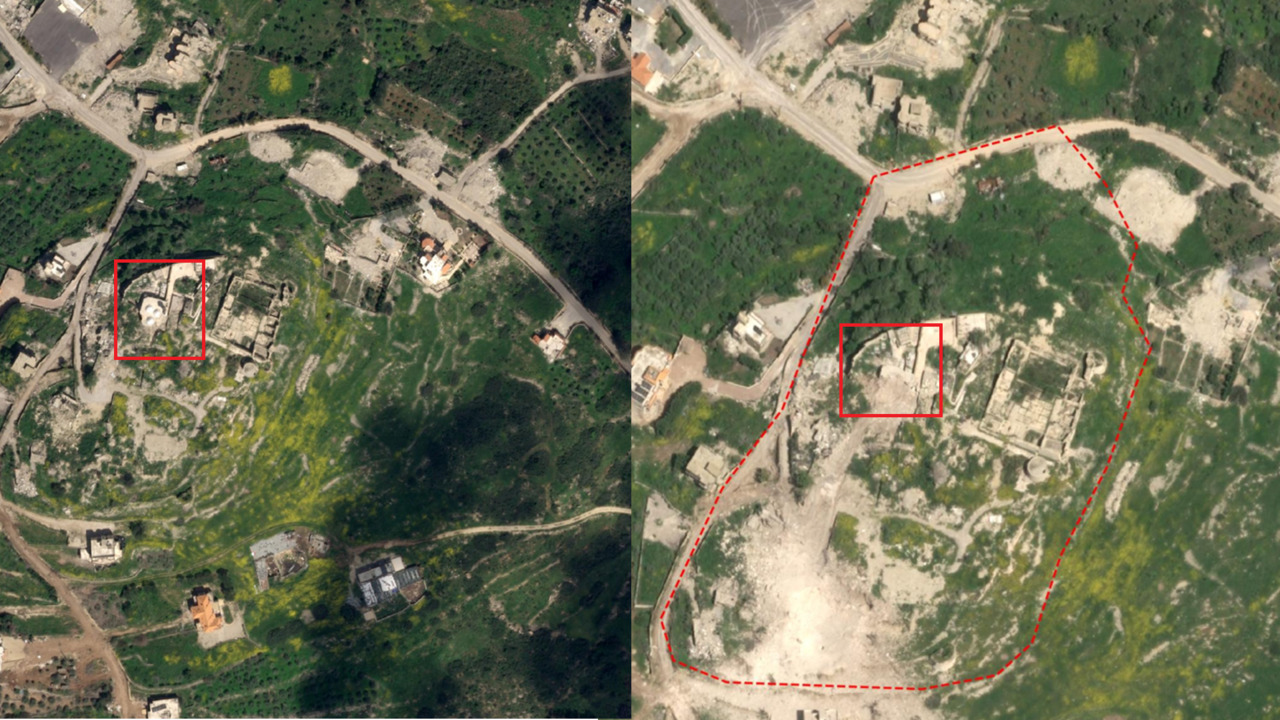
The destruction extends to other significant landmarks in the region. In Yaroun, the 19th-century Imam Ali mosque was destroyed during a ground offensive in October 2024, according to before-and-after images released by the NGO. In Chamaa, the Shamoun al-Safa sanctuary, a Shiite site believed to date back to 1097, appears to have been razed to the ground. Satellite images obtained by Green Southerners and Lebanese media on April 13, 2026, show the site destroyed despite previous restoration efforts by locals following earlier damage in November 2024.
Further destruction has been recorded in Al-Qantara, where a historic mosque believed to be from the 14th century was destroyed during operations in the forward defence zone, according to a Green Southerners post on May 4. In the village of Al-Taybeh, videos and satellite imagery indicate the mass destruction of at least 400 historic buildings and homes. This includes potential damage to the Taybeh well, a Roman or Byzantine-era spiral staircase water source, which Younès described as a critical remnant of the region's identity.
In response to the escalating threat, UNESCO has granted temporary reinforced protection to 39 cultural sites in Lebanon, including the Chaama citadel, and is deploying "blue shields" to increase visibility to armed forces. The organisation also announced international financial aid for emergency operations on the ground. Despite these measures, Younès expressed concern that the systematic targeting of historic centres in towns and villages represents a methodical process of erasing the historic relationship between the local population and their environment.
While bombings have occurred near UNESCO world heritage sites such as Tyr and Baalbek, neither site has suffered serious direct damage. An Israeli strike on March 6 caused damage near the entrance to the Roman necropolis Al-Bass in Tyr, but the site itself was not hit. Meanwhile, social media initiatives have emerged to preserve the memory of destroyed sites in the Jabal Amel region, including the Bint Jbeil Mosque and the mosque in Zrarieh, as residents face the loss of both material homes and symbolic heritage.