Landsat Science Team Sets Five-Year Roadmap at Inaugural Meeting
The newly formed 2026–2030 Landsat Science Team has outlined technical priorities for surface reflectance, thermal imaging, and aquatic monitoring, while the Landsat 10 spacecraft procurement process remains open for industry review.
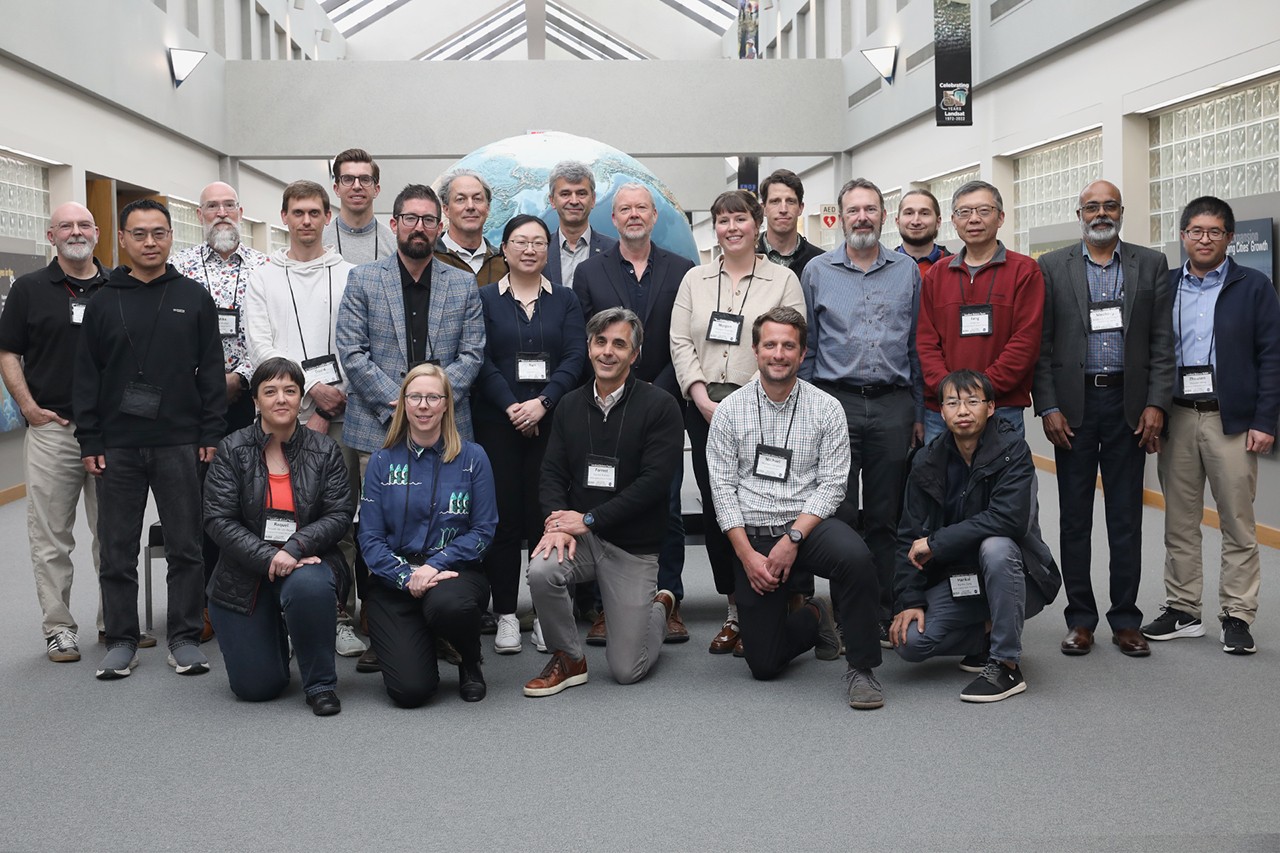
The 2026–2030 Landsat Science Team held its first in-person gathering from May 5 to 7 at the Earth Resources Observation and Science (EROS) Center in Sioux Falls, South Dakota. Co-moderated by Chris Neigh, the Project Scientist for Landsat 8, 9, and 10, the three-day meeting brought together leaders from NASA and the USGS to establish a vision for the upcoming five-year period. The event served as the official introduction of new team members and facilitated discussions on the future trajectory of the Landsat programme.
Attendees received comprehensive status updates on the upcoming Landsat 10 project, the ongoing interagency collaboration on Harmonized Landsat and Sentinel-2 (HLS) data products, and detailed plans for Collection 3 (C3). Throughout the sessions, representatives from funded, international, and federal programmes showcased the impact of Landsat data across diverse Earth science disciplines, including snow cover mapping, atmospheric correction, water quality monitoring, and volcanic monitoring.
Breakout sessions produced specific technical recommendations to guide future mission data processing. The surface reflectance working group identified priorities such as topography and adjacency corrections, Bidirectional Reflectance Distribution Function (BRDF) correction, and enhanced cloud masking for HLS data. The group recommended incorporating CMIX2 cloud masking results into future collections and mapping out C3 toolkit dependencies for user-applied corrections.
Discussions on land surface temperature emphasised the need for archive consistency. Experts recommended maintaining native resolution or standardising to 60 meters, with additional testing for volcano studies. The team endorsed the use of ASTER GED/CAMEL emissivity datasets and called for better quantification of how atmospheric inputs impact harmonisation efforts through collaboration between NASA’s Jet Propulsion Laboratory, RIT, and EROS.
Aquatic reflectance experts raised concerns regarding Landsat 10’s planned 18-day repeat cycle, noting it limits the monitoring of dynamic processes such as harmful algal blooms. The group advised against pixelwise algorithm switching to prevent data discontinuities and stressed strict compliance with CEOS Aquatic Reflectance V2.0 standards. Meanwhile, the projection and tiling group endorsed the USGS pixel grid nesting plan but recommended further trade analysis to optimise storage costs and coordinate with Sentinel-2 Next Generation.
The recommendations generated during the meeting create a roadmap for the new team, ensuring the global scientific community continues to receive high-quality Earth observation data through the end of the decade. Concurrently, the Landsat 10 Spacecraft Draft Request for Proposal (DRFP) is available for review via SAM.gov.